
R&B Star Melanie Fiona Goes Home
By Stacy Lee Kong
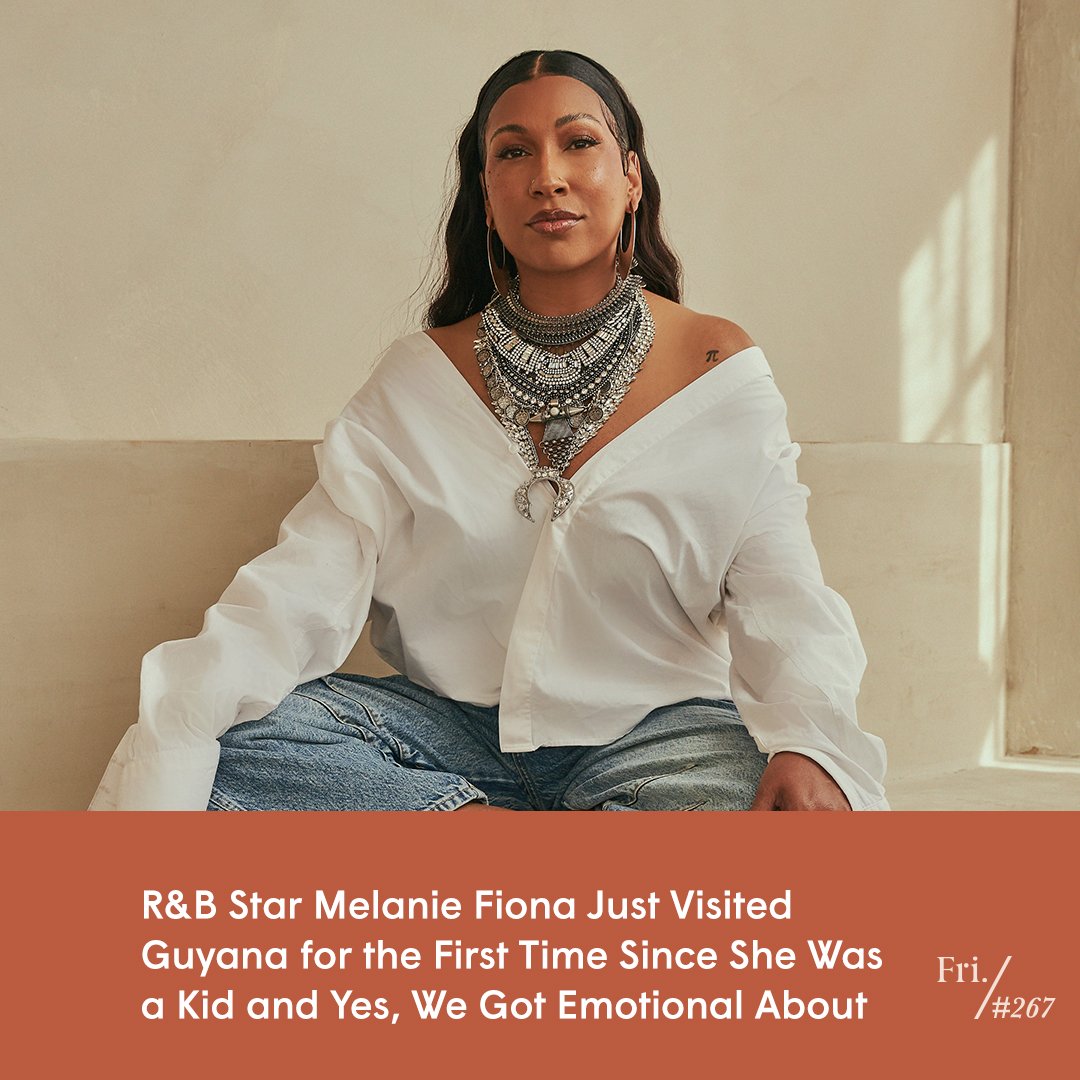
Image: Courtesy of Melanie Fiona
If you love R&B, you already know Melanie Fiona, but a quick recap, just in case: born and raised in Toronto, she made her musical debut in the girl group X-Quisite before launching her solo career—and honestly, if “4AM” hasn’t been on your playlist since its release in 2012, what kind of millennial are you even?! She’s known for her powerhouse vocals and versatile style, which spans classic R&B, pop and reggae, and has won Grammys, Soul Train Awards and earlier this year, a Juno for Traditional R&B/Soul Recording of the Year for “Say Yes,” an anthem for those who are ready to take the leap, in love or life. Outside of music, she’s a podcaster (she co-hosts the mom-focused pod The Mama's Den) and is building a community aimed at empowering moms, called Melly Belly.
And, she’s a speaker, most recently at WeLead Women's Leadership Conference in Guyana, which was focused on the role women play in shaping the country’s economic, cultural and global future. The topic was important, obviously, but we really connected over the idea of returning, because this trip would be the first time she’d gone back to Guyana since childhood. Read on for our chat about why growing up in Toronto as a Caribbean person is an unmatched experience, the beautiful and challenging parts of Caribbean womanhood—and the tension of promoting empowerment in a time and space when women are rapidly losing their rights.
What was it like for you to grow up in Toronto as a Guyanese-Canadian person, and a member of the Caribbean diaspora?
Honestly, it's one of my most cherished things about who I am. It really is. I'm very grateful that my parents chose to immigrate to Canada and to land in Toronto so that we could experience what it felt like to grow up as culturally close to who our parents are without actually being born in the Caribbean.
Toronto is my safe place. It is the place I feel most seen, most understood. When I step outside and I say I'm Guyanese, I don't have to explain what that means. I don't have to explain why I look the way that I look, and why my mom looks the way she looks, and my dad looks the way he looks, and the food we eat, and the songs, and the music and the accent. Being around a highly populated Caribbean community is where I always feel best. It's really my one of my favourite parts of how I was grown up. Actually, it is my favourite part of how I grew up. That’s part of the reason why I don't live in California anymore [and] why I moved back to the East Coast, because I want my children to experience that.
I so get that. The older I get, the more important my culture is to me. Like, when I hear someone with a Trini accent, or any Caribbean accent, it’s like I almost settle deeper into myself. But it’s only recently that I’ve thought about my Trinidadianness in a professional context. So I’m curious how it is for you—how does this part of who you are show up in your work, in your parenting, in your life? Or does it?
It does. For me, it was an absolute must for me to fly that flag proud. I grew up being influenced by one of the most multicultural cities in the world, so what I naturally enjoy—in entertainment, in food—comes from my culture. I'm always seeking out the Caribbean restaurant. I'm always seeking out the person that has Caribbean roots near me. I'm always figuring out a way to include a reggae song in my set.
I understand for a lot of people in different professions, it wasn't always the thing that they wanted to lead with. But that’s really just shining a light on what racism and patriarchy has done to people. We've all been victims to that at some point, especially as women of colour. So, I do feel very blessed that this was the thing I stood on every room that I walked into. I was like, ‘Yeah, I’m not from here.’
Last month, you were the keynote speaker at WeLead Women's Leadership Conference in Guyana. Why was this something you wanted to be involved in?
It's twofold. In the last year of my life, I’ve been being extremely intentional about saying out loud what I want to do, and being really clear, vision-wise, about who I want to be. I've got a clear understanding that using my voice in all mediums is the way forward for me, so whether it's in the spaces of motherhood, womanhood, music, I want to show up and say yes. And, I haven't been to Guyana since I was nine years old, so this was a real return. My parents have been several times the last decades of my life, but I haven't found space or time to get out there.
What was it like to step off the plane and be in your homeland for the first time since you were a little girl?
I had such a truly emotional [reaction]. I have a newfound respect for my family from Guyana. I had heard the stories of how and where my grandparents, parents, aunts and uncles and cousins grew up, but to be a woman and a mother and to walk the streets of where my mom walked as a young girl growing up in Guyana, to see where my dad and my grandparents and aunts and uncles lived, to witness the obstacles and the hardships of the neighborhoods that they grew up in, it just really gave me a deeper level of reverence for my family and for my parents. And of the journey that they had to take, and what great determination, resilience and ambition it took for them to get to where they are today. It was a short trip, but it was such a gift for me to be able to see where my parents were as young people and envision what they were like.
How did it feel to address a room full of Guyanese women?
It was really, truly beautiful. I've never been in a room with all Guyanese women, a room that’s full of women that all have the same background as I do. As much as I wanted them to feel seen, I felt really seen and understood in that room, and that was a gift for me.
The theme of the conference was bridging Guyana to the world and ironically, but never coincidentally, my first album was called The Bridge, so I really leaned on the symbol of what a bridge is and how I see myself as a bridge through my art, through my music, and everything that I create. I definitely wanted to instill the idea that women are the greatest resource on the planet, and I wanted the women in the room to feel empowered by the magic of what being a woman is.
Women are so often made to feel like we have to second-guess ourselves, or to assimilate, or to people-please, or to self-sacrifice, and I'm not here for it anymore. I want all women to find their power in their roles and stop worrying about making other people feel comfortable.
I think that even in Caribbean culture, we have seen that narrative for women before us, our grannies, our nannies. I don't want that to be my legacy. I want my daughter to look at me, and I want any young women who are in a place of progression to look at me, and think, she lived a full life, she did what she said she wanted to do, she was herself.
I so agree with that, but I also really appreciate the point you’re making about Caribbean culture. It’s making me think about the ideas I’ve internalized about what a good Caribbean woman is. It’s so weird, because my sisters and aunties and grandmas have really big personalities, as do I, and yet the cultural message around what a good woman is kind of… small. What's up with that?
The patriarchy. Always. There's been so much shame put on women. And just like you said, at the core, these women have bright, big personalities, but shrink themselves in certain ways, or mute their needs, or quiet themselves, or accept mistreatment, or abuse, or, you know, just aren’t honored for the bright lights that they are.
As a woman who has been self-sufficient and did take a lot of time before I stepped into the role of my wife and mother, I'll say this: it is very easy at times to resort to playing a supporting role. I've walked those lines, but I also have to remember who I am at the core and how I want to feel about myself without any sort of external validation. Like, how do I feel about me? Am I living up to my fullest potential, am I shining as bright as I possibly can, am I being the author of my life—or am I just waiting for somebody else to give me permission?
We’re mostly talking about individual empowerment right now, but I want to zoom out a little to think about the larger social and political context. Because it's a really interesting moment to be talking about women's leadership; feminism is probably the most mainstream it's ever been, and yet women's rights are being stripped all over the place—and specifically in the Caribbean context, intimate partner violence in Guyana is among the highest in the world. How are you thinking about that tension?
I think the fact that there is a conference for women is counteracting oppression. Hearing stories of women who have escaped abuse and have broken generational curses is a sign of resistance against what's happening. And when it comes to the rights of women being challenged, equality feels like oppression to the privileged, right? Men are now feeling that the advancement of women infringes on their rights, so what we have a responsibility to do as women is empower ourselves to unapologetically stand 10 toes down and let men know that that we're actually going to be the change in the world, and we can do this together, not in opposition to one another.
Unfortunately, and we've seen it in politics, there's still a large population of women who feel they have to subscribe to what the patriarchy has told them to be. So, when all women can be aligned in the progression of women, then we can really start to make change.
I personally am not the solution to the problem, but I am a link in the chain, so it's my responsibility as a woman, a woman of colour, a woman with a voice, a woman with platform, to get into these spaces to help pour more light, more energy, more fuel so women can be preserved, protected and progressed in this life.
@cbcmusic @Melanie Fiona wins the Juno award for traditional R&B/soul recording of the year. #JUNOS ♬ original sound - CBC Music
How can people get more Melanie Fiona in their lives?
I put out an EP last year called Say Yes, which is a whole catalyst for why I even did this talk. I'm also doing a mini tour in July and August with City Winery. I still have my motherhood podcast, The Mama's Den, and my community called Melly Belly, where I am going to be launching something extremely soon.
I’m feeling free to be all that I am, in every capacity that I'm called to be, and that’s really, really exciting.
This interview has been edited and condensed.
Thank you for reading this week’s newsletter! Still looking for intersectional pop culture analysis? Here are a few ways to get more Friday:
💫 Upgrade to a paid subscription to support independent, progressive lifestyle media, and to access member-only perks, including And Did You Hear About, a weekly list of Stacy’s best recommendations for what to read, watch, listen to and otherwise enjoy from around the web. (Note: paid subscribers can manage, update and cancel their subscriptions through Stripe.)
💫 Follow Friday on social media. We’re on Instagram, YouTube and (occasionally) TikTok.
💫 If you’d like to make a one-time donation toward the cost of creating Friday Things, you can donate through Ko-Fi.