
Trust in the Age of AI Literary Scandals
By Stacy Lee Kong
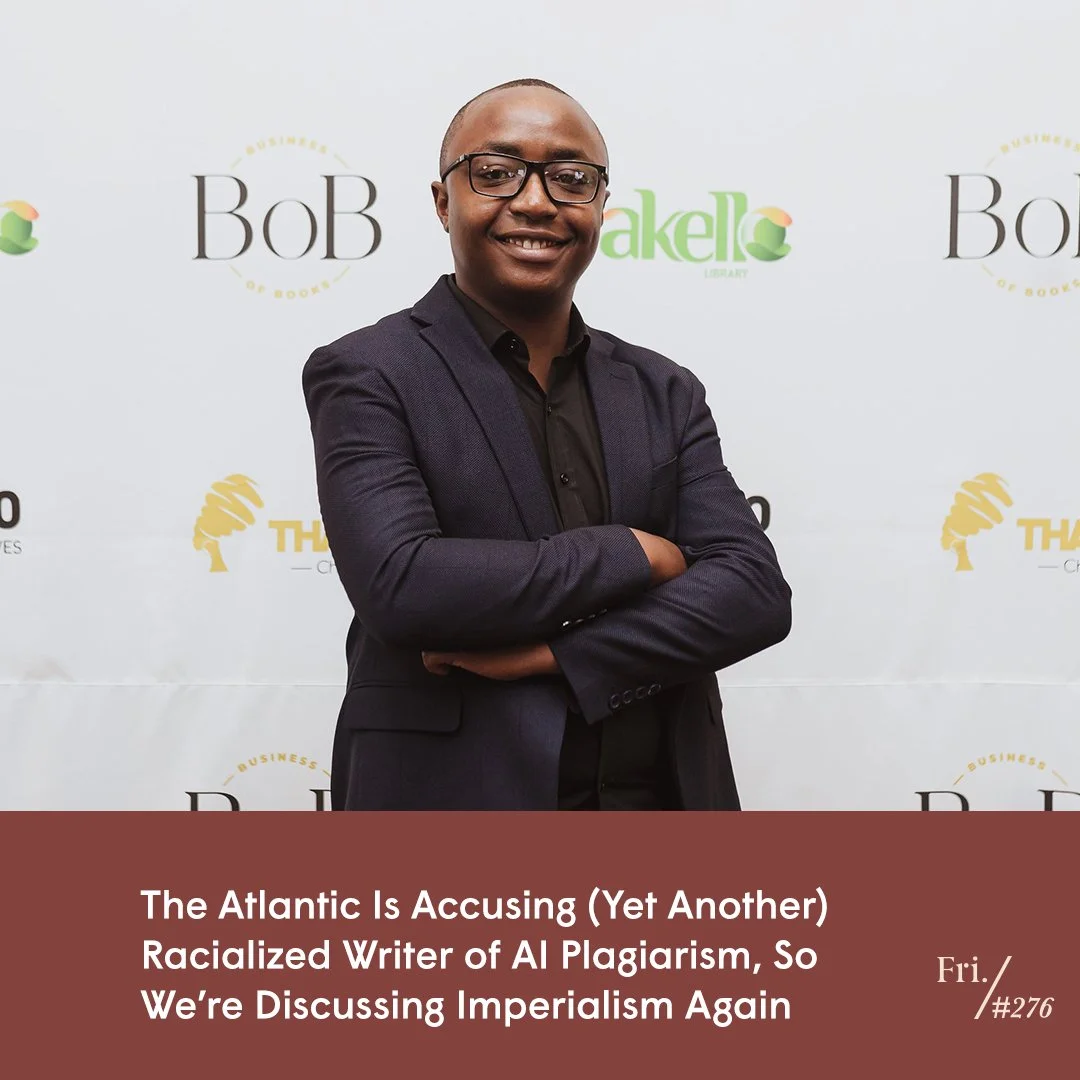
Image: x.com/S_S_Kundizeza
In 2021, writer Vauhini Vara wrote what is considered the first viral AI essay, “Ghosts.” Published in The Believer, it was about her sister’s death from Ewing sarcoma—and, since it was written using an early version of Chat-GPT, it was, subtextually at least, also about the possibility of machine creativity (which I should point out is not a real thing), the impulse to anthropomorphize generative AI chatbots and what ‘writing’ even means.
“I began by feeding GPT-3 a couple of words at a time, and then—as we got to know each other—entire sentences and paragraphs,” Vara wrote in the introduction to her essay. “I had always avoided writing about my sister’s death. At first, in my reticence, I offered GPT-3 only one brief, somewhat rote sentence about it. The AI matched my canned language; clichés abounded. But as I tried to write more honestly, the AI seemed to be doing the same. It made sense, given that GPT-3 generates its own text based on the language it has been fed: Candor, apparently, begat candor.”
Generative AI chatbots don’t ‘get to know’ anyone, of course. Nor do they respond to candor with candor. They are not people who think and feel and slowly settle into familiarity; they are lines of code that make predictions with varying degrees of accuracy. In fact, Vara spells this out in that quote, when she says Chat-GPT generated text “based on the language it [was] fed.” What she doesn’t acknowledge is that the chatbot didn’t produce portions of her essay based solely on her writing. By design, it, and other generative AI tools, rely on a vast collection of ‘training data,’ a term that has arguably become a euphemism for ‘other people’s writing.’ That is, web pages, news publications, blogs, academic journals, coding repositories, conversations posted on public forums, the entirety of Wikipedia… and books, both classic titles that had entered the public domain and, crucially, contemporary, and therefore pirated, ones. This isn’t value neutral, and in fact can be considered copyright infringement. (The U.S. Court of Appeals just upheld a ruling that found using another company’s legal headnotes to train AI is not covered by fair use, and several other lawsuits alleging AI copyright infringement are slowly winding their way through the court system.)
So, it matters that Vara is able to justify using AI in this essay, and in her next book, 2025’s Searches: Selfhood in the Digital Age. Especially because in recent months, she has become a loud voice against AI plagiarism in the literary world, and while you’d think I—a devout hater of generative AI—would be pleased to see people held accountable, or at the very least loudly dragged, for adopting the identity of writer without engaging in (struggling through) the act of writing, instead I am annoyed. At her hypocrisy, definitely, but even more at how laughably predictable this all is. Inevitably, the writers who become the targets of these allegations are racialized people from the Global South, most recently Zimbabwean writer Simbarashe Steyn Kundizeza, who Vara accuses of plagiarism in a recent column for The Atlantic. Much like “Ghosts,” that piece is ostensibly about one thing (why she thinks Kundizeza’s “The Blue Fighter” was written using AI, making it yet another example of the proliferation of alleged plagiarism in literary competitions) and actually about something quite different (the Western, white supremacist underpinnings of the global literary establishment, which very predictably controls whose writing is considered legitimate, good, even real—and yes, I am using control very deliberately here).
It is really chilling to see how quickly Black, Caribbean, and African writers and academics have become the global face of AI use and plagiarism. For such a serious charge, @vauhinivara's article rests on...a Pangram scan. No comment from the African writer in question.
— Karen Attiah (@KarenAttiah) October 12, 2026
Black and brown writers are quickly becoming the face of AI plagiarism, and I think we can all agree that’s a bad thing
Vara is deeply concerned with the idea that AI has infiltrated the literary establishment; in her column, she describes a “crisis of trust—in both writers and technology—that threatens to undermine a global system of literary recognition.” As proof, she points to “The Blue Fighter,” the short story that was chosen as the winner of the 2026 Caine Prize for African Writing earlier this month. It follows Tinashe, a boy whose father quits his job to pursue his passion of building fish tanks, a decision that puts the family in ever more dire financial straits. And Vara hated it; “Taste is subjective, but trust me, this story is bad—maudlin and full of tired tropes,” she writes. “That this narrator has all the personality of a chatbot is probably not coincidental. The AI detector Pangram flags almost the entire story as AI-generated.” (This week, he published a lengthy statement denying the allegations.)
Pangram also played a role in the discourse the last time I wrote about an AI plagiarism scandal in the literary world, back in May when Trinidadian author Jamir Nazir won one of the Commonwealth Prize’s regional awards. (He went on to win the overall Commonwealth Prize after the Commonwealth Foundation conducted a review of his drafts and notes and felt satisfied that he hadn’t used AI.) While other internet commenters had already turned to Pangram to assess Nazir’s story, Vara went quite a bit further, asking a research scientist at the company to run 15 years of Commonwealth Prize winners through the software to determine whether any of those stories were suspicious. Only four were flagged: Nazir’s and work by two other authors from this year, and one author from last year. This time around, she ran “The Blue Fighter,” a previous story of Kundizeza’s and the previous 25 winners of the Caine Prize through Pangram herself; she says it only flagged “The Blue Fighter” as being AI-generated.
few days ago when joyce carol oates blabbered about AI use & a bunch of African writers took her to task, & she blocked all of them instead of engaging in good faith, that is the colonial machinery in action. for them, we are nothings, there is historical evidence for this.
— tòlú Daniel (@iamToluDaniel) October 14, 2026
I… am not sure I care. Okay, I care, in that I don’t like or respect cheating and it’s objectively unfair to win a literary prize for a story you didn’t write. (Because using AI is not writing, it’s prompting, and that’s an entirely different thing that cannot be a genuine act of creation, sorry not sorry.) But whether or not someone cheated is like, the eighth most notable thing about this discourse. Instead, I’m thinking a lot about how unsurprising it feels to see Western writers brand their award-winning peers in the Global South as plagiarists and cheaters based on vibes and a single Pangram search. It’s important to note that overwhelmingly, it’s Black and brown writers with roots in Africa or the Caribbean who get the Pangram-and-Atlantic-thinkpiece treatment, and who become the face of AI plagiarism discourses, which contributes to an inaccurate and unfair narrative about who cheats. (See also: Thélyson Orélien, Mia Ballard, and Nazir and the other Commonwealth Prize winners Vara said used AI, all of whom were racialized.) And, let’s not ignore why the Western writers who are making these accusations are doing so: because of their own privileged perspective—their assessment of what is ‘good’ or not tends to align with colonial, white supremacist and Western taste, even if they are racialized themselves. What’s more, they are targeting people who often don’t have the resources to fight back.
I’m also increasingly fascinated by this adversarial style of reading. On one hand, I get why writers, and maybe all of us, have started looking for the tell-tale signs of AI in everything we read; AI-generated text is just not the same as a story or article or book or even an Instagram caption written by an actual human to express their emotions or ideas, and if that’s something you care about, seeing those signs everywhere starts to feel existential. But reading to prove something is, or is not, AI-generated isn’t the same as engaging with those emotions or ideas. Earlier this week, writer Colin Horgan wrote an essay for The Walrus about the increasingly common question of what AI writing looks like. In it, he cited a study that found “when humans look for clues that a bit of verbiage is AI, they get it wrong. “All of this AI shaming has quickly become a kind of purity test and not about the content at all,” he went on to say. “But as much as this is about writing, what we’re facing is not a writing crisis. It’s a reading crisis. Thanks to our own seemingly increasing tendency to want to uncover inauthentic writing, we are now turning reading into an adversarial exercise, like a prosecutor poring over the defence’s argument. Or, maybe more pointedly, like one of those online AI checkers, scanning, doing pattern recognition.”
But also: Why exactly does everyone find Pangram so trustworthy?
The big thing I’m thinking about, though, is trust. Vara and her editors are operating from a place of moral superiority, but I actually find their actions quite untrustworthy: criticizing others for using Chat-GPT after doing so yourself is wild, and so, so Western. It doesn’t really matter that she is racialized herself; she’s hand-waving away her use of AI by framing it as a some sort of therapeutic and/or intellectual exercise but positioning it as unforgivable when done by people who are outside of cultural centres of power. Even more importantly, I’m uncomfortable with the part where they’re levying a potentially career-ending allegation against a racialized writer with much less power than they have, based on the say-so of a Big Tech tool that itself relies on AI. If Vara is worried about a crisis of trust that undermines the integrity of the global literary establishment, I’m worried about the trust writers like Vara and her other AI plagiarism vigilantes are putting in Pangram.
It is the frightening possibility that a new literary culture is being created where an African writer's work is no longer read based on the quality of work itself and instead approached as some sort of crime scene.
— ZEYA (@zeyawriting) October 12, 2026
Vara cites Pangram’s oft-repeated claim that its tool incorrectly labels human text as AI just once out of every 24,000 queries. Which sounds impressive! Here’s my question: are we trusting Pangram to report on Pangram’s accuracy without checking to see whether Pangram might, perhaps, be intentionally or unintentionally skewing its numbers? I know we’re not all journalists but… really? Because here’s an interesting thing I found via a 17-second Google search: a couple of weeks ago, author Andrea Bartz went to the Association of American Literary Agents’ People of Publishing conference, where she was slightly horrified to see her industry peers wholeheartedly embrace the company. (Major publishers are increasingly using AI themselves, which absolutely adds to the sense of hypocrisy and existential angst, for me at least.) Her preliminary concern was the potential conflict of interest, since Pangram was an event sponsor and multiple speakers had a financial interest in its success. But she also said she knew a dozen authors who found the tool unreliable, including one who found changing a sentence or two could turn her rating from 100% human written to 51% AI written. Bartz followed that up with a second post, this one doubling down on those doubts about Pangram’s reliability, for reasons ranging from the disparity between results in Pangram’s carefully chosen test cases and in real-world applications to the “underlying analytical assumption” of this technology. Pangram works by using an LLM to generate a ‘synthetic mirror’ of the writing it’s analyzing, then comparing the two to distinguish between “the choices the author makes vs what AI will typically do,” according to the company’s CTO. But Bartz cites writer Alma Katsu, who’s a former CIA intelligence professional and technology futurist, and who says this means what it’s actually doing is determining how well AI writing mimics human writing, not assessing whether someone created text using AI.
There’s also the issue of bias in machine learning, of course. A recent Wired profile of the company’s founder, Max Spero, points out that a 2023 study “showed that detectors were more likely to identify work by non-native English writers as AI-generated, and neurodiverse writers have also claimed that their writing patterns are disproportionately flagged.” The story also quotes Sam Illingworth, a professor of critical AI literacy at Edinburgh Napier University, who says, “I don’t think [AI detectors] work. I think that detectors are prejudiced against certain people.” To be fair, Vara does acknowledge that study, though only as an aside. It’s not enough to disrupt her trust in Pangram’s technology.
Once someone decides your writing is AI-generated, it can be difficult to convince them otherwise. You can show your Word version history, record yourself writing, or prove you don’t use AI tools. But if they treat a Pangram result as definitive proof, none of that matters.
— spicy ops (@OpeAdedeji_) October 12, 2026
So to recap, a panel of judges—highly respected writers, editors and other creatives from across the African continent—assessed Kundizeza’s work and judged it exemplary. Vara and Panagram did the same, and judged it plagiarism. Not to make everything about cultural imperialism, but to me, the question then becomes, do we trust African people to judge African writing by African standards, conventions and themes, even if those conventions don’t adhere to Western aesthetics? Because the underlying assumption of Vara’s approach is that we don’t. The worldview she’s perpetuating is one where Black and brown people, especially those from the Global South, can’t be trusted to determine what is cliché, pandering or stereotypical. Nor can they be trusted to competently run their institutions, cultural or otherwise. They just… can’t be trusted. And that’s why ‘we’ need American tech companies to keep them in line.
My argument here is not to stop caring about AI plagiarism. The net harm of using generative AI to create is profound, and probably hurts people in marginalized groups more than anyone else. But I do think we should look closely at these scandals, and notice how often they rely on, and uphold, very old patterns of oppression.
Thank you for reading this week’s newsletter! Still looking for intersectional pop culture analysis? Here are a few ways to get more Friday:
💫 Upgrade to a paid subscription to support independent, progressive lifestyle media, and to access member-only perks, including And Did You Hear About, a weekly list of Stacy’s best recommendations for what to read, watch, listen to and otherwise enjoy from around the web. (Note: paid subscribers can manage, update and cancel their subscriptions through Stripe.)
💫 Follow Friday on social media. We’re on Instagram, YouTube and (occasionally) TikTok.
💫 If you’d like to make a one-time donation toward the cost of creating Friday Things, you can donate through Ko-Fi.