
I’m Officially Obsessed With the DR Congo Fan Known as Lumumba Vea
By Stacy Lee Kong
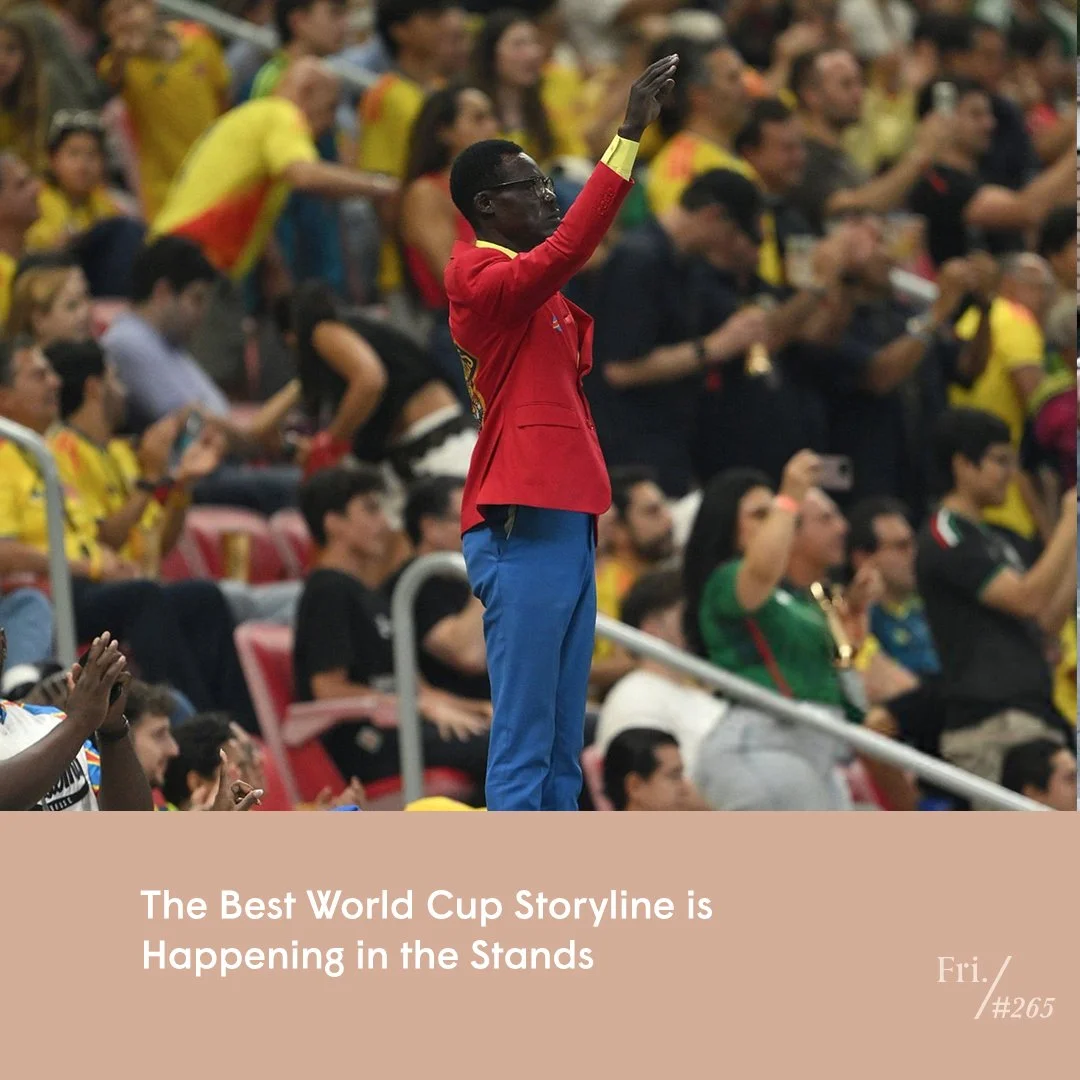
Image: x.com/JumbaDrc
This week, I kept seeing the same man across all my social feeds: slim, Black, dressed in blue slacks, a red blazer and a yellow button-down, his red tie, side-parted hair and retro glasses referencing 1960s chic (and bringing to mind La Sape, the Congolese fashion subculture that first emerged in Kinshasa and Brazzaville in the 1920s). In photos and videos taken from all angles, he’s standing completely motionless on a small platform in the stands at Estadio Akron in Guadalajara, Mexico, one arm raised to mimic an iconic statue of Congolese politician and revolutionary Patrice Lumumba.
#LUMUMBA 🇨🇩🐆 pic.twitter.com/qL4a0DIwiK
— LUMUMBA VEA 🇨🇩🐆 (@JumbaDrc) June 25, 2026
Nicknamed Lumumba Vea (Lumumba Lives), his real name is Michel Kuka Mboladinga and he was there to cheer on his country’s national team, the Leopards, in its ill-fated match against Colombia. If he looks familiar, it’s because he’s gone viral before, most recently during the Africa Cup of Nations (AFCON) in January, but he’s actually been posing as Lumumba during the Leopards’ games for a long time—since 2013. It’s partially to give the players what he calls “emotional stamina” and partially an expression of national identity. In fact, he’s become such a staple that members of this year’s national team reportedly petitioned Congolese president Félix Tshisekedi to make him part of the Democratic Republic of Congo’s official FIFA World Cup delegation, ensuring his attendance. (He wasn’t at the country’s opener against Portugal because of America’s entry restrictions.)
I obviously love everything about this. Even though I’ve only watched at most 2.75 of the approximately 400 (or, you know, 72) group stage games, I am fascinated by the fandom, spectacle and politics of this tournament and, yes, sports in general. And Lumumba Vea’s whole thing is so political. The actual Lumumba was an important figure in Congo’s fight for independence, a pan-Africanist and anti-imperialist who became the country’s first prime minister—and not long after that, the victim of a brutal assassination that occurred through the joint efforts of the Belgian government and the C.I.A., with the blessing of then-U.S. president Dwight Eisenhower. To channel him is not just to express national pride; it’s to make an anti-colonial, anti-imperialist statement. And it’s happening in a space that is intended to be strictly apolitical.
Try as they might, World Cup organizers can’t actually keep politics out of the Beautiful Game
I think it’s kind of hilarious (or, you know, totally ridiculous) that the organizers behind international sporting events like the World Cup insist on ignoring the fundamental politicism of their events. In April, FIFA’s president, Gianni Infantino, spoke at the CNBC Invest in America Forum in Washington, where he communicated his belief that “inclusion and access should also transcend politics and the difficulties of the day,” according to the organization’s official website. He was specifically referring to Iran’s participation in the World Cup, because of the obvious awkwardness that comes with being at war with one of the tournament’s hosts. “The Iranian team is coming, for sure. We hope that by then the situation will be a peaceful (one). That would definitely help,” he said. “But Iran has to come if they are to represent their people. They have qualified, and they’re actually quite a good team as well. They really want to play, and they should play. Sports should be outside of politics.”
So, Haiti cannot use the figure of their country’s hero and anti-genocide liberator from the 1700s on their uniform, but current-day genociders and descendants of slavers enriched and empowered through mass murder can HOST the World Cup?
— Uju Anya (@UjuAnya) June 13, 2026
But the idea that sports are apolitical is also FIFA’s overarching stance. The organization bans political symbolism, including Iran’s pre-revolution Lion and Sun flag and Japan’s Rising Sun flag, and forbids references to military battles or political conflicts on team kits, armbands and player badges, ostensibly to keep the tournament focused on athletic excellence, sportsmanship and international unity. That’s why the Haitian national team was forced to change the design of its jerseys just before its first match—the design, which was created by Colombian sportswear company Saeta and previously approved, was deemed inappropriate because of a design element that “depicted silhouettes inspired by the Battle of Vertières and the Haitian revolution,” per The Guardian. “In 1803, revolutionary leader Jean-Jacques Dessalines, who later became the nation’s first emperor, tore the white band off of a French flag to create a new flag for ‘the world’s first free Black republic.’ The moment is commemorated throughout the nation every 18 May as Haitian Flag Day.” You might recall that something similar happened with Haiti’s Olympic uniforms, too.
https://www.youtube.com/watch?v=HyLVMJ75c_0&t=105s
Now, the Rising Run flag is widely considered a symbol of hate, so it makes sense to ban that, in the same way that Nazi paraphernalia is banned, but the idea that illustrated references to Haiti’s battle for independence from France is somehow more political than France’s actual flag—which was adopted during the French Revolution, a famously violent moment in that country’s history—is just nonsensical. And so is the idea that an international tournament could ever be exempt from geopolitical sensitivities. Like, on a very basic level, we’re talking about competitions between nation states that are intended to reward tactical supremacy and actually demonstrate unequal distribution of resources, including the broader pool of talent that former colonial powers have access to. Also, the very nature of the tournament naturally leads supporters of said nation states to lean into their most jingoistic selves. All of that is very political.
But also: remember the Somalian World Cup ref who was questioned for hours at Miami International Airport before eventually being barred from entering America, despite having valid travel documents and visas? Or the Iranian players and support staff who have to stay in Mexico and fly in and out of the U.S. on game days? Or the 15 Iranian officials and team staff, who were denied visas entirely? Or the Iraqi player who was detained for seven hours at O’Hare International Airport before finally being allowed to enter the U.S.? Or the participating nations whose citizens are banned from entering America, despite FIFA saying this wouldn’t happen? (Haiti and Iran are totally banned, Côte d’Ivoire and Senegal face partial restrictions, and several more nations have visa rejection rates exceeding 40%.) Or the pre-tournament concerns about potential ICE raids? And let’s not forget about Canada, which has rejected more than half of the 17,000 visa applications it received from World Cup visitors, with the rejections concentrated among countries like Ghana, Syria, Uganda and Sri Lanka. Who gets to move freely between the developed and developing world, how much it costs them to do so, and how safe they are when they arrive are all political questions, too.
Which brings us back to Lumumba Vea
This is also relevant to conversations about Lumumba Vea, because Mboladinga’s performance art isn’t just about Lumumba’s legacy. It’s not even just about highlighting America’s interventionist approach to foreign policy, though that is definitely something Americans, and everyone, should recognize. (The U.S. engaged in almost 400 military interventions between 1776 and 2019 alone, and while these campaigns are always positioned as being about high-minded goals like ‘promoting democracy’ or ‘enforcing international law,’ this so-called diplomacy is typically leveraged against resource-rich nations that would offer America strategic access to oil, uranium and other critical minerals.) Mboladinga’s human statue performance is also about what is happening in Congo right now.
🇨🇩: Mboladinga “Lumumba Vea” is a DR Congo football fan who’s famous for covering his mouth at matches in protest against the world's silence on the violence in Congo.
— AJ+ (@ajplus) June 25, 2026
The war in Congo has caused the mass displacement of over 8 million Congolese people, with over 27 million… pic.twitter.com/ni9uKxbAur
During Tuesday’s game, he covered his mouth and pointed two fingers at his temple to mimic a gun, in what is widely understood as a protest against the world’s silence on the humanitarian crisis in his home country. According to UNHCR, more than 5.8 million people are internally displaced within Congo, while millions more are now refugees and asylum seekers in neighbouring countries. Food insecurity and disease are rampant, as is sexual violence, torture, arbitrary detention and enforced disappearances, per Amnesty International. It is one of the largest humanitarian crises in the world, and yet it’s largely ignored in international press, to the point that the Norwegian Refugee Council has declared it the world’s most neglected refugee crisis—for the second time this decade. (This is tragically ironic considering King Leopold II’s exploitation of the Congo Free State in the late 1800s was one of the most horrific, and under-acknowledged, genocides in history.)
FIFA’s cameras appeared to cut away from Mboladinga at this exact moment, which is not surprising considering the organization's opinions about ‘politics.’ But this is the exact tension I’ve been thinking about, right? Lumumba Vea went super viral this week, with articles in USA Today, the Wall Street Journal, Reuters, ESPN, Sports Illustrated, Complex, CNN and BBC, plus a bunch of sports outlets that I’ve never heard of. And yes, they all explain the Patrice Lumumba connection (obviously). But I don’t think I read a single thing that referenced his protest about the current situation in Congo, or made even the most subtle link between Lumumba’s assassination, a Western strategy to destabilize a newly independent country, and the current state of the DRC today, which is about as destabilized as you can get. Even when the politics are right there and confer emotional and intellectual heft to fan behaviour, they’re kind of… perpetually unexplored.
This also brings to mind last week’s news cycle around Cape Verde goalkeeper Vozinha. He made key saves that lead to a 0-0 draw in the June 15 match between Cape Verde and Spain, which was very exciting because everyone expected Spain to clobber the West African team. After the game, he told reporters that his mother hadn’t been able to get a visa, so she wasn’t there to watch him play. This unfair reality captured basically everyone’s attention, including House Democratic Leader Hakeem Jeffries, who promised to appeal to U.S. Secretary of State Marco Rubio on auntie Vozinha’s behalf. The very next day, Jeffries announced that she had not only been granted a visa, but all fees had been waived and travel arrangements made, so she’d be on U.S. soil in time to catch her son’s next match. All of the news coverage presented this as a heartwarming story, but for me, it was more like those poverty porn memes about people pooling their money to buy a used car for a senior citizen who had been walking miles in the snow to get to work, even though they were long past retirement age, or to pay off months of lunch debt for elementary school students, which is actually just a thing that should never exist.
i hope the americans who find this so adorable look up the real lumumba and what happened to him https://t.co/3oJkMzVvkL
— bomani (@bomani_jones) June 23, 2026
In all of these cases, the ostensibly heartwarming framing relies on a superficial story of human connection that distracts from bigger, harder questions, like: why does passport privilege exist in the first place? Is it fair that Western countries can control entry to their nations in an attempt to restrict access to resources considering the wealth of those Western countries is in large part due to stripping resources from their visitors’ homelands? Should you even be allowed to host international events if you are busy oppressing all the racialized people who try to enter your country? (Probably not!!!!)
I think this is what’s so fascinating about sports, and especially huge global events like this. It’s not the gameplay, really. (Though I will acknowledge that it’s exciting to watch elite athletes play at this level, and I do feel very strongly that the team I’ve decided to like on any given day should win 🤷🏽♀️). It’s that the World Cup is joyful, exciting, nostalgic and deeply meaningful, and cannot be separated from historical context, the legacy of colonization, unfair labour practices, resource hoarding, geopolitics, human rights, and so on. Lumumba Vea’s fandom, like anyone’s, is inherently political, and demands that we engage with all of those ideas, all at the same time.
Thank you for reading this week’s newsletter! Still looking for intersectional pop culture analysis? Here are a few ways to get more Friday:
💫 Upgrade to a paid subscription to support independent, progressive lifestyle media, and to access member-only perks, including And Did You Hear About, a weekly list of Stacy’s best recommendations for what to read, watch, listen to and otherwise enjoy from around the web. (Note: paid subscribers can manage, update and cancel their subscriptions through Stripe.)
💫 Follow Friday on social media. We’re on Instagram, YouTube and (occasionally) TikTok.
💫 If you’d like to make a one-time donation toward the cost of creating Friday Things, you can donate through Ko-Fi.