
Spencer Pratt’s Mayoral Bid May Have Failed, but His Style of Politics is Here to Stay
By Stacy Lee Kong
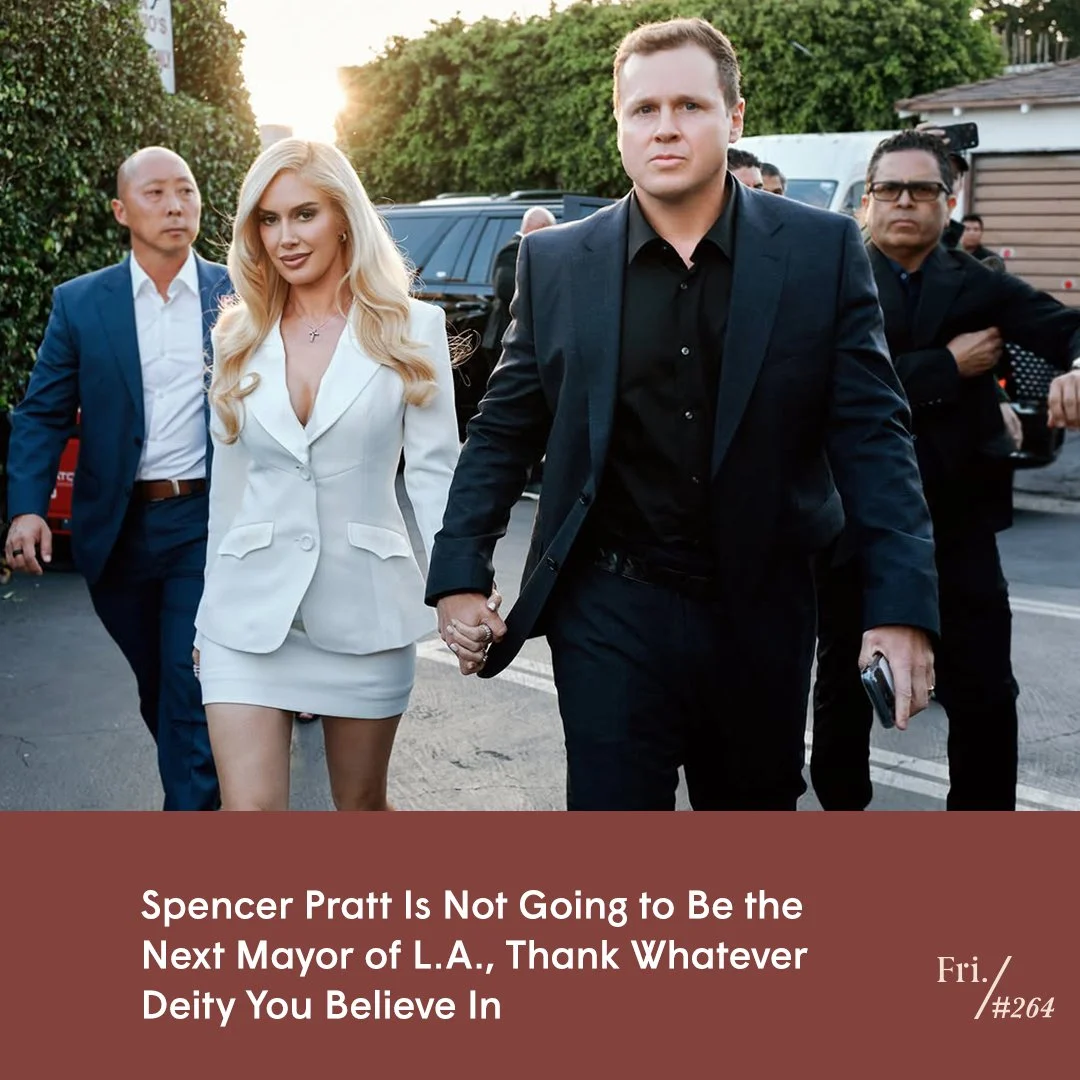
Image: instagram.com/spencerpratt
Remember Spencer Pratt? You know, one half of The Hills’ Heidi-and-Spencer, who was everyone’s favourite reality TV villain for a minute there and experienced a late 2010s resurgence in popularity because of his charming but also kind of random obsession with crystals? And who, alongside Heidi, went on to blow $1 million on said crystals—not to mention another $9 mil on shopping sprees and bodyguards and wine? Yes, that Spencer Pratt. Well, for the past six months, he has been attempting to convince the voting public in Los Angeles that he has transformed into a paragon of smart financial decisions and civic engagement, and as such deserves to be the mayor of the second-largest city in the U.S. The good news is, that’s not going to happen.
@itscaitlinhello Dark energy
♬ original sound - Caitlin Reilly
But I have a whole a lot of thoughts about why it’s still worth paying attention to his failed campaign. In short: I’ve been thinking a lot about the politicization of celebrity and its inverse, the ‘celebritization’ of politics (for… reasons), and Pratt offers us an excellent case study for how and why that happens, what makes the contemporary cross-over between celebrity and politics so interesting and how these shifts are landing with regular people. Though I think we we all know I’m actually going to go long on this!
I regret to inform you that Spencer Pratt was a legit contender in the L.A. mayoral race
The core contradiction at the heart of this story is that a) it was never really likely that LC’s one-time nemesis would become the challenger in L.A.’s mayoral race, and b) it also seemed like he could actually pull it off. And not just because that would be a very Hollywood plot twist! More because his run fell very neatly into an existing pantheon of celebrities-turned-politicians. (See also: Ronald Reagan, Arnold Schwarzenegger, Donald Trump.)
As PBS noted this week, “Democrats outnumber registered Republicans in California by a nearly 2-1 ratio, and Republicans account for under 15% of registered voters in Los Angeles. With that math working against Pratt, there were simply not enough Los Angeles voters who believed he should be given a chance to oversee a $15 billion budget and 50,000 municipal workers, including roughly 8,600 police officers, in the nation's second-largest city.” Still, just before the state’s June 2 primary, a UC Berkeley-L.A. Times poll of likely voters found 26% would support incumbent mayor Karen Bass, 25% would vote for progressive city council member Nithya Raman and 22% would throw their support behind Pratt. Compared to a March 2026 poll, that represented an eight-percentage-point rise in popularity for each Raman and Pratt, while Bass’ support stayed flat. Meanwhile, last week, BBC reported that Pratt had “blown [his competitors] out of the water” when it came to fundraising, raising USD$2.7 million between April 19 and May 16, which was seven times what Raman raised during the same period—and nearly 10 times what Bass did. (Raman ended up being the one to secure the challenger spot, knocking Pratt out of the race.) It’s true that polling is not always a reliable indicator of how a race will go, for a variety of reasons.
Spencer Pratt has been eliminated from the Los Angeles mayor race
— chris evans (@notcapnamerica) June 8, 2026
Here’s a list of the celebrities who humiliated themselves by endorsing him pic.twitter.com/K0j6vavSEm
But I also understand why Pratt was being treated like a viable contender; for all intents and purposes, he was. While my eternal hope is that Republicans are actually capable of putting aside the tribalism of party politics and recognizing when someone is so clearly incompetent that it would be a disaster to put them in charge of $15, much less $15 billion, that’s not usually what happens. Combine that with the fact that he was gaining traction with donors, and even some Democrats, and his campaign suddenly seems pretty viable.
Not because he had good ideas, mind you. More because he used social-media savvy (and, reportedly, an army of clippers) to deliver emotionally-charged messaging that landed with a wide swath of people, even though it was vague on details and not exactly rooted in truth. He entered the race in January, “a year after he lost his home in the devastating fires in the city in 2025, which were some of the deadliest and most destructive blazes in the area's history,” according to BBC. “Much of his campaign has centred on the disaster, and he has accused Bass of failing to respond to the crisis.” As the New York Times pointed out just before the primary, his platform was… light on specifics, shall we say, and heavy on AI slop videos that cast himself as a superhero, poised to save a post-apocalyptic Los Angeles from corrupt politicians, homeless people—who he said were dangerous, drug-addicted zombies that abused their pets and were trying to scam the state of California out of services, all of which is misinformation—and the ‘G-Wagon Brigade,’ his nickname for the city’s wealthy elite. The most specific policy he managed to put out was a five-step plan to end homelessness that amounted to putting people in mandatory conservatorships—or, alternatively, bussing them to Seattle. His only really consistent message was around perception of safety; “everything is about not feeling safe,” he said, even though last year the city saw the lowest number of murders since 1966, not to mention a decrease in both violent and property crimes.
Spencer Pratt was never winning the LA mayor's race. Every number that said he was had been bought.
— Matt Royer (@royermattw) June 11, 2026
The betting market: 75% of $78 million on Kalshi wagered on him, while influencers Kalshi paid hyped the odds with "paid partnership" stamped on their posts.
His $3.75 million… pic.twitter.com/QdNuK9foSD
It was a populist message that found an audience across the political spectrum, the Times noted: “The open-endedness of his platform has made Pratt’s campaign a vessel for a motley crowd with diverse political views: disgruntled liberals upset with the current mayor; homeowners paranoid about crime; burn-it-all-down Gen X-ers agitating for change; Hollywood executives exasperated by the state of the industry; and a raft of MAGA-aligned supporters hungry for a brash outsider to take charge.”
Why are all the celebrity politicians Republican?
However, it’s that last part—the MAGA crowd that wants a brash outsider to step in—that really matters, I think. Donald Trump, who I’d argue is Pratt’s spiritual predecessor, is a fan (not only did Trump say he wanted to see the former reality star “do well,” he also responded to Pratt’s loss with allegations of voter fraud), and a model for a particular type of political engagement. Just like the president did in his own campaigning, Pratt emphasized the ways his supporters had been victimized, blamed marginalized people for these problems and positioned himself as a saviour to the downtrodden, though ‘the downtrodden’ seemed to mean upper-middle class and upper class white people. His ideas, light as they are, largely focus on punishing people for their own oppression and marginalization. He also portrayed himself as a harsh critic of the political elite, all the while being very wealthy himself and openly surrounding himself with said elite. (A perfect anecdote, courtesy of Vanity Fair: “On Election Day, Spencer Pratt made a final pitch to voters in a social media video: a crash course in the laws of supply and demand paired with an attack on the city’s ‘G-Wagon Brigade’—his term for the affluent elite he accused of running Los Angeles into the ground. Hours later, several Mercedes G-Wagons—alongside a steady procession of McLarens, Porsches, and Range Rovers—pulled up to the back entrance of Pratt’s favorite local Mexican restaurant, Don Antonio’s, for his election-night watch party.”) Not that his supporters care about his hypocrisy, of course. Last month, TMZ reported that, despite posting a video that claimed he was living in a trailer parked in front of his burned-out home, he, Heidi and their kids are actually living at the Hotel Bel-Air, where suites can go for $8,000 per night. This seemingly had zero impact on his polling.
It all speaks to what L.A. Times writer Matt K. Lewis describes as a “different elevator” to political success. No longer do aspiring public servants “run for local office, earn supporters, master policy details and only then earn a shot at higher office.” Instead, they master the attention economy, building fame and fan bases via “television, social media, podcasts, activism, entertainment or the internet,” so they can win votes without demonstrating any ability for competent governance. (I’d wager they don’t even think of themselves as public servants.) Interestingly, he says, this seems to be a particularly Republican phenomenon, pointing to Politico writer Alexander Burns’ assertion that J.D. Vance’s biggest threat is Pratt, and the fact that people keep asking Candace Owens and Tucker Carlson to run for president. I see where he’s coming from; while there are increasing numbers of politically vocal celebrities of all stripes, the ones who tend to pursue public office do tend to be right-leaning, and the ones who actually win are almost exclusively so.
Hard to believe Spencer Pratt lost the election despite having no experience, being highly unpopular and running in a 4:1 democratic stronghold.
— Just Jack (@7Veritas4) June 8, 2026
Makes no sense.
Which is kind of fascinating, and raises a lot of questions for me, none of which I really have answers to yet. Like: what is the point of running for public office if you don’t seem to actually want to do the boring, bureaucratic, paperwork-heavy work of administration? Aren’t there easier, more fun ways of accumulating power, especially in today’s attention economy? And if it’s because celebrity power doesn’t feel as potent as political power, does that say something about the limits of celebrity—especially now, when it’s easier than ever to access fame, or a version of it, at least? Why do right-leaning celebs find more political success than left-leaning ones? Lewis believes Republicans are more vulnerable to hostile takeovers, while Democrats are more rigidly hierarchical and better at the type of gatekeeping that helps ward off this particular brand of chaos, and I agree that’s probably a factor. But… I’m not sure if those distinctions are always going to be relevant, because I think Pratt’s campaign demonstrated a wider reorganization of the political spectrum, which seems to be shifting away from a neat left/right divide. And that raises yet another question: what will political organizing divorced from traditional parameters look like, especially since, as Lewis notes, “attention is now the key to political power. The ability to dominate a news cycle is more valuable than the ability to draft a white paper. A viral video can reach more voters than a year’s worth of carefully crafted position statements”?
I want to say Pratt’s failed campaign is a good sign but… I’m not sure that’s true
I think it’s also worth noting here that increasingly, it’s not just about celebrities becoming politicians, but also the opposite. Yes, politicians have often become a type of celebrity after their election, but they’re now increasingly leaning on the mechanisms of mainstream celebrity to reach a base of potential supporters, mobilize them and, eventually, communicate with constituents. I’m thinking of Alexandria Ocasio-Cortez here, or more recently, Zohran Mamdani. And that’s interesting, too. In Mamdani’s case, his popularity inside and outside of New York City hinges on the fact that he’s actually effecting change for his constituents—but there was no way to know if that would actually happen before he took office.
When I initially started thinking about what Pratt’s campaign meant, especially after he wasn’t able to leverage all of that attention into actual votes, I wanted it to be that people are getting smarter, or at least more suspicious of celebs who want to enter public office without any experience or aptitude for the literal admin work of running a city, province/state or country. And I think that is part of it, especially considering the wider cultural moment we’re in, where so many people have become disillusioned with the ultra-wealthy and politically powerful. But this campaign also highlights a real vulnerability in our electoral processes. I mean… If everyone has learned how to convincingly perform authenticity and connection and no one has to prove they have the skills or experience to govern, how do voters make an informed choice? Because if the right-wing goal is to dismantle voter protections and, in some cases, elections, it seems particularly urgent that we resist the urge to make politicians into subjects of fandom, that we hold them accountable—and that we figure out how to prioritize substance over a style that resonates with us.
Thank you for reading this week’s newsletter! Still looking for intersectional pop culture analysis? Here are a few ways to get more Friday:
💫 Upgrade to a paid subscription to support independent, progressive lifestyle media, and to access member-only perks, including And Did You Hear About, a weekly list of Stacy’s best recommendations for what to read, watch, listen to and otherwise enjoy from around the web. (Note: paid subscribers can manage, update and cancel their subscriptions through Stripe.)
💫 Follow Friday on social media. We’re on Instagram, YouTube and (occasionally) TikTok.
💫 If you’d like to make a one-time donation toward the cost of creating Friday Things, you can donate through Ko-Fi.