
The Epstein Files Are Giving Pizzagate
By Stacy Lee Kong
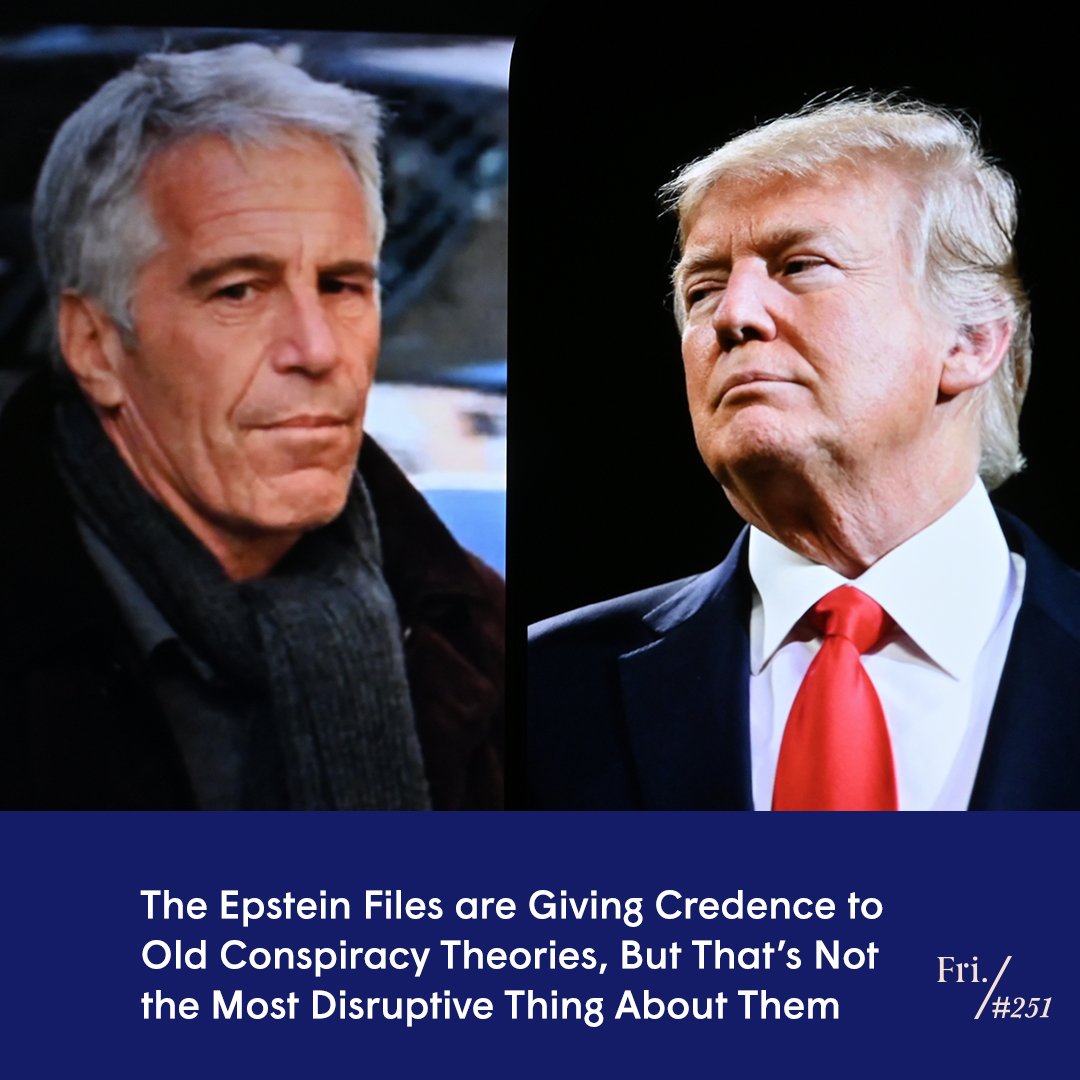
Image: Shutterstock
Trigger warning: this newsletter contains references to sexual assault and abuse against children and adults.
I don’t know if you remember this—and you’d be forgiven for blocking it out, tbh—but a decade ago, a wild conspiracy theory emerged on /pol/, 4chan’s anonymous political message board. The claim: that high-ranking Democratic officials, including then-presidential candidate Hillary Clinton, were operating a child sex trafficking ring out of the basement of Comet Ping Pong, a Washington, D.C. pizza shop, and using terms like cheese, pizza and hot dog as code words for sexual abuse. Pizzagate, as it became known, quickly gained steam, leapfrogging from 4chan to Reddit, YouTube, Rumble and Twitter, where people posted nearly a million tweets containing the phrase in November 2016 alone. Eventually, it went offline, too. On December 4, 2016, 28-year-old North Carolina native Edgar Welch drove across several states to “self-investigate” the allegations. Welch brought an AR-15 and a revolver with him, and upon his arrival fired several shots, damaging a door, closet lock and the restaurant’s computer equipment. Of course, there were no children being kept captive in the basement of the pizza shop. In fact, there wasn’t even a basement. He was arrested and charged with assault with a dangerous weapon and transporting a firearm over state lines, and was eventually sentenced to four years in prison. Pizzagate didn’t go away immediately—and in fact, Elon Musk was trying to revive versions of the conspiracy theory as recently as 2023—but it did eventually fizzle out. For a long time, if you brought it up at all, it was only to demonstrate U.S. President Donald Trump’s use of disinformation as a political cudgel.
And then, on January 30, the U.S. Department of Justice released the latest in the so-called Epstein Files, a trove of documents related to financier and convicted sex offender Jeffrey Epstein. In this drop: 3.5 million pages, 180,000 images and 2,000 videos, including emails to and from Musk, Richard Branson, Bill Gates, Donald Trump, Bill Clinton, Andrew Mountbatten-Windsor (fka Prince Andrew) and his ex-wife Sarah Ferguson, Steve Bannon, Woody Allen and Soon-Yi Previn, former Israeli Prime Minister Ehud Barak, filmmaker Brett Ratner, Google co-founder Sergey Brin, linguist Noam Chomsky, New York Giants co-owner Steve Tisch, new age guru Deepak Chopra—and, per Vanity Fair, almost 1,000 mentions of the word pizza (which, btw, is a codeword for child sex abuse material that predates Pizzagate by years). Combine that with rumours that Epstein was somehow entangled with 4chan’s founder, Christopher Poole, and that Epstein accomplice Ghislaine Maxwell was a Reddit power user who moderated several huge subreddits including r/worldnews, r/politics and r/technology, and suddenly Pizzagate is… back?
Me: “The West is being controlled by a serial child rapist human trafficking cabal that conspired to foment the genocides and culture wars that have plagued this world for many years”
— Vivian (@suchnerve) February 5, 2026
Offline person: https://t.co/VMrH1IQ8Aw pic.twitter.com/UCOlqlaiak
Well, sort of. It’s not that these latest Epstein files lend any credence to the stories about Hillary Clinton and John Podesta sexually abusing children that the alt-right trolls of 2016 were posting with wild abandon. It’s more the realization that every accusation really is a confession. There is a shadowy cabal of powerful men and women who rape and torture women and children with impunity, and who also happen to exert control over global economies, trade, politics and artistic and cultural spaces. Oh, and they documented it all in email. It’s… quite a lot, even for someone who didn’t have a super high opinion of the ultra-wealthy beforehand.
So, the thing I’d like to think through this week is, how do we navigate a world where things we’d previously dismissed as conspiracy theories actually do happen? Because it’s feeling a lot harder to know what’s real and what’s not these days.
Not every allegation in the Epstein Files is credible—but how do we tell the difference?
The vast majority of what I’m seeing from this collection of documents, which followed smaller releases in February, March and December 2025, is disgusting, but not unexpected: jokes about attending a “pedophile convention” in Paris with Woody Allen between Epstein and a redacted email address; correspondence from Allen’s wife, Soon-Yi Previn, who describes the 15-year-old girl former congressman Anthony Weiner was caught sexting as “a despicable and disgusting person who preys on the [weak]” (and I could write an entire newsletter on how fucked up that is); musings from Emirati businessman Sultan bin Sulayem, the CEO of DP World, about the comparative beauty of some ‘new arrivals’ (“Big disappointment the Moldavian is not as attractive as the picture while the Ukrainian is very beautiful,” he wrote). There are photos and emails that speak to Epstein’s cozy relationships with various royals, from Saudi Crown Prince Mohammed bin Salman (who the U.S. says approved the killing of journalist Jamal Kashoggi) to a bunch of random European monarchs, even beyond the British royal family. “He purported to pay off their debts, provided them temporary apartments, flew them on private jets, and hosted them at his homes,” per the New York Times. “In return, some of his royal and royal-adjacent correspondents appeared unbothered by his 2008 criminal conviction, though the newly released files do not prove that they knew of Mr. Epstein’s other criminal activity.” And, there’s the exchange of child sex abuse materials, and references to providing victims to other powerful men as a way of currying favour or rewarding loyalty, and mentions of violent sexual encounters that left victims bruised and bleeding.
The psychological torture of just reading the most heinous shit about the useless billionaire class and then having to do my dumb little tasks. Cosmically exhausting.
— Akilah Hughes (@AkilahObviously) February 3, 2026
I’m not trying to downplay any of this; it’s all extremely awful. But, if you’ve been paying attention to the way powerful people wield their influence across racial, gender and class lines, it also feels tragically normal. This behaviour exists within a paradigm that we have all seen play out time and time again, even if we weren’t able to accept just how systematic it was, or how protected the perpetrators really are.
But then there are other files. NYC publicist Peggy Siegal’s offer to bring Epstein “a little baby back [from Kenya] for you….or two. Boys or girls?” An email from Epstein asking a redacted contact what they would like him to do to their friend, followed by a message asking if Epstein should “try to do her.. or just torture her.” Another email from Epstein to a redacted address asking if the recipient was okay, and telling them he “loved the torture video.” Harvard professor Martin Nowak apologizing to Maxwell for “spoil[ing[ this day” and saying he’s “so happy [he] did not kill anybody.” An email from someone who says they used to work at Epstein’s Zorro Ranch claiming that two “foreign girls” were strangled to death during “rough, fetish sex” and are buried “somewhere in the hills outside the Zorro on orders of Jeffrey and Madam G.” An unverified journal entry from a teenage girl that claims she was forced to carry Epstein’s baby, and that the financier wanted to use his stable of victims to create a “superior gene pool.” A receipt for $8,000 worth of furniture from Wayfair. Allegations of cannibalism and ritual sacrifice. These allegations feel worse because they indicate a level of transgressiveness and depravity that frankly, I don’t want to believe exists. I mean, procuring babies for unexpressed but possibly horrific reasons? Forcing young girls to incubate fetuses? Torture? Buying children off Wayfair—yet another old conspiracy theory that’s rearing its head again? Eating people?
all the satanic sacrifice bullshit is an obvious way for ppl to deny the banality of the actual abuse, these ppl are billionaires who rule the world sure but the kind of violence they want to enact on it is sadly unexceptional, only their means are https://t.co/Zdv2YNZW1l
— no earthquake (ear flu victim) (@no_earthquake) February 1, 2026
This is where the journalist in me has to say for the record that not all of the accusations in the Epstein files are credible. But not because this level of transgressiveness and depravity doesn’t exist. It does—there are numerous accounts from enslaved Africans about white people engaging in cannibalism dating from the 16th to 19th centuries, something academic Vincent Woodard explored in his 2014 book, The Delectable Negro: Human Consumption and Homoeroticism within U.S. Slave Culture. What I mean is, some of these specific allegations just aren’t backed by evidence. For example, the Wayfair thing took off on my social feeds, but Gizmodo dug into the correspondence and found cancellation requests, billing disputes and refunds, all of which imply the purchase of actual furniture. (“Sometimes a receipt for furniture is just a receipt for furniture,” the site notes.) Meanwhile, the cannibalism and ritual sacrifice came from an interview between FBI agents and an anonymous man, per Snopes, but the man “did not provide supporting or corroborating evidence for his allegations.” A lot of this confusion can be attributed to how the files are being released. According to NPR, it’s “highly unusual” for the American federal government to release its entire cache of investigative files for a criminal case, much less be forced to do so by Congress. What’s more, the Epstein Files Transparency Act doesn’t provide any additional funding for the Justice Department to review and release the files. As a result, there’s no way to know whether the acts described in the latest drop of files come from real victims, what evidence (if any) exists to back them up and if there’s been any vetting or investigation at all. Also, the redactions feel weird. Like, find-and-replace levels of weird.
Now, everything feels like a conspiracy theory
Now, maybe this is conspiratorial, but I think mixing credible and not credible accusations is actually the point. The sheer amount of information in the Epstein files already makes it difficult to wrap our heads around the scope of the financier’s depravity, much less figure out if each individual horrific thing he’s accused of doing seems legit. The fact that we’re getting fragments of information, some of it untrue but presented on exactly the same footing as the things we know did happen, only makes it harder to tell real from fake. And who does that benefit the most? Ultra-wealthy predators, from business leaders and philanthropists to political leaders and royalty. Including Trump, whose government is handling the release of the files.
As journalist, author and academic Stacey Patton explained in December, “the slow drip of the Epstein files isn’t about justice. It’s about conditioning. We’ve been watching information about elite criminality being released in fragments. Some names today. Some documents next month. A headline here. A shrug there. This strategy trains the public to metabolize horror in manageable doses. Not to act, not to demand, but to absorb so that all this evil just gets turned into background noise.”
At some point we’ll have to address that a lot of what is referred to as “conspiracy” is just learning from history, pattern recognition, rigorous analysis of systems &the cultural memory that patriarchy, capitalism &anti-blackness codes as “insanity”. https://t.co/oI9RomqGBf
— We’re Losing Recipes! (@SoualiganAmazon) February 3, 2026
This leads to several psychological responses, she notes. First, it prevents moral climax, because “there is never a moment where the truth lands with enough force to seriously demand reckoning.” It turns the files into an entertaining spectacle, which trains the audience to “watch and not intervene.” It normalizes sex trafficking. And, it teaches us to stop expecting any sort of justice. “Each batch confirms what people already suspect. Which is that powerful men are implicated. And then we keep being shown, again and again, that nothing happens,” she says.
Patton describes the consequences of this process as a “devastating psychological outcome.” A viral tweet from earlier this week puts it another way: “I don’t have the language for it but we do not live in reality anymore and everything is a grift.” The author might be talking about Epstein, or Bezos decimating the newsroom at The Washington Post, or some other example of billionaire tech bro-induced capitalism; it doesn’t really matter. Either way, the sentiment is accurate: the world’s most powerful people, whether they’re titans of the tech industry or political leaders, have shaped society to their benefit. Now, we’re seeing the scope of their evil and feeling a sense of futility because their power is so entrenched, and it’s destabilizing… Especially for the people who have themselves been insulated from the ways power is typically leveraged against marginalized groups.
So actually, I think the most disruptive part of this Epstein news cycle isn’t that wild conspiracy theories from the 2010s could be real, it’s the way it upsets our understanding of the world. As these revelations become common knowledge, and we see very loud inaction from the institutions and systems that supposedly exist to maintain societal equilibrium, we’re forced to reflect on the times we thought we could trust and admire these powerful people—or maybe even just the times we believed that our interests aligned with theirs—and realize we were so, so wrong. Which puts us in a very difficult position, because we’ve ceded so much control of our lives to people who literally get off on controlling and abusing us.
Thank you for reading this week’s newsletter! Still looking for intersectional pop culture analysis? Here are a few ways to get more Friday:
💫 Upgrade to a paid subscription to support independent, progressive lifestyle media, and to access member-only perks, including And Did You Hear About, a weekly list of Stacy’s best recommendations for what to read, watch, listen to and otherwise enjoy from around the web. (Note: paid subscribers can manage, update and cancel their subscriptions through Stripe.)
💫 Follow Friday on social media. We’re on Instagram, YouTube and (occasionally) TikTok.
💫 If you’d like to make a one-time donation toward the cost of creating Friday Things, you can donate through Ko-Fi.