
I Can't Believe I'm Saying This But: Maybe Brooklyn Beckham Has a Point?
By Stacy Lee Kong
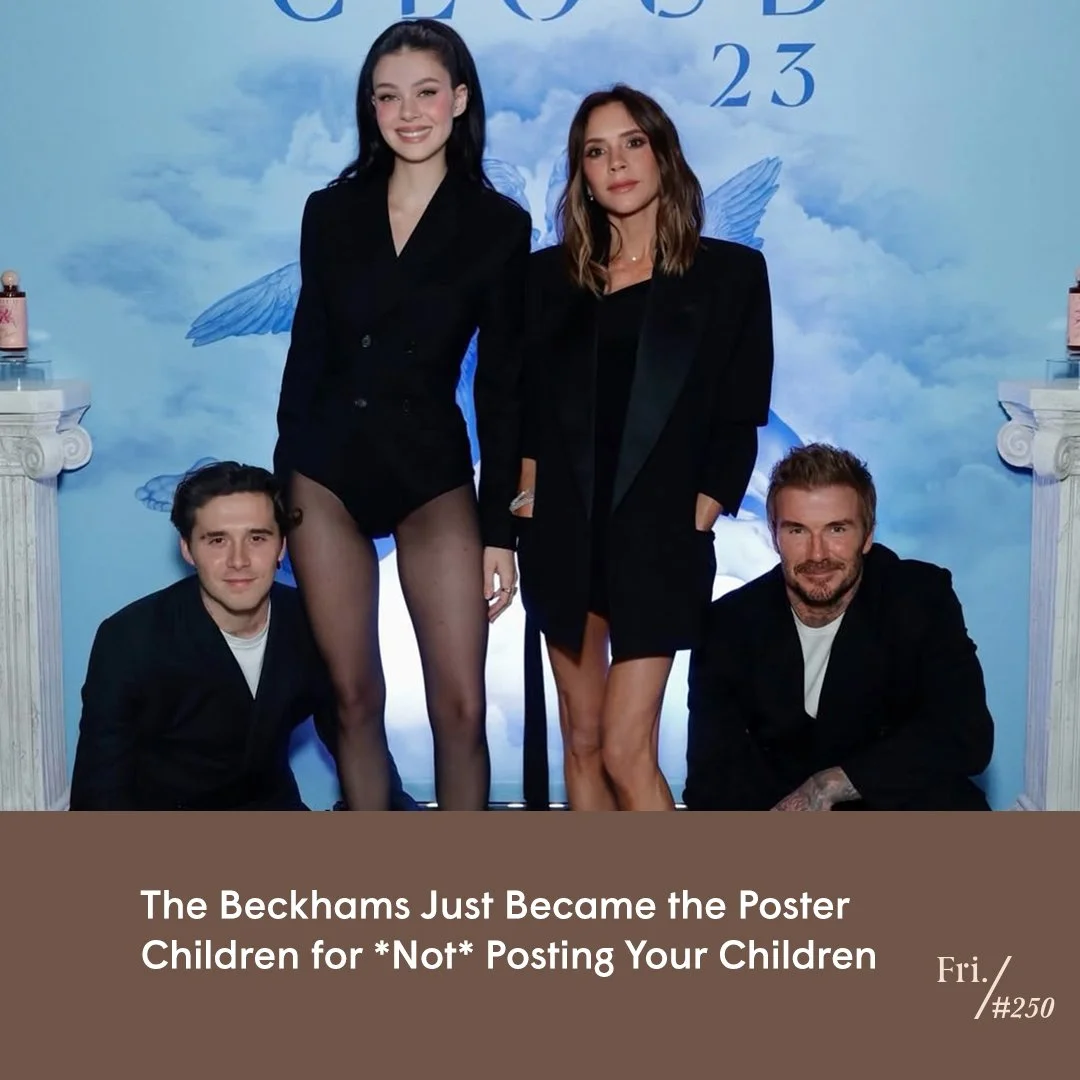
Image: instagram.com/victoriabeckham
I didn’t expect to spend quite so much of this week thinking about various members of the Beckham family, but you know what I really didn’t expect? To discover a latent, admittedly parasocial, fondness for Posh and Becks. I think it’s mostly because I’m a racialized millennial woman for whom the Spice Girls and Bend it like Beckham were both pretty foundational, and who also couldn’t help but follow their love story/brand evolution as it unfolded, because it was literally all over the newsstands for years. Oh, and I’m still entertained by that viral documentary clip. I’m not alone—amid the fallout from the newly-public feud between David and Victoria Beckham and their eldest son Brooklyn, the internet does seem to be quite firmly in camp OG Beckhams, and so is three-fifths of my most pop culture-obsessed group chat. But still. Before I actually get into the newsletter this week, I do have to acknowledge my biases: I really love the elder Beckhams, apparently? And, I don’t want to believe they’ve been as mean to their eldest son as he’s claiming.
(A side note: I do think said elder son might be a tad misguided, and not just because of the ill-fated photography career. Or his short-lived stint as a food influencer. Or his hot sauce brand that is called Cloud23, for some reason. More because he doesn’t seem to have thought through the potential long-term consequences of rejecting the devil he knows, a.k.a. his family, for the one he’s still learning about: his new wife and her billionaire, MAGA-loving relations. Also: there’s that prenup.)
I like how Brooklyn Beckham spent 8 long paragraphs airing his famous family’s drama in detail and then ended it with “all we want is privacy” like that is divalicious
— Keara Sullivan (@superkeara) January 20, 2026
To be fair, I actually don’t think Posh and Becks have treated Brooklyn as badly as he' claims. In fact, I think this family feud is exactly the type of low-stakes celebrity drama that I live for. While I don’t want to diminish the emotional impact of being estranged from your loved ones, I do think this is, at its core, several incredibly wealthy people who are mad at one another and are now saying so publicly… Which also means they’re demonstrating a very entertaining spectrum of approaches to navigating scandal. There’s no real danger, no one’s facing irreparable harm—so I can watch the drama go down with zero guilt. The best!
However. While the general consensus is that Brooklyn is just a whiny nepo baby, I do think the way his parents have built their businesses on the back of their family brand is probably not great for several important members of that family/brand. Namely, their children. In fact, this entire news cycle has me thinking about the very concept of a ‘family brand,’ and the consequences of putting your children in the public eye from a very young age.
First: Some background on the Beckhams vs. the Peltz Beckhams
Buzzfeed recently published an exhaustive recap of the feud, which has been simmering for years, but here’s a quick recap for the uninitiated: back in spring 2022, rumours began swirling that something was amiss between the elder Beckhams and their son and soon-to-be daughter-in-law, Nicola Peltz. The gossip was largely centred around Peltz’s decision to wear a Valentino wedding gown instead of one designed by her future mother-in-law, and a perceived coolness in their respective social media posts. Over the next few years, the family seemed to go through periods of closeness and distance, but things took a turn for the worse in 2025. Last spring, sharp-eyed fans noticed the younger couple didn’t attend any of David’s three (!) 50th birthday parties, and speculated there was a feud between Brooklyn and one of his younger brothers (Romeo, kid #2).When the Peltz-Beckhams renewed their vows over the summer, the Beckhams did not attend, and the duo didn’t show up to the premiere of Victoria’s Netflix doc in the fall. British media has clearly been following this story more closely than I have, because just before Christmas, another Beckham progeny (Cruz, kid #3) posted an Instagram Story debunking a Daily Mail article that claimed the elder Beckhams no longer followed Brooklyn on social media. Then, this week, Brooklyn went “nuclear” (though perhaps this was not the best adjective for media to use considering the current state of the world, but okay), posting a six-part Instagram Story that confirmed they are definitely feuding and explained why he doesn’t want to reconcile.
Honestly, the specific examples Brooklyn gives of his parents’ behaviour do sound pretty annoying, and the Posh-specific bits very much give Boy Mom™️. But these things were also irritating in pretty regular, wedding-adjacent ways, tbh. (Aside from his comment about Victoria “danc[ing] very inappropriately on [him] in front of everyone,” which was confusing wording and had icky implications that a particular subset of the internet is now running with, of course.) The more interesting parts, to me, were his statements about ‘Brand Beckham.’
“My family values public promotion and endorsements above all else. Brand Beckham comes first. Family ‘love’ is decided by how much you post on social media, or how quickly you drop everything to show up and pose for a family photo opp, even if it’s at the expense of our professional obligations,” he wrote. “The narrative that my wife controls me is completely backwards. I have been controlled by my parents for most of my life. I grew up with overwhelming anxiety. For the first time in my life, since stepping away from my family, that anxiety has disappeared.”
Is this a slightly overdue rebellious phase, or something more?
I did laugh out loud at that tweet about how 26 is “a bit old for an “I HATE YOU! I NEVER ASKED TO BE BORN!’” phase, but in all seriousness, I don’t think kid rebelling against his parents is quite the right analogy here. I think it’s likely closer to an employee rage-quitting after spending years angry about the lack of work-life balance. In case you didn’t grow up during the golden age of Posh and Becks, this is important context: the senior Beckhams are considered celebrity royalty now, but for a while there, they were perceived as slightly gauche for their fame-chasing ways. In fact, their public brand—and subsequent business success—was totally built on their private relationship, so selling access to just about every major moment in their private lives was a big part of the strategy.
They *literally* branded themselves together: pic.twitter.com/cB3ZfxG3SH
— kaomi (@kaomi_k) October 5, 2023
As columnist Marina Hyde explained in the Guardian earlier this week, “Brooklyn Beckham has been commodified since he was a foetus. The story of Victoria’s pregnancy was sold by his parents. When he was born, David and Victoria sold the first pictures of him. They sold intimate looks around their home and his nursery. They sold their wedding, staying up till 3am on the night of that big day, deciding which pictures would be featured in OK! magazine. They sold everything – mostly, back then, to OK!... [A]s time went on, David and Victoria acquired more sophisticated advisers who understood the rapidly morphing potential of controlling image and brand, and built a vast and diversified empire for them off the back of it. When social media came along, the Beckhams channelled their business through its pipes. As I’ve written here before, they were past masters at not simply turning to their children and telling them they loved them, but photographing them, tagging them and sending the message of love via social media.”
The celebrity family brand has some disturbing similarities to ‘kidfluencing’
Pretend for a moment that we’re not talking about Brooklyn Beckham, erstwhile model/photographer/chef and scion of a celebrity family that’s worth half a billion dollars. Instead, what if we were talking about a regular kid, from a regular family, who’d been trotted out on various social media platforms for likes, follows and clicks since birth? That starts to feel different, right? Especially since we’ve recently been hearing a lot about the damage a childhood spent performing for an audience can do. In 2023, journalist Fortesa Latifi spoke with a young woman she calls Claire for a Teen Vogue feature on kidfluencing. Claire’s childhood has been documented on her family’s YouTube page, with videos of her life from toddlerhood to teenagedom racking up more than a billion views. That family brand has grown to the point where she feels like her childhood was co-opted by the work of being an influencer, something she didn’t—and as a toddler, literally couldn’t have—consented to. And there’s no escape. Once, she says, “she told her dad she didn’t want to do YouTube videos anymore and he told her they would have to move out of their house and her parents would have to go back to work, leaving no money for ‘nice things’… Her father has told her he may be her father, but he’s also her boss.” Worse, she’s not even legally entitled to any of the revenue she has helped generate.
There is a precedent for this type of dynamic: child stars. Many U.S. states and Canadian provinces have child labour laws designed to protect minors who are working in creative industries, but that wasn’t always the case. In fact, California’s Coogan’s Law, which is probably the most famous example of this type of legislation, was named after the child actor Jackie Coogan, who made millions of dollars as a child actor, only to discover when he turned 18 that his mother and stepfather had spent it all. This comparison isn’t an exaggeration; a 2025 study published in the Journal of Business Ethics used the United Nations Convention on the Rights of the Child to determine whether there were ethical concerns with kidfluencing, and determined that yes, this type of labour involves five fundamental threats to children’s rights and freedoms.
here are the nine wildest things influencer kids have told me about growing up online pic.twitter.com/RClOnWWOMI
— Fortesa Latifi (@hifortesa) January 13, 2026
And it’s not just about labour issues. A 2024 study published in the International Journal of Sociology and Social Policy found child influencers experience specific negative impacts, “such as affecting individuals’ work-life balance, their education, how safe they felt online and physically, how they maintained friendships, pressure to increase their profile and their mental health well-being.” This doesn’t even take into account the sexual exploitation that is rife in kidfluencing spaces, which a 2024 New York Times investigation broke down in nauseating detail. According to journalists Jennifer Valentino-DeVries and Michael H. Keller, “thousands of so-called mom-run accounts examined by The Times offer disturbing insights into how social media is reshaping childhood, especially for girls, with direct parental encouragement and involvement.”
Loving your kids isn’t protection from exploitation
Obviously, as a child of mega celebrities, Brooklyn has probably not faced the same kind of exploitation as the children in that Times exposé, or even as Claire. But I’d argue these disparate examples are still on the same spectrum. They all involve a blurring of the lines between leisure and labour, and private, public and professional. They all subvert the child’s needs and desires in favour of revenue generation. And all those things matter, even if the labour looks or seems fun.
The other thing that makes this spectrum of exploitation so troubling is that it doesn’t necessarily look or feel like abuse; in fact, it can seem totally loving. Last year, Netflix released a three-episode series about Tiffany Smith, an L.A. parent whose daughter, Piper Rockelle Smith, built a massive following by creating content alongside a ‘squad’ of friends. In 2022, 11 families whose children belonged to that squad filed a lawsuit against Tiffany alleging she had emotionally, verbally, physically and sexually abused their children. Even among this very dark turn of events, though, the documentary tries to capture the nuance of kidfluencing. That is, the fact that these parents aren’t trying to exploit their children. They are, on some level at least, motivated by love. As Variety wrote in its review, “at times in the docuseries, it’s hard not to judge the parents for putting their children’s lives online for millions to see, but there are also several scenes that depict deep family connections and love. Each of the families believes in the kid influencer career, which has given them the freedom to spend more time together, even though the struggle to stay relevant is a constant stress.”
Obsessed with this Beckham drama because PR crisis deflection strategy is going to get us Spice Girls reunion at the Sphere
— Kevin Fallon (@kpfallon) January 21, 2026
Of course, this is also why it’s not surprising that family brands so often fall apart, whether we’re talking about social media influencers or A-list celebrities. The pressure and stress is intense, and requires a level of narrative control that can feel disingenuous, if not downright dishonest. Eventually, all of that may stop feeling worthwhile to some members of the family—and once they start to feel resentful about their assigned duties, it’s only a matter of time before their discontent feels too big to ignore. So, even though I do still really love the elder Beckhams for reasons I can’t even really explain (and yes, I am laughing at every Victoria dancing meme), I can also see where Brooklyn is coming from. It’s really not surprising to hear that he’s tired of the role he’s been required to play since birth.
Thank you for reading this week’s newsletter! Still looking for intersectional pop culture analysis? Here are a few ways to get more Friday:
💫 Upgrade to a paid subscription to support independent, progressive lifestyle media, and to access member-only perks, including And Did You Hear About, a weekly list of Stacy’s best recommendations for what to read, watch, listen to and otherwise enjoy from around the web. (Note: paid subscribers can manage, update and cancel their subscriptions through Stripe.)
💫 Follow Friday on social media. We’re on Instagram, YouTube and (occasionally) TikTok.
💫 If you’d like to make a one-time donation toward the cost of creating Friday Things, you can donate through Ko-Fi.