
South Asian Hate is on the Rise in Canada, and Those Jagmeet Singh Ads Are Proof
By Stacy Lee Kong
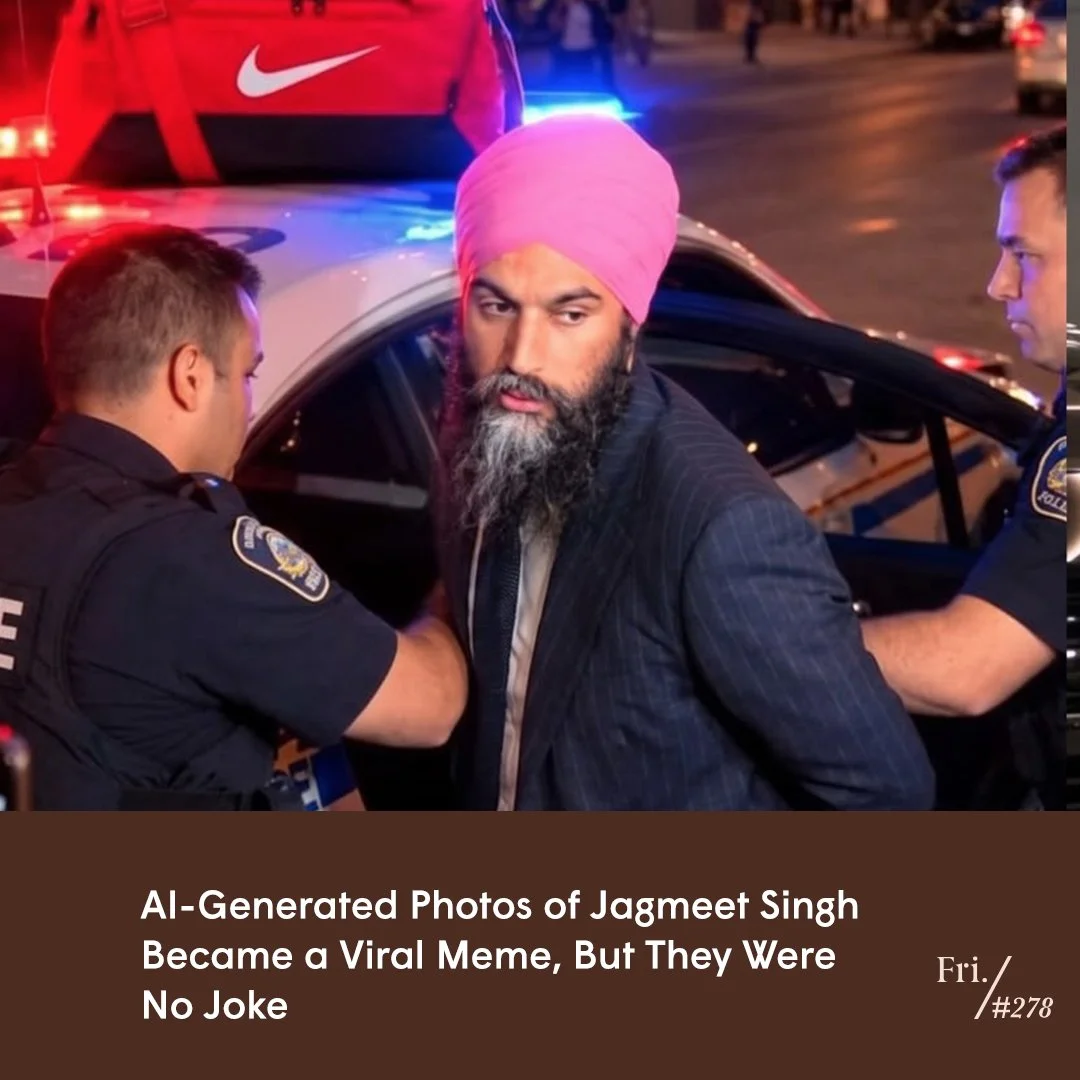
Image: X
This week’s newsletter is a guest post from journalist and culture critic Katherine Singh, who you should definitely follow on Instagram and TikTok!
If you’ve been on the dreaded hellhole of an app that is X (fka Twitter) any time in the last month, chances are you noticed a series of images featuring former NDP party leader Jagmeet Singh. Arguably the most prominent one features Singh, dressed in all black and holding a ~suspicious~ red Nike bag as he climbs into a black SUV. Additional photos show him hugging and exchanging the bag with another man, and, for some reason, sitting among a group of women while wearing a gold suit like someone on Deal or No Deal, red Nike bag perched between his legs, of course. Most of the images are accompanied by a vaguely ominous, but nonsensical, question (“What’s in the bag?”) or statement (“A few minutes after yesterday’s release”).
The posts are clearly meant to imply that the former party leader is involved in pretty suspicious—and let’s be honest, seemingly illegal—activity.
While reports vary on the actual origins of the posts—they’re being published by accounts with a variety of random handles like “ccfoxsystems,” “JB9” and “AIndroid69”—the images are reportedly tied to a scam (what’s new!) directing users to a fake CBC article stating Singh was arrested for promoting an investment platform, and promising people over $1,000 in earnings in exchange for a small initial deposit.
Is any other Canadians getting Jagmeet Singh spam political spam every 3-4 posts?
— Tara (@Halifaxidocious) October 15, 2026
This is far from the first time bots have used a Canadian celebrity or politician to try to exploit people for money or personal information. But unlike these past examples, there’s an additional layer to this scam that speaks to where we are as a country right now. Because using Singh, a visibly Sikh man, in these fabricated images is not just a coincidence. It reflects a broader climate of persistent hate and racism directed at South Asian communities in Canada. And we need to actually talk about it.
Hate for South Asian people in this country is real and it’s only getting worse
It might seem hyperbolic to say hate for South Asian people is at unprecedented levels, but only if you haven’t been paying attention.
For many South Asian people in Canada, as well as members of other POC communities, this has been obvious for years—nowhere more so than in online interactions and comments, and especially on social media. In fact, recent data shows South Asians are disproportionately targeted on platforms like X. A 2025 report published by the Institute for Strategic Dialogue, found that posts using anti-South Asian slurs in Canada increased by more than 1,350% between 2023 and 2024. And in 2024, in the lead up to the April federal election, incidents of online racism towards politicians, particularly Singh, rose sharply.
“I’m not shocked at all, because I’ve been seeing the rise in hate online over the past few years, and I kind of just knew it was a matter of time before people started feeling emboldened to be openly racist in person as well,” food influencer Aashim Aggarwal told Now Toronto in a 2025 interview about his own experience of simply existing online. Aggarwal, who’s based in Toronto, said any time his posts go vira, regardless of the content, his comment section is inundated with racist and anti-immigrant comments, which is the sad reality for many online creators. “I could literally be saving puppies, and there [would] still be comments with South Asian racism, Indian racism, as the focus,” Aggarwal said.
Worse, this hate is increasingly moving offline. According to reporting from Statistics Canada, police-reported hate crimes against South Asian people across the country increased 227% between 2019 and 2023. We have already seen this in the most horrific ways. In June 2021, the Afzaal family, a Pakistani-Canadian couple, their teenage daughter and their elderly mom, were killed by a white man in London Ont., after he intentionally rammed his pick-up truck into the family while they were on a walk in their neighbourhood. In Toronto, a 2024 Hate Crime report from Toronto Police Service found that between 2022 and 2024, anti-South Asian instances of hate jumped from 14 reported occurrences in one year to 41 occurrences a year. And in London, Ont., a recent police report found that South Asians were the second most targeted group in 2025, with 35 reported incidents of anti-South Asian hate, a 105.9% increase from the previous year.
anti-indian racism is so aggressive in canada that when I get a video about tim hortons, I don't bother checking the comments because I already know they're gonna be VILE towards migrant workers from india omfg 💔 genuinely diabolical
— angel 🇭🇹🇵🇸 seven havens | himejoomfshi (@hannibalismybbg) October 22, 2026
At the same time the AI tweets about Singh were making their rounds, a video was also going viral. Initially shared on X before making its way to other platforms, it showed a South Asian food delivery driver seemingly being pushed off his bike by a white man at an intersection in Toronto. While the video only shows the moments after the delivery driver hit the ground and the reaction of the people assisting him, the implication is that the incident was racially motivated. That same month, a man in Toronto was arrested for a hate-motivated assault against a South Asian person; he made anti-immigrant and anti-South Asian remarks and then physically assaulted them.
What goes viral tells us a lot about how Canada views South Asian people
Remember that whole ‘Canada is a mosaic’ thing we’ve been sold our entire lives? It seems that doesn’t apply when that mosaic isn’t entirely awash in white.
My TikTok FYP has increasingly become inundated with videos targeting South Asian people that go on to rack up thousands of likes and comments: complaints about their cultural celebrations, assertions that their presence means this “isn’t Canada anymore” and whining about how the posters “miss the old Canada.” They don’t even have to feature real people to gain traction; in 2024, two completely false narratives about South Asian people defecating in public places took off. In July, a photo that seemingly showed a Sikh man defecating outside a Tim Hortons in Brampton, Ont. went viral after a right-wing journalist shared it on X. The owner of the establishment later spoke out and shared surveillance video that showed it was Photoshopped—though online commenters were so committed to their anti-South Asian narrative that they didn’t believe him. That same summer, rumours that South Asian people were defecating on Ontario’s Wasaga Beach reached a fever pitch online. The town’s mayor eventually had to speak out, saying the city had received “no evidence” to show these incidents had happened.
The reactions to, and proliferation of, these posts makes one thing clear: a growing number of people in Canada see South Asian people as dirty, invaders, criminals and a threat to the ‘Canadian’ way of life. (This, while the fashion girlies are simultaneously co-opting and whitewashing South Asian aesthetics as high fashion—because ICYMI, the beloved Scandinavian scarf is actually a dupatta!)
It’s not surprising, given this country’s history of racism towards anyone who doesn’t look ‘Canadian’ (i.e., white). But it is exhausting. I’m so tired of constantly being on alert in every interaction, or going into my day-to-day life wondering if someone is going to make an offhanded comment that dehumanizes me and my loved ones.
Immigrants are the biggest scapegoat for every structural and political problem in the west but its unbelievable how much that’s translated into racism, hate crimes, and prejudice against south asians in Canada in the past few years
— drig (@gontararak) October 30, 2026
Listen: I have a lot of privileges. Being mixed (my mom is white) offers a level of protection from discrimination that I know other racialized people don’t have. But being mixed also means that often people can—and will—say disparaging comments or make racist remarks about South Asian people around me, thinking they’re not talking about me. Every time I hear that we smell a certain way, don’t speak English and don’t deserve basic human decency, it cuts.
I can vividly recall one of the first times I came face-to-face with racism aimed at South Asian people. I was in my first year of university and a girl who’d been in my grade throughout high school shared her parent’s Halloween costume to Facebook (yes, I’m a millennial). Their ~hilarious~ costume featured her white parents in full brownface, wearing a saree and turban and holding packages of blueberries. They were a caricature of South Asian blueberry farmers. The comments section of the post was filled with comments from other people I’d gone to high school with LOL’ing and saying just how funny and accurate this costume was. (I will, for obvious reasons, not name her, but just know… it’s still clocked.) Just like people dressing up as the Jagmeet Singh meme for Halloween, this casual racism, and the potential emotional, physical and mental impact of it, was considered a joke.
So why aren’t we talking about it? Like, actually talking about it
This context helps explain why those viral posts implying Singh’s criminality aren’t just another harmless meme, but are instead lowkey nefarious. Because regardless of the actual intent behind the posts themselves, whoever is behind the scam knew that these images—which position a brown man as suspicious, deceptive and ‘bad’—were going to land. And that’s pretty telling.
To be clear, racism in Canada is nothing new. While there’s data showing hate towards South Asian people has risen in the country over the past seven years, I’d be remiss if I didn’t mention the fact that South Asian people in this country are not alone in their experiences of racism. Indigenous and Black folks are especially targeted and experience racism at increasingly high rates. There’s also a long and complicated history of racism within South Asian communities, aimed both internally at other members of the community via colourism and the caste system, and at members of other BIPOC groups. This is especially prevalent when it comes to anti-Blackness within the community. As writer Selena Randhawa noted in a 2020 article for Refinery29, “we can’t hashtag Black Lives Matter or share a black square to our feeds without accepting that people of darker complexions are routinely overlooked, denigrated, and ridiculed in our community. Our preference for lighter skin positions whiteness as being aspirational, creating negative connotations against Blackness.”
Still, there is something notable about this specific period of time. I think it’s how widely accepted this type of racism has become—and how intrinsic it has become to South Asian people’s everyday experience, in a way it really wasn’t before. In August, I experienced this first hand when I got into an argument with a man in an airport in rural Newfoundland. TL;DR: He was on FaceTime with someone in the luggage area loudly and unabashedly scanning the South Asian families waiting for their bags and talking about “the real Canada being alive and well” before making comments about the number of South Asian people working jobs in the hotel industry and at Tim Horton’s—and their inability to speak what he considered coherent English. When I confronted him about his comments and the fact that everyone, including myself and other South Asian people around, could hear him making racist statements and speaking disparagingly about us, his response was, “I know. That’s okay where I come from.”
Montreal police were collecting the locs of the Black men they were arresting. Alberta just had the most RACIST referendum where majority voted they didn't think immigrants should have access to basic human rights lol being Black, Indigenous or POC right now is terrifying.
— Goddess Graveyard Punany✨ (@xm_muva) November 5, 2026
And increasingly, it feels like it is. As Reena Kukreja, an associate professor of global development studies at Queen’s University, told me in a July 2025 RepresentASIAN Project article on appropriation of South Asian culture in the fashion industry, “the state is directly contributing to this form of hate. It’s not as if it is absent from this discourse; it is totally embedded in the creation and the enabling of racial violence.”
Much of the anti-immigrant and anti-South Asian sentiment is fuelled by the misconception that an influx of South Asian residents is the reason for housing shortages and a foundering economy, and that newcomers are unfairly accessing social services and taking limited jobs. (As of 2023, 30% of newcomers to Canada were people of Indian origin, the largest share.) As Kukreja noted, the arrival of newcomers from countries like India—and the lack of social services and jobs to meet these numbers, issues that predated their arrival—is on the government, who have long courted international students. Essentially, the federal government has historically invited people in, then refused to address these long-standing issues—or meaningfully engage with the hate South Asian people receive because of them. Or, put another way, the government is essentially scapegoating them. (It should be noted that in 2024, the Canadian government enacted stricter entry requirements and put a cap on immigration numbers, and while there was some speculation that might change, news just broke that Prime Minister Mark Carney’s government will admit the same number of people as permanent residents this fiscal year as it did the year before—380,000—and will be maintaining that number through 2029.)
Someone needs to take on the responsibility of fixing this—and it shouldn’t be South Asian people
The thing is, it shouldn't fall to marginalized folks to argue for our own humanity. (FYI, we have enough going on!) The government—who we vote for, and pay taxes to—should be taking steps to change the narrative, but in reality, our politicians are still only promising to “collaborate with” racialized people in Canada to “develop federal approaches” around combating racism in this country, according to the most recent federal anti-racism strategy, Changing Systems, Transforming Lives: Canada's Anti-Racism Strategy 2024-2028… which, btw, was released in 2024 under then-Prime Minister Justin Trudeau, so who even knows where the current PM places this on his list of priorities!
So, what should be happening? For one thing, we need to see continued data collection on all racism, and South Asian hate specifically, so that we’re able to quantify it and better understand how it feeds into other disparities. There is a lot of work being done by independent organizations, but formal recognition of this specific uptick from the government feels like it would be impactful. And, as with every social and racial issue, we need more organizing and awareness of this issue to spread outside of the community, and become a concern for not just South Asian or racialized Canadians, but all Canadians. And also? The government needs to take accountability for their role in this situation, and work to explicitly dispel misinformation about South Asian communities and the assumptions they tax the country’s services and economy.
We hear time and time again that immigrants and diversity in our country is what makes it great—which is fabulous lip service. But how about we work on actually making those people feel safe and respected in the country they call home? Because really, is that too much to ask?
Thank you for reading this week’s newsletter! Still looking for intersectional pop culture analysis? Here are a few ways to get more Friday:
💫 Upgrade to a paid subscription to support independent, progressive lifestyle media, and to access member-only perks, including And Did You Hear About, a weekly list of Stacy’s best recommendations for what to read, watch, listen to and otherwise enjoy from around the web. (Note: paid subscribers can manage, update and cancel their subscriptions through Stripe.)
💫 Follow Friday on social media. We’re on Instagram, YouTube and (occasionally) TikTok.
💫 If you’d like to make a one-time donation toward the cost of creating Friday Things, you can donate through Ko-Fi.