
Does Anyone Even Care About People's Sexiest Man Alive Franchise Anymore?
By Stacy Lee Kong
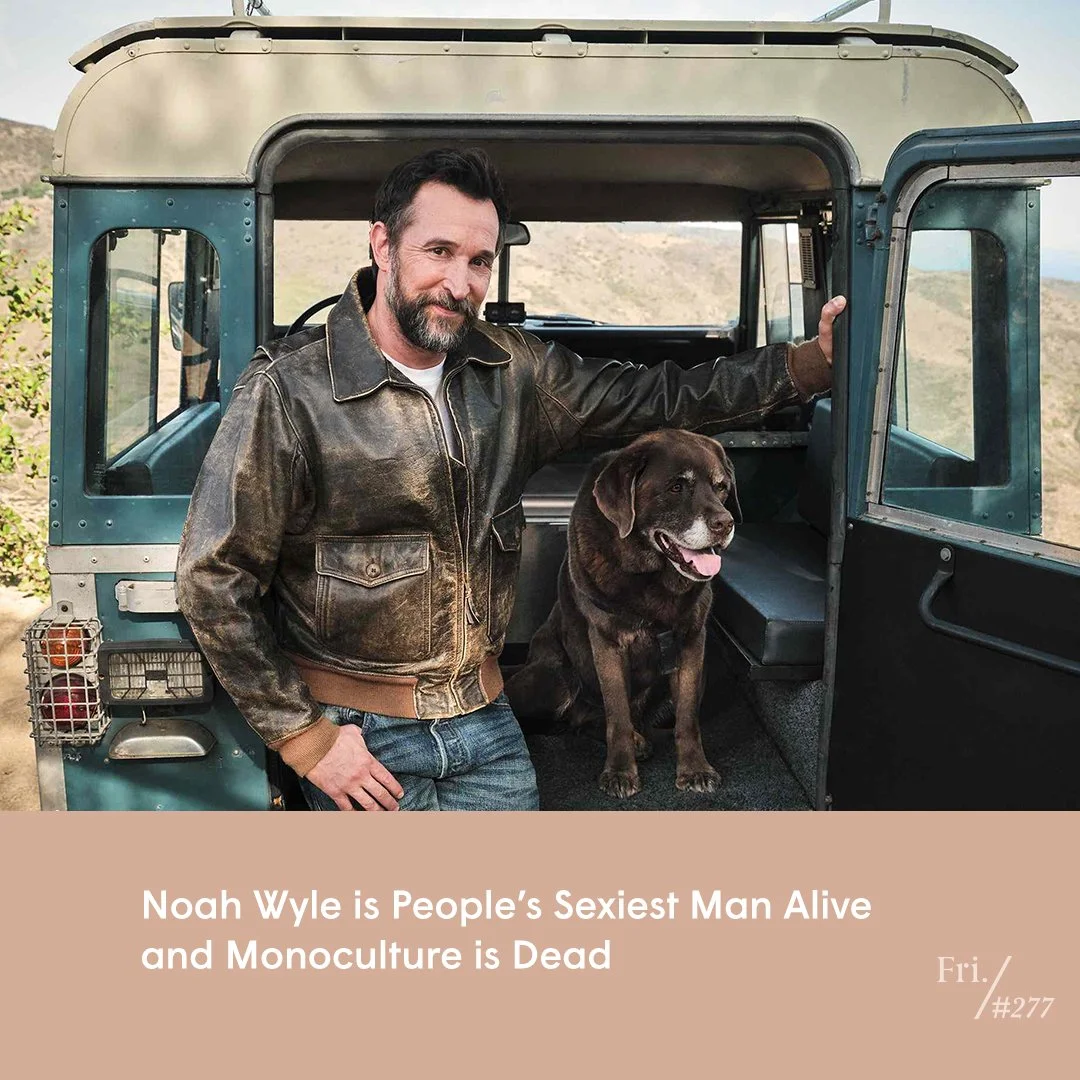
Image: Jeff Lipsky for People magazine
You’re so forgiven if you missed this one—it’s not the headline-maker that it used to be—but this week, People chose Noah Wyle as its 41st Sexiest Man Alive, and I think it’s worth talking about. Not Wyle as an honouree, really, though some factions of the internet are quite upset about the magazine’s choice. (Don’t you worry, we’ll come back to that.) Instead, I’m more interested in the Sexiest Man Alive franchise as a cultural artifact, and what it can tell us about modern masculinity, female desire and fame. Especially the last one, because I’d argue this thing is one of the last vestiges of monoculture, and the way we talk about it, or don’t, is a good indicator of how fragmented pop culture has become.
I’m fairly certain sex appeal is the least important element of each year’s Sexiest Man Alive
As the lore goes, the first Sexiest Man Alive cover was actually kind of an accident. Back in 1985, People reporter David Wallace was in Sydney, Australia, where he met up with a young Mel Gibson on the set of Mad Max Beyond Thunderdome. According to a 2014 deep dive into the franchise by Amanda Hess, Wallace “witnessed Gibson work through a pack of cigarettes, a smuggled-in six pack, and a generous helping of personal issues.” He sent his notes back to Michelle Green, a young writer for the magazine, who was tasked with turning them into the type of story that would grab shoppers’ attention in the checkout line. In a stroke of magazine-making genius, she “spun Wallace’s reporting into a rare deconstruction of a guy struggling to strike the pose of an international sex symbol while actually being a classic drunk,” Hess wrote. “She ended the feature on an ironic note: ‘And then the sexiest man alive slouches away, alone.’”
There’s also a version of the story where photo editor Mary Dunn referred to Gibson as the sexiest man alive in an editorial meeting. Either way, the moniker became a cover line, and then an entire franchise that crowned male celebrities and public figures, including Tom Cruise, Keanu Reeves, Brad Pitt (twice), George Clooney, Ben Affleck, Matt Damon, Johnny Depp (also twice) and Harrison Ford, as the pinnacle male desirability. The first two decades of Sexiest Men Alive might have played with what ‘sexy’ meant, with John F. Kennedy Jr. exemplifying one version in 1988, followed by a very different version—Sean Connery—in 1989, I’m not sure sex appeal was a deciding factor for any of the post-millennium Men. Like, yes, the recent list includes men who I would personally describe as sexy (see: Michael B. Jordan, Idris Elba, Chris Evans), but overwhelmingly, People’s selections offer a different type of fantasy altogether: one of safe, reliable domesticity. Take Wyle’s cover profile, which paints him as a self-effacing wife guy and doting father who still gets self-conscious when he’s not acting and loves doing the dishes. (“I am the dish maven. The sink is my domain. And I would recommend more guys get into the dishwashing, because it’s very therapeutic,” he says.) He waxes poetic about his children, easily acknowledges that he cries and says he both journals and does Pilates.
The ladies call me this on a regular lol fuck a magazine validation 🚯
— Big Smoke - (@Skepta) October 28, 2026
None of these are bad things! Loving your partner, kids and pets, equitably dividing household labour and being able to process your emotions in a healthy way are excellent qualities for any person to have, but especially men and especially right now, when manosphere nonsense continues to gain traction, on and offline. But I do think it’s interesting that the magazine continues to position these qualities as ‘sexy,’ even as the female gaze increasingly drives pop culture, and women are now very willing to be horny on main. When we compare People’s picks to what women are actually saying they find sexy—which can be unhinged in both delightful and deeply problematic ways—it becomes clear that the Sexiest Men Alive are a pretty narrow representation of ‘what women want’ that sidesteps any real engagement with the reality of female desire.
Putting aside the fact that it’s impossible to make some sort of definitive statement about what all women want, because different women are attracted to different combinations of gender, ethnicity, age, height, weight, personality type and profession, the fantasy People pushes with its Sexiest Man Alive picks isn’t about attraction at all; it’s actually about achieving traditional, heteronormative life goals. This definitely makes business sense, especially considering People’s readership: 66% women, median age 52, middle class to upper middle class, suburban residents. But it also feels increasingly irrelevant, because Noah Wyle in 2026 just doesn’t mean what Denzel Washington did in 1996. (And don’t even get me started on how few racialized men have been deemed Sexiest!!!!)
The recent Sexiest Man Alive discourse shows how little cultural overlap there is between demographic groups
That fragmentation of culture is actually the crux of what I find so interesting about this franchise, and especially people’s reaction to this year’s pick. I’m not sure the magazines’ picks for Sexiest Man Alive could ever tell us anything meaningful about female desire, especially when the task of choosing each year’s honouree often fell to straight men. As Hess argued, from almost the very beginning, “the SMA provided a safe, sanitized outlet for female desire—a minor indulgence for successfully married women.” But there was a time when a Sexiest Man Alive announcement could tell us something about fame, because as it became more and more of a cultural moment throughout the ‘90s and into the early 2000s, the men who snagged this honour were ones who everyone knew. They were A-list celebrities, which are only possible through monoculture.
noah wyle seeing the reaction roll in https://t.co/R8JrhTXACd
— holly (@LITTLEBlRDS) October 27, 2026
As marketing prof Maria A. Rodas noted in The Conversation in a piece pegged to the finale of The Late Show with Stephen Colbert, the term monoculture has its roots in agriculture, where it describes planting a field with a single crop, which can boost profits, but comes with increased vulnerability to pests, disease or bad weather. It migrated to culture criticism as a way “to describe a media landscape dominated by a handful of TV networks, magazines and record labels,” she wrote. There were lots of problems with that approach to entertainment, not least of which was the stunning lack of diversity in stories that got told, celebrities that gained stardom and perspectives that were highlighted. But, there was something kind of lovely about the shared cultural experience it engendered, where people could reliably assume their friends and colleagues were familiar with the same entertainment touchpoints as them. That’s not the only definition of monoculture—Rodas notes that the same term has been used to describe the soul-sucking sameness of AI generated content and algorithmic scrolling—but it’s what I mean when I refer to something dying. Our feeds are tailored to our extremely individual interests, so while we still experience moments of mass cultural togetherness, they’re vastly outnumbered by ultra-niche cultural experiences. Similarly, there are fewer and fewer celebrities that resonate across demographics. Society-wide shared cultural experiences are increasingly rare, and getting rarer.
That showed up in a slightly ridiculous way this week, when someone noticed that basically all of the most recent Sexiest Men Alive were promoting something at the time of their win, and their media blitz typically happened on a platform that was under the same ownership umbrella as the thing they were promoting. This is where Wyle’s controversial reputation comes in—in addition to questions about his politics and possible support for Israel, there seems to be a conflation of Wyle and his character, and some fans of the show believe that he is a misogynist who’s especially threatened by women of colour. The implication of the initial tweet was that Wyle’s win was some kind of conspiracy theory intended to launder his reputation, which sparked a counter discourse about how the youth don’t know how magazine covers/media/anything works. And sure, lots of people genuinely don’t know that magazine covers are negotiated for months, or sometimes years, in advance, and rarely happen outside of promotional cycles for new projects or endorsement deals. We also have to acknowledge the fandom angle, because some of this can be traced back to fans’ dislike of Wyle, and the incorrect assumption that everyone believes the same things about him.
The “Sexiest Man Alive” title has always been a promotional tool. What did you think this was? A democracy? Americans casting individual votes inside a polling booth?
— Michael (@yosoymichael) October 28, 2026
Can People continue to crown a Sexiest Man Alive when no one cares about the same celebrities anymore?
But also, that line of conspiratorial thinking isn’t just a consequence of fan behaviour—it’s also a sign of declining cultural literacy. Previous versions of the Sexiest Man Alive were familiar to wider audiences and had a more cohesive ‘star text,’ so even if we didn’t agree on People’s definition of sexiness, we recognized their picks as huge, demographic-spanning stars because the magazine was relevant to different demos, and so were actual celebrities. Now, the magazine is still doing the same thing it always has; editors chose Wyle as this year’s Sexiest Man Alive, not due to a scam to tidy up Wyle’s controversial reputation by giving him a magazine cover, but because they assessed him to be popular with their readers, who actually think he’s hot. (Presumably this was also the case with Blake Shelton, difficult as it may be to believe.) It was a tactic to sell magazines, as all magazine covers are. The target audience is just way narrower than it used to be. So, more than anything else, this conversation is a sign of media fragmentation.
Is this… bad, though? I’m not sure that it is. Yes, there are fewer chances to feel connected to everyone via pop culture, and that is a loss. Increasingly niche online experiences can also make it easier to become radicalized because we can more easily stumble into echo chambers. But monoculture often ends up catering to the widest, most mass audience possible, so in some ways, the loosening of that grip allows for other types of storytelling to happen. At the very least, a post-monocultural media landscape offers more opportunities to undermine white hegemony. (I mean… the magazine has chosen a non-white man just six times in the past 41 years, or 14% of the time, so they weren’t ever even pretending to choose everyone’s sexiest man, were they?)
Mostly, though, I’m curious how the trend toward increasingly niche cultural experiences will affect next year’s Sexiest Man Alive pick. I mean—we’re clearly running out of men that everyone likes.
Thank you for reading this week’s newsletter! Still looking for intersectional pop culture analysis? Here are a few ways to get more Friday:
💫 Upgrade to a paid subscription to support independent, progressive lifestyle media, and to access member-only perks, including And Did You Hear About, a weekly list of Stacy’s best recommendations for what to read, watch, listen to and otherwise enjoy from around the web. (Note: paid subscribers can manage, update and cancel their subscriptions through Stripe.)
💫 Follow Friday on social media. We’re on Instagram, YouTube and (occasionally) TikTok.
💫 If you’d like to make a one-time donation toward the cost of creating Friday Things, you can donate through Ko-Fi.