
The Media Pile-on Over Jason Arday Was Actually About Punishment
By Stacy Lee Kong
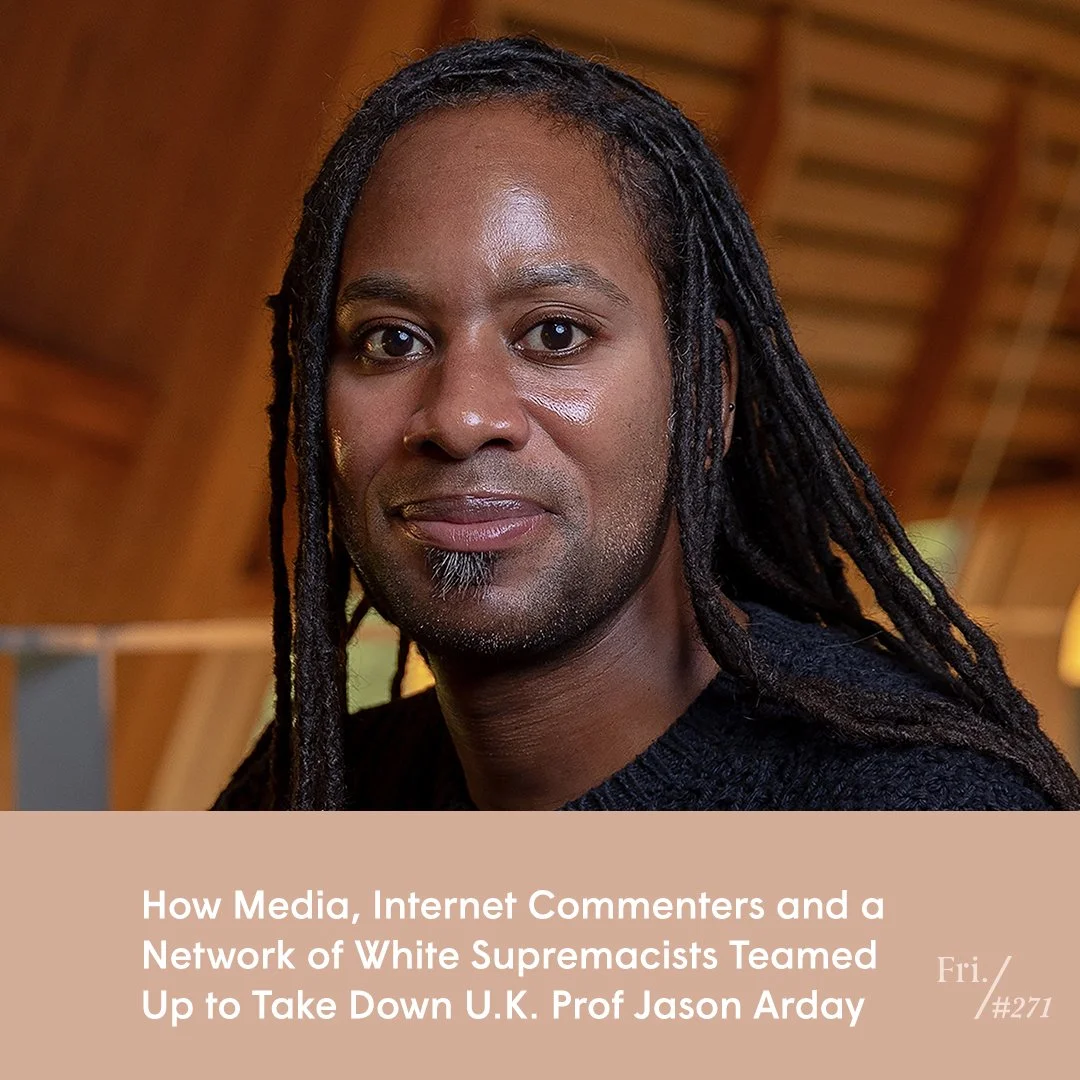
Image: Anselm Ebulue for Simon & Schuster
Content warning: This newsletter contains references to suicide.
For the past few years, I’ve been keeping a Notes app list of times the internet has lost its collective shit over some relatively minor wrong-doing. Think, when that one woman yelled during the “mute challenge” at one of Beyoncé’s Renaissance concerts, prompting an explosion of TikTok takes. Or, those semi-regular posts about someone’s husband, fiancé or boyfriend, which always follow the same script (“If your boyfriend’s name is Chad and he’s at a bachelor party in Nashville…”). The implication is that there’s infidelity afoot, but the methodology casually reveals a startling amount of personal information about a complete stranger. There’s also a friend-group variety of this style of post, most famously influencer Kellie Yancy’s TikTok addressed to Sarah, whose friends were gossiping about her at brunch. Or, the entire Coldplay concert cheating debacle, which spawned endless memes, commentary and news coverage. I’m interested in in how surveillance culture allows us to notice and respond to other people’s actions this way, and how the scale of that response takes harmless gossip into a completely different realm. But the reason I started that note in the first place is because I kept seeing an underlying craving for punishment. The thing that was actually driving the virality of these stories wasn’t so much the thing that happened; it was the online mob that wanted to see someone they thought was bad face some kind of consequence in the online version of a Medieval pillory. (The title of the note is, ‘Mobs + punishment. Are we just carceral people?’)
I’m trying to scroll significantly less these days, so I haven’t been updating that note as much as I probably could have, but I thought about it again this week in light of Dr. Jason Arday’s death, seemingly by suicide. Arday was a professor of sociology of education at Cambridge University in the U.K. who had recently been the subject of intense media scrutiny over unsubstantiated (or downright false) claims about his academic integrity—that, it turns out, were part of a coordinated attack by a Peter Thiel-backed network of anti-Black race science advocates.
the idea that Arday's reputation is restored in death is steeped in a logic of necropolitics. he didn't need to be sacrificed at the altar of "racial science" & "meritocracy" for his life to mean something. to quote Nikki Giovanni, the fact "that he [sic] breathed was enough."
— lina | لينه (@labushouk) August 18, 2026
Arday was 41; when Cambridge hired him in 2023, he became “the youngest Black person ever appointed to a professorship” at the school, according to the announcement published by its Faculty of Education at the time. He had achieved a level of success that felt unbelievable to his detractors, both because of his specific life experiences (he said he had been non-verbal until the age of 11 and couldn’t read or write until he was 18) and his race (many of them were, if not overt white supremacists themselves, receptive to those ideas). Racism was clearly the factor at play here. But how that racism manifests as carceral is, I think, important to recognize.
You can’t talk about Arday’s death without considering Black excellence fatigue
The primary example is white supremacists’ fury over Arday’s accomplishments, obviously. On July 21, Nathan Cofnas published a Substack post branding Arday “a plagiarist and fabulist.” Apparently, a Cambridge faculty member had anonymously reached out to Cofnas, a postdoctoral researcher in the department of philosophy and moral sciences at Ghent University, to reveal that “many if not most professors at Cambridge have known about [Arday’s supposed academic misconduct] for more than a year. However, Arday and/or Cambridge’s administration are using intimidation and legal threats to squelch the story.” Which faculty member? I mean, who can say? Certainly not Cofnas, who apparently felt zero responsibility to prove anything he was saying. But not any of the media outlets that jumped on this story, either. Just three days later, the Telegraph published its first article about the allegations, kicking off an actual media firestorm. According to media analysis organization NewsCord, U.K. outlets ran 229 articles about Arday in 22 days, a pile-on that was driven by some of the country’s largest outlets: The Times, the Telegraph, the Mail, the Spectator and the Express.
Few, if any, of those articles included what I’d argue is very important context: Cofnas is a virulent racist who has long criticized DEI, and was fired from Cambridge’s Emmanuel College in 2024 over blog posts where he argued that if academic was a meritocracy, the number of Black professors at Harvard would “approach zero.” In fact, he went on to say, “Blacks [sic] would disappear from almost all high-profile positions outside of sports and entertainment.” Oh, and while media sometimes identified him as a professor, he was not. What’s more, his academic accomplishments arguably paled in comparison to Arday’s, something that few of the journalists who were writing about this situation seemed equipped to check, as philosopher and academic Jason Stanley wrote on his Substack this week. Even worse, few of these outlets saw fit to disclose that the source of their information was an aggressively mediocre, proudly racist white man who had accomplished significantly less than the subject of his ire.
This despite Cofnas being very public about his motivation and technique; as New Yorker writer Lauren Michele Jackson pointed out this week, “it must have stung… not staying on at Cambridge, and Cofnas later joked that the events that followed were ‘what happened if you don’t give Cofnas a job.’ What happened: the ‘race-realist’ found ‘a hook for a story,’ as he recently told the conservative video podcaster Rob Montz, one that would embarrass champions of equality and confirm his prejudices. His target was Jason Arday.”
This Guardian article/headline was the worst example of what the media did to Jason Arday.
— Antoine Allen (@AntoineSpeaker) August 17, 2026
The headline is based off a TikToker/YouTuber who wasn't in Jason's year at school. But, a grown adult that supported Jason clearly states he did have learning and speaking difficulties. pic.twitter.com/JvTWIsdide
I think it’s important to note that, while Arday had been the subject of a plagiarism investigation in 2025, a misconduct panel at Liverpool John Moores University, where he earned his PhD, “ruled any similarities between his work and others’ were ‘well within the accepted range of compliance with the academic standards of the time,’’ per the Liverpool Echo. And, the accusation that he’d lied or exaggerated about his childhood isn’t actually about academic misconduct at all. It was just another way for Cofnas to portray Arday, and by extension all Black people, as dishonest, incapable and undeserving. Because the white professors at Cambridge who were accused of plagiarism and allowed to stay in their positions, like William O’Reilly, didn’t inspire the same level of vitriol, did they?
Writing in The Conversation, Cornel Grey, an assistant professor in Western University’s department of gender, sexuality, and women's Studies, characterizes the sustained, over the top media campaign against Arday as an example of “Black excellence fatigue,” a term originally coined by McMaster political scientist Nathan Andrews. When Grey and Andrews talk about Black excellence fatigue, they’re largely focused on the weight of public scrutiny and unfair expectations on Black academics, but when I first read it, I actually interpreted it in a different way: as a description of white society’s boredom with the very notion of Black excellence, and its apathy, if not downright anger, at the goal of racial equality. I’d argue that this is what Cofnas wanted to punish Arday, and all Black academics for, tbh. Arday had the audacity not only to succeed as an individual, but also to provide a model and mentor for other young academics, and to symbolize a more equitable, diverse academic landscape overall. He was one example of how societal progress was upending a long entrenched power structure, and Cofnas and his ilk couldn’t stand it.
And this obviously has much wider implications than just this one tragedy. “When an appointment symbolizes racial progress, serious allegations can spread suspicion beyond the individual,” Grey wrote. “Black academics have already warned that Arday’s alleged failures will be used to question Black academic legitimacy and diversity initiatives more broadly.”
U.K. media published 229 articles about a relatively unknown sociology professor. What the actual fuck?
Black excellence fatigue was definitely also a factor for the journalists who ran with this story; per NewsCord, “a very small number of [journalists did] most of the work. At the Telegraph, Albert Tait filed 13 pieces and Gordon Rayner 11; with Janet Eastham’s 6, three reporters produced 30 of that paper’s 42.” Do I know whether Tait, Rayner and Eastham are racist? I do not. Do I suspect that their interest in this story hinged on the racist belief that Arday was undeserving of his position and needed to be taken down a notch or 20? Uh, yes. Because you cannot convince me that all of this was because of some high-minded respect for academia. As Jackson wrote, “the relish in the unmasking, flung out across our debased online watering holes for anyone to see, has belied any professed piety when it comes to the topic of honesty and academic standards. Ours is not a society that loathes charlatans; look who’s running things.”
So the allegation of plagiarism in his PhD was investigated and dismissed. It turns out he did run all those marathons. So tell me, precisely, all you online sleuths — what exactly did Jason Arday do wrong?
— Peter Jukes (@peterjukes) August 17, 2026
(Apart from being the wrong class and colour of course)
And far-right perspectives have infiltrated media organizations, too, to dangerous effect. As former Washington Post columnist Karen Attiah wrote in her newsletter this week, “Arday’s impact is precisely what made him—and what makes Black intellectuals like him—targets for elimination… In this global anti-DEI age, removing Black people from public life has become an explicit political project, orchestrated at the highest levels of government, academia, and media, and embedded into policy. We [have been] seeing high-profile news of Black college presidents being pressured to resign (Claudine Gay of Harvard), prominent Black journalists being forced out of their positions (Don Lemon, Joy Reid, and myself), and corporations stepping back from funding or supporting anything that looks like diversity initiatives.”
But I think there’s another carceral angle to keep in mind when it comes to media: publications are well aware of audiences’ desire to punish what they perceive as bad actors, and that plays into their editorial decision-making, from the framing right down to the decision to publish this volume of stories at all. Despite all claims to the contrary, legacy media often debases itself to survive in a capitalist structure. In the age of short-form TikToks and endless algorithmic scroll, media outlets are increasingly using the same tactics as influencers and content creators to ensure their work is surfaced on our news feeds. I do this, for Friday Things and in my other work. On one level, this is just how it works, which is why there was a time I was posting on Instagram three times a day. But this also makes it easier to slip into—or frankly, decide to—use the same outrage culture hallmarks to stand out, including sourceless, negative, often bigoted, sleazily ‘neutral’ slop. Like, I shouldn’t see the same leading framing (“thoughts?”) from 6ixbuzz and a newspaper that has been continuously publishing since 1855, you know? But the unfortunate reality of today’s media landscape is, traffic remains among most outlets’ KPIs, which means someone has pointed out that a unique view being a unique view, whether the person behind that view likes the story or not—or whether it’s strictly fair or not. That is to say, even if individual journalists weren’t necessarily looking to punish Arday themselves, their larger strategy clearly depended on flooding their websites and social feeds with update after update on Arday’s supposed misdeeds as a deliberate strategy to capitalize on readers’ desire for punishment—and hunger for ‘proof’ their desire was justified.
NEW: It was a digital lynching. And the media is never going to hold itself to account for the role it played in Jason Arday’s death.
— Carole Cadwalladr (@carolecadwalla) August 17, 2026
But there are things we can do. This is a practical guide based on my own experience.
Link below. pic.twitter.com/sL2yTuq3Ut
This is actually deeply human, uncomfortable as that is to admit. Investigative journalist Carole Cadwalladr called the campaign against Arday a “a digital lynching,” which is really not an exaggeration. And in addition to the anti-Blackness of it all, there is the wider umbrella of mob mentality. As British psychologist and University College London professor Nichola Raihani told Vox in 2016, “it seems like our brains are wired to enjoy punishing others. [This kind of third-party punishment] is kind of like jumping off a cliff. You don’t expect that type of behavior to stay in generations very long.” And yet, the article points out, “this is a defining feature of humanity. Our justice system is built around juries, which are collections of third-party punishers. No other species on Earth gets joy out of punishing strangers like humans do.”
This is where it gets a bit complicated for me
I know that’s true, because this week, I learned several things that I found very satisfying: Cofnas, who was so concerned about Arday misrepresenting himself, had actually been misrepresenting his own title, calling himself a professor when he was in fact a postdoctoral researcher. Just a few days ago, he was fired from Ghent for the role he played in stirring up an anti-Arday cyclone of media coverage. And, his colleagues at Ghent were previously so concerned about his lack of qualifications and shoddy work that they wrote a 19-page document explaining why they believed he should not have been hired, including that he produced an “abysmal quality of work” and that his intention was not academic research as much as furthering a far-right agenda within the university.
Guys, remember he’s the victim here. https://t.co/oFsh6d0wly
— @timnitGebru (@dair-community.social/bsky.social) (@timnitGebru) August 20, 2026
To be clear, much of this is actually just proportionate consequences for Cofnas’ actions. I think he does absolutely deserve an academic smackdown and even some light trolling. What I’m finding uncomfortable is my own desire to see him not just face consequences, but actually experience punishment, even as I recognize that framework as carceral. I don’t know what the answer to that is, necessarily, but it feels like a thing to pay attention to, especially amid our reignited conversations about abolition.
Like… I don’t think this is about the pseudo-morality of ‘equal treatment’ or a false equivalency between Arday’s supposed misdeeds (which, again, seem to mostly be about exaggerating his childhood experiences) and Cofnas’ genuinely harmful leveraging of his whiteness, connections and relatively privilege to take down a Black professor who was just doing better than him. Cofnas’ career should probably stall, tbh. But I admit to feeling conflicted on the why. The ‘right’ answer is because he’s really just not good enough. I think the ‘real’ one might still be as punishment for his bad behaviour.
Thank you for reading this week’s newsletter! Still looking for intersectional pop culture analysis? Here are a few ways to get more Friday:
💫 Upgrade to a paid subscription to support independent, progressive lifestyle media, and to access member-only perks, including And Did You Hear About, a weekly list of Stacy’s best recommendations for what to read, watch, listen to and otherwise enjoy from around the web. (Note: paid subscribers can manage, update and cancel their subscriptions through Stripe.)
💫 Follow Friday on social media. We’re on Instagram, YouTube and (occasionally) TikTok.
💫 If you’d like to make a one-time donation toward the cost of creating Friday Things, you can donate through Ko-Fi.