
I'd Be Very Happy to Never Hear the Words 'Woke 1 Was Crazyyyyy" Ever Again
By Stacy Lee Kong
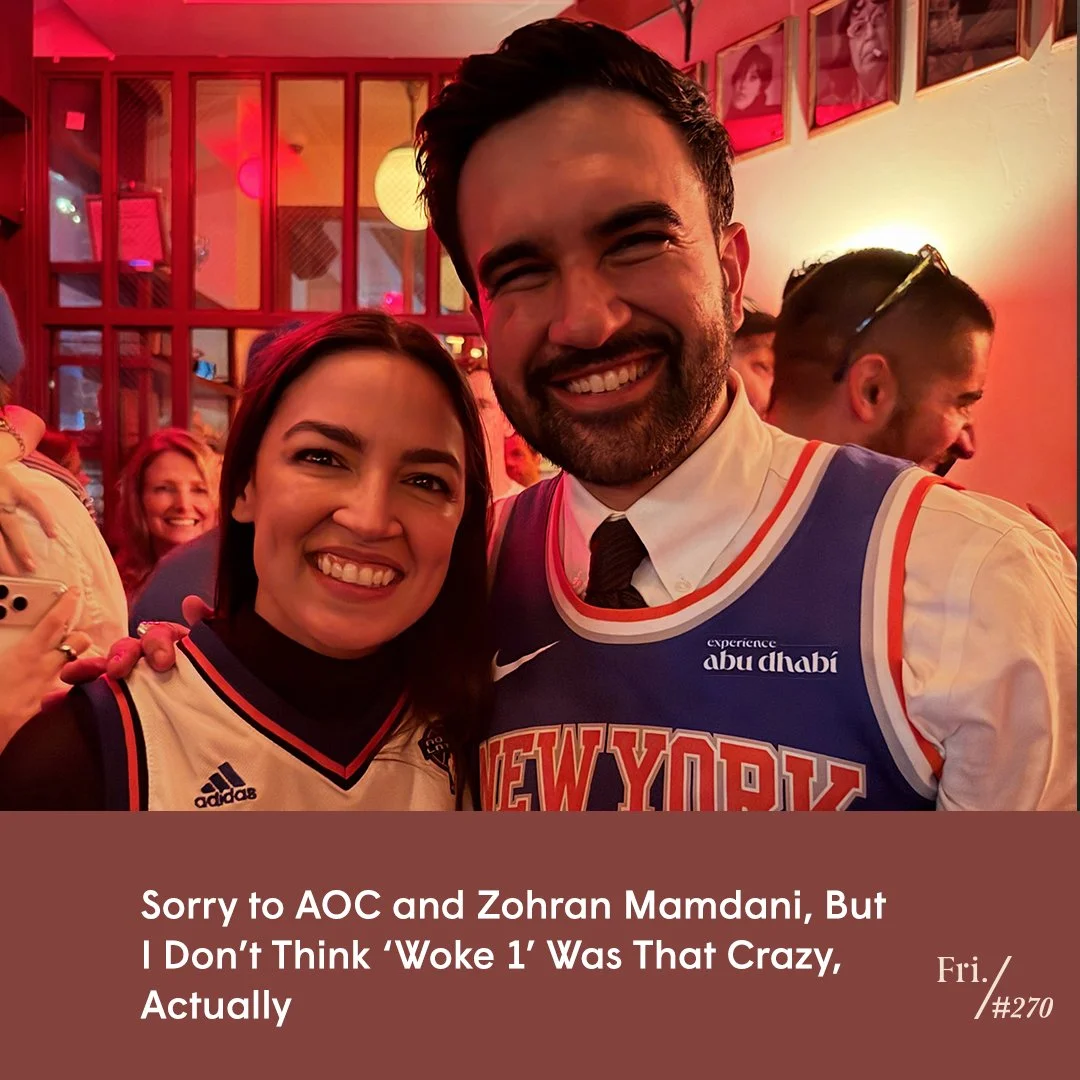
Image: instagram.com/aoc
I think it was the chuckle that did it.
This is convoluted, but stay with me: On Sunday, U.S. congresswoman Alexandria Ocasio-Cortez appeared on ABC’s This Week with George Stephanopoulos to weigh in on topics including Wisconsin’s race for governor, and particularly frontrunner Francesca Hong’s stances on issues like police abolition, which she had previously supported but more recently walked back. (A concession that didn’t secure Hong the governorship, btw; she lost to David Crowley in Tuesday’s election.) Specifically, AOC referenced New York City Council Member Chi Ossé, who coined a catchphrase that has absolutely haunted my social feeds this week.
It happened on X, of course. Back in May, Ossé quote-tweeted a viral Subway Take video where Pakistani-American singer and composer Arooj Aftab argued white people should not be allowed to sit on stoops in Bedford-Stuyvesant, his commentary implying he didn’t agree with Aftab’s argument. When pseudonymous writer Lee Kuan Yimby this you’d him with a screenshot of a 2021 tweet where Ossé had argued the next speaker of NYC’s Council should not be a cis white man, he replied, “Woke 1 was crazyyyy.” What, exactly ‘Woke 1’ meant was not clearly defined. Internet discussions about anti-racism, I guess? But Ossé’s implication was obvious: in 2020, people—including him—were tweeting things like, ‘the people who are elected into political office should reflect the diversity of their constituents,’ but in 2026, he’d become realistic enough to see that was like, so radical (derogatory).
Rep. Alexandria Ocasio-Cortez on her support for defunding the police in 2020: “During lockdown, of course, rhetoric in that time is not rhetoric that we would use today.”https://t.co/dR4cGgbAq4 pic.twitter.com/e8z7EFyQvU
— This Week (@ThisWeekABC) August 9, 2026
I’m sure you can guess from my sarcasm what I think about that, but in the interest of clarity on my part: When AOC chatted with This Week co-anchor Jonathan Karl about Hong’s politics by saying, “I have a local city councilman that has this saying, woke 1 was crazy”—with the aforementioned chuckle, which btw was mad condescending—it really pissed me off. Not just because it felt like (yet another) betrayal of the progressive values that got her elected. Not just because she basically hand delivered a rhetorical bludgeon to conservatives and critics of leftist policies. But also because she’s playing into dishonest, revisionist claims about the conversations that were happening in 2020, and actively undermining not just my, but many other people’s, trust in electoral systems.
This is the total opposite of why people voted for AOC in the first place
In 2018, a then-29-year-old AOC became the youngest woman ever elected to U.S. Congress in a landslide victory, thanks to a platform tailored to “underrepresented constituencies such as Latino and younger voters,” per City & State New York. She campaigned, and won, on promises including Medicare for All; cancelling student debt; a Federal Jobs Guarantee that would mandate a minimum wage of $15, full healthcare and paid child and sick leave; accessible housing; abolishing ICE; and ending the war on drugs, demilitarizing police departments, abolishing for-profit prisons and mandating “automatic, independent” investigations when police kill people, among other justice system reforms. So, it’s not surprising at all that in 2020, after a week where police killed George Floyd, Regis Korchinski-Paquet and Tony McDade, sparking global protests and drawing unprecedented attention to police brutality against Black people (and anti-Blackness in all areas of society) AOC led conversations about defunding the police—which is not the same as abolishing the police, but is often used interchangeably. At the time, she argued that defunding police in America would not lead to the anarchist hellscape fearmongering conservatives were describing, but instead would resemble a white suburb, a perspective she re-upped the following year when Minnesota police officer Kim Potter killed 20-year-old Daunte Wright. “Daunte Wright’s killing was not a random, disconnected ‘accident’ – it was the repeated outcome of an indefensible system that grants impunity for state violence,” she tweeted in a thread that The Independent characterized as “among her most outspoken on police reform.”
Now, she (and Ossé) are laughing off the idea that perhaps state apparatuses should not kill citizens with impunity in what seems like a naked bid to maintain power. (In the same This Week interview, she said she “hadn’t ruled out” a presidential run in 2028, which catapulted her to frontrunner status, at least according to Polymarket’s odds.) So that’s… gross.
Genuinely maddening to have lived through the mass death events and eroding of civil and human rights since 2020 and find out that the great concern of these people is the online arguments they got into with people who annoyed them.
— Zito (@_Zeets) August 11, 2026
Worse than the hypocrisy, though, is the dismissive attitude—and the accompanying implication that calls to defund and/or abolish police were rooted in some kind of mass hysteria. In fact, that part feels like it’s verging on misinformation. As a reminder, while Floyd, Korchinski-Paquet and McDade’s deaths may have provided the spark for 2020’s Black Lives Matter protests, the movement is rooted in decades of anti-racist organizing. Per Politico, calls for prison abolition emerged in the ‘40s, and expanded to include the wider prison-industrial complex in the ’80s and ‘90s. In 2013, when George Zimmerman was acquitted in the murder of 17-year-old Trayvon Martin, Alicia Garza, Patrisse Cullors, and Opal Tometi created the #BlackLiveMatter social media campaign that eventually evolved into a decentralized movement of organizers with chapters in cities across North America. BLM’s growth was directly tied to rising police violence; when police killed Eric Garner in New York City and Michael Brown in Ferguson, Missouri in 2014, and Freddie Gray in Baltimore the following year, it led to another huge wave of organizing against police brutality, including the formation of Campaign Zero, a reform-focused campaign founded by Brittany Packnett, Samuel Sinyangwe, DeRay Mckesson and Johnetta Elzie.
Calls to abolish police are reasonable responses to real injustice
But those calls for reform—including eight policy proposals that Campaign Zero says would decrease police violence by 72%, if only police departments would implement them—went largely ignored, to fatal effect. According to the organization’s Mapping Police Violence tool, U.S. police killed 1,070 Americans in 2013. In 2019, that number was 1,117… and it would continue to rise for the next six years. AND, many of the activists who began fighting against police brutality in Ferguson died under mysterious circumstances in the years following Brown’s killing. So yes, in 2020, the stakes seemed higher, and demands escalated beyond reform. That feels pretty logical to me!
The other thing is, it hasn’t gotten much better? Black people are still 2.8 times more likely to be killed by police than white people. The bare minimum request—putting even a tiny fraction of bloated police budgets toward mental health care and social programs—doesn’t really seem to be happening on a large scale. In fact, cities in the U.S. and Canada are pouring more and more money into policing—and they’re spending that money on “military-like weapons, flashbangs, battering rams and a range of other specialized equipment,” as University of Manitoba assistant professor Tandeep Sidhu explained in The Conversation in 2023. His research found that since 2016, the Toronto Police Emergency Task Force has increasingly resembled a military special force unit, which is troubling, to put it lightly. “By adopting military technology and tactics, police are treating our cities and communities like theatres of war, and treating civilians as the enemy,” Sidhu wrote. “The implied message of such militarized equipment is that the civilian population is a threat and war-like tactics are needed to respond to that threat… These practices contribute to the dehumanization and criminalization of racialized people and those living in poverty [and] undermines public trust in the police and damages the very communities the police aim to serve.”
It's pretty wild that the big politics twitter discussion right now is "did police reform go Too Far" and then the actually existing police reforms are like "they have a camera now that they can just turn off before they shoot you".
— Dok (@Dok845) August 11, 2026
We’re also living in a society that is more organized around surveillance than it was just six years ago, which has clearly led to the further criminalization of Black and racialized people, even when the organization at the core of this criminalization isn’t technically a police force. Take the impact of Flock Safety, a U.S. company that has recently been in the news because its network of traffic cameras have been helping U.S. police officers spy on and stalk their exes, conduct inappropriate searches (i.e., related to immigration status or abortion) and, of course, disproportionately target Black and other racialized people. At the same time, ICE is expanding across America at what Wired calls “breakneck speed,” secretly adding new facilities or expanding existing ones in almost every state. Oh, and its officers will soon be outfitted with high-tech gloves that can deliver electric shocks to the people they’re trying to detain—who are, you guessed it, overwhelmingly Black and brown. (Horrifyingly, these gloves have also been purchased by prisons, jails, hospitals and public schools, according to NPR.)
‘Woke 1 was crazyyyy’ is a gift to conservative commentators
So: AOC, Ossé, Hong and other progressive politicians walking back their support of abolition is a slap in the face, yes. But it’s also actively detrimental. Already, mainstream media outlets, conservative commentators and all manner of anti-anti-racism grifters are using ‘Woke 1 was crazyyyy’ as a kind of political litmus test. Because what better way to determine whether someone is a ‘serious’ politician in 2026 than by asking them whether they’ve abandoned their previously progressive stances, apparently! That’s what happened with New York City mayor and leftist darling Zohran Mamdani, anyway. Mamdani had previously backed down from his pandemic-era opinion that policing is a scourge, but this week he went even further, telling journalists he felt similarly to AOC. “Sometimes what you believe in can change,” he said in an Aug. 12 press junket. “I know there are some for whom they still believe in that. I’ve made very clear that I do not believe in defunding the police and that to me, delivering critical public safety also looks like working with our police department alongside many other partners.” (… Sigh.)
This doesn’t just feel like a rejection of a voting public that worked so hard to put these politicians in office; it also gives conservatives a credible argument that they’re hypocrites who can’t be trusted. In fact, on that same episode of This Week, former New Jersey governor Chris Christie made this exact argument for me, saying, “I listened really carefully to what Congresswoman Ocasio-Cortez said this morning. You know, every position that Scott just laid out, when you presented it to her, she talked about backing off, changing her views, evolving views… there's two parts to this. It's what are you talking about and do we trust what you're saying? And after listening to the congresswoman, why should anyone trust her? The things that she has said previously now, when she senses that she didn't know what she was talking about and she was out of touch with the American people, and now wants to advance her career, now all of a sudden she's saying different things. And I have to say, when you played the Francesca Hong part, I can tell you this, the Republican Governors Association is giddy over what will happen on Tuesday because we're going to hold people like her and the congresswoman to what they've said over their careers, not what they're trying to conveniently evolve into now.”
And this is why whatever AOC meant to communicate in that clip it was a huge blunder. https://t.co/9vTY3aqCze
— Dr. Mia Brett (@QueenMab87) August 11, 2026
This backpedalling also jeopardizes the literal safety of grassroots activists, as Derecka Purnell argued in The Guardian this week. When politicians downplay movements like police abolition and Free Palestine it “puts organizers who continue this work at risk, especially right now,” she wrote. “What time is it when politicians across the political spectrum, from AOC and Ossé to Marco Rubio and Donald Trump, suggest that progressive and left organizers are ‘woke’ and ‘crazy’? It is the time when those who have not yet realized that the demonization of people, organizations and ideas about justice – regardless of where they come from – leads to targeting, surveillance, deportation, imprisonment and death.”
And you know the wildest part of all of this? The back-tracking is probably for nothing. As Hong learned this week—and, I’d argue, Kamala Harris and the federal democrats learned last fall—‘big tent’ politics that sheds so-called radical positions in an attempt to appeal to centrists or conservatives doesn’t actually work. As Christie so perfectly demonstrated, they don’t appreciate your compromises, so you’re not really gaining votes. And, you stand to lose your base, who became invested in your campaign because of your firm stances. As I’ve written before, that’s definitely a thing I’m struggling with. Not that I can vote for any of these people, because I live in Canada. But it’s the lingering question for me: how do we engage in a political system that really doesn’t see a value in serving our needs or prioritizing our interests?
THREAD. Contrary to what you are being told, 40 years of polling have established that shifting money away from police/prisons toward social services is one of the most popular public policies among *all* political demographics. But it's not just that, it goes way deeper. pic.twitter.com/QrV4I3AzcF
— Alec Karakatsanis (@equalityAlec) August 12, 2026
And btw? Even if the language of defunding or abolishing police never gained widespread approval, and now feels actively contentious, the actual practice of reallocating police funding toward social and mental health services has been popular among voters of all political stripes for the past four decades.
So who is this posturing about ‘woke 1’ even for?!
Thank you for reading this week’s newsletter! Still looking for intersectional pop culture analysis? Here are a few ways to get more Friday:
💫 Upgrade to a paid subscription to support independent, progressive lifestyle media, and to access member-only perks, including And Did You Hear About, a weekly list of Stacy’s best recommendations for what to read, watch, listen to and otherwise enjoy from around the web. (Note: paid subscribers can manage, update and cancel their subscriptions through Stripe.)
💫 Follow Friday on social media. We’re on Instagram, YouTube and (occasionally) TikTok.
💫 If you’d like to make a one-time donation toward the cost of creating Friday Things, you can donate through Ko-Fi.