Remember that Time Jenny McCarthy Helped Anti-Vax Sentiment Go Mainstream? Because I Sure Do
By Stacy Lee Kong
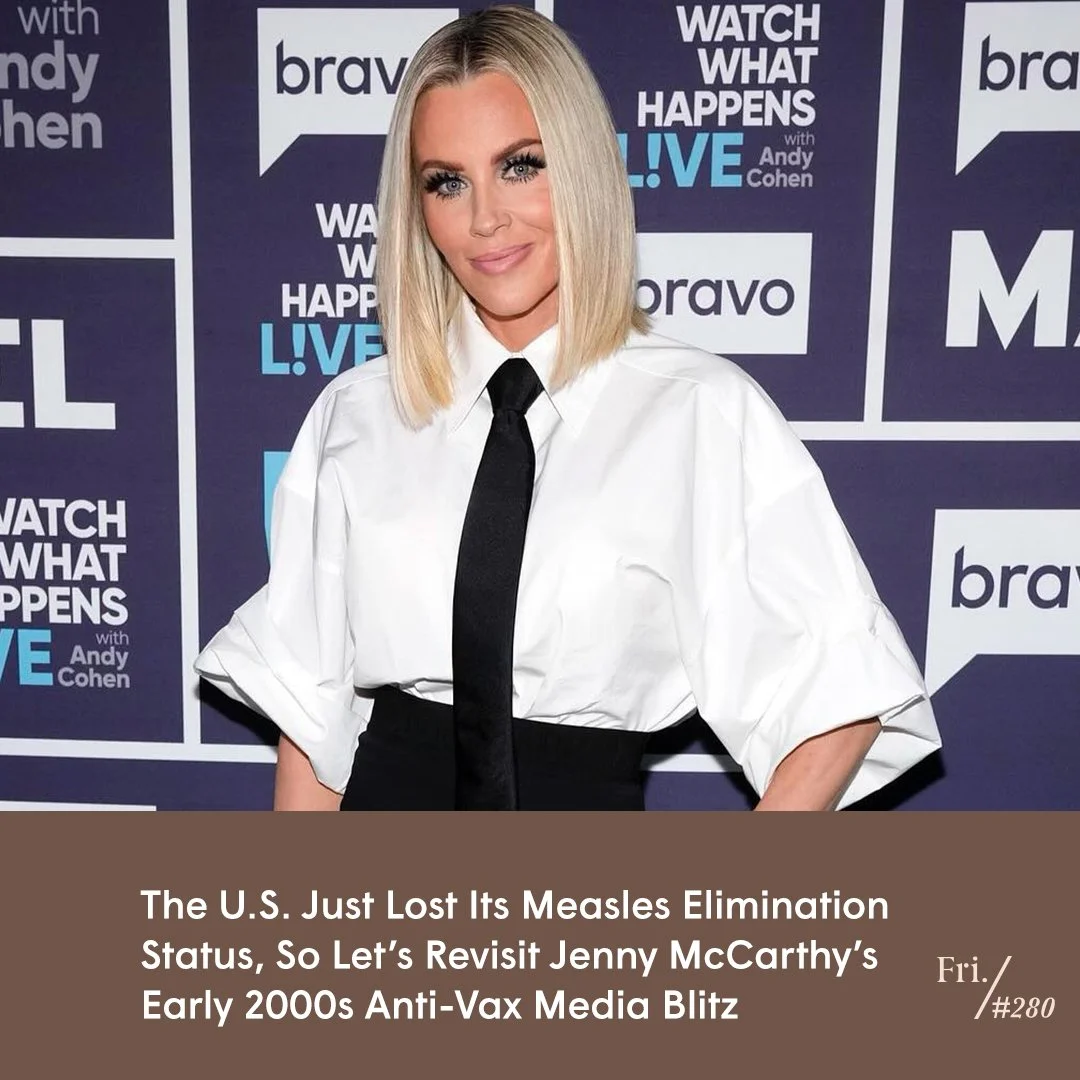
Image: instagram.com/jennymccarthy
This week’s newsletter is brought to you by Reality Revisited

Calling all Bravo lovers! Join us for Reality Revisited: A Housewives Holiday on December 2 at Toronto’s Second City for a festive Real Housewives of New York City rewatch of the iconic “December: Berkshires County” episode. Expect hilarious commentary, games, prizes and a special performance by Canada’s Drag Race star Karamilk. Plus, your ticket includes a free drink! Get your tickets here.
Allow me to take you back to the early 2000s for a moment. Imagine it's 2007, and Jenny McCarthy is on The Oprah Winfrey Show telling millions of people in America—and around the world—that she saw her son’s soul disappear from his eyes after his pediatrician gave him the measles, mumps and rubella (MMR) vaccine. Vaccines, she claimed, were full of dangerous chemicals. They were also given to children too early and too often. And it was her duty to talk about it. Where did the actor and former model gain this expertise, you ask? Oh, she Googled it. As she put it, “the University of Google is where I got my degree from,” which is a truly bonkers sentence that Winfrey responded to by saying, “Thank God for Google.” Twice, and apparently in all seriousness. After the show, McCarthy told Oprah fans that if she had another child, she would not be vaccinating them, a sentiment she repeated on CNN that same year.
Wait, no, it’s 2008, and she’s on Larry King Live telling millions more people that “vaccines play the largest role right now [in triggering autism] and something needs to be done.
Oh, my bad. It’s actually 2009 and she’s telling Time magazine’s science editor, Jeffrey Kluger, “if you ask a parent of an autistic child if they want the measles or the autism, we will stand in line for the fucking measles” (a very ableist POV, by the way) and “I do believe sadly it’s going to take some diseases coming back to realize that we need to change and develop vaccines that are safe. If the vaccine companies are not listening to us, it’s their fucking fault that the diseases are coming back. They’re making a product that’s shit. If you give us a safe vaccine, we’ll use it. It shouldn’t be polio versus autism.”
Vaccines are so effective they created an entire generation of people who think the diseases they prevented weren’t a big deal.
— Lynne (@_ayandamay) November 19, 2026
No, no—it’s 2026, and the U.S. has just lost its measles elimination status alongside Mexico and Bolivia. (Don’t feel smug; Canada lost our elimination status last year.) This means a country has experienced 12 consecutive months of measles outbreaks. In the U.S. specifically, there have been 5,412 measles cases and 10 deaths so far this year; in 2024, there were less than 300 cases. To be clear: a lot has happened in 20 years, and it’s not possible to pin the blame for this massive public health failure on any one person, even someone as irritating as McCarthy. However, she did play an important role in normalizing a deeply dangerous and fringe health opinion, which led to a real social change and helped spur the modern anti-vax movement. And… I’m not willing to overlook that.
McCarthy’s Oprah interview totally legitimized anti-vaccine sentiment
Anti-vaccine sentiment has existed for as long as vaccines have, with childhood vaccines becoming particularly controversial in the past few decades. In the U.K., there was a serious backlash to the pertussis vaccine in the ‘70s after a flawed academic study claimed it could cause neurological problems. This led to tumbling vaccination rates and several whooping cough epidemics. Eventually, this controversy spread to other countries, including Japan and the U.S., and it took years of subsequent studies and public health campaigning to convince parents the vaccine was safe. Meanwhile, controversy around the MMR vaccine started brewing in the late ‘90s with the publication of a study by disgraced scientist Andrew Wakefield in respected medical journal the Lancet. He and his co-authors supposedly identified a link between vaccines and autism, a finding that gained immediate and lasting media attention, even though it was almost immediately refuted by other studies. The study was eventually retracted entirely because he falsified data, didn’t follow ethical research practices and didn’t disclose his conflicts of interest. Still, it was McCarthy’s first Oprah interview (there were several, plus online coverage and even a short-lived production deal) that moved the modern anti-vaccine movement out of the fringes and firmly into the public consciousness. As health journalist Rina Raphael noted in a 2023 newsletter, “by 2008, the percentage of parents who delayed or refused vaccinations climbed to nearly 40 percent, in comparison to 22 percent in 2003. At the American Academy of Pediatrics national conference, pediatricians ‘shared story after story of parents who have refused shots on the basis of what they had seen on Oprah and elsewhere in the media.’”
To be fair, a big part of why that happened was Winfrey’s well-documented love for absolute bullshit; when McCarthy was rambling on about what the University of Google had revealed to her about autism, this iconic and well-respected journalist did not push back on those claims, explain that the opinions McCarthy expressed were fringe or even bring up information that might complicate what viewers were hearing—like, for example, the fact that the CDC conducted or contributed to six different studies between 2003 and 2007, all of which found zero link between childhood vaccines and autism. (Plus more after 2007, of course.) (Also, the CDC’s website now says there is a link, despite all of this science, because U.S. Secretary of Health and Human Services Robert F. Kennedy Jr. is a rabid anti-vaxxer and an embarrassment to his office, but more on that in a moment.)
Jenny McCarthy has so much blood on her hands.
— Ashley Reese (@offbeatorbit) November 17, 2026
We can also place some blame on the other journalists who gave McCarthy a platform; of the interviews I referenced, Winfrey’s was the most welcoming to her anti-vax perspective, but only Time’s Kluger actually pushed back on her claims or cited the most recent science on vaccine safety. We can also criticize Penguin Random House for publishing three McCarthy tomes on autism in three years (Louder Than Words in 2007, Mother Warriors in 2008 and Healing and Preventing Autism in 2009), and the Huffington Post for giving her a platform to call vaccines “injected toxins” and to defend Wakefield. (That blog post has since been removed “in the interest of public health” and replaced with an editor’s note.) And that’s still only a small sample of the media coverage she garnered during this period, which allowed her to spread very harmful misinformation under the guise of being a mom who was just worried about her kid—and all kids, really.
But the lion’s share of responsibility for Jenny McCarthy’s actions lies with… Jenny McCarthy. Seth Mnookin, author of The Panic Virus: The True Story Behind The Vaccine-Autism Controversy, called her “the single most important figure in kind of popularizing this notion vaccines are dangerous and could potentially cause autism.” And I’m not sure her motives were as pure as she claimed. As Raphael pointed out, McCarthy wasn’t just talking about autism to other parents. She was also “carrying on about curing her son through detoxes, vitamin supplements, and specialized ‘free-from’ diets. On her now-defunct website, she sold books, consumer products, and something called a ‘quantum prayer wheel.’ All this, supposedly, was essential to being a good mom—to fighting the good fight.” Bad enough that she was explicitly encouraging parents to avoid vaccinating their children, she was doing it, at least in part, to make money off the very people she was claiming to help. (Interestingly, she began trying to downplay her anti-vax messaging, including with a column for the Chicago Sun-Times where she said she had been wrongly branded anti-vaccine and is in fact strongly pro-vaccine, right around the time she landed a hosting gig on The View. But that was totally unrelated, I’m sure.)
McCarthy’s media tour was the blueprint for other anti-vax celebs, and their influencer successors
Anti-vaccine sentiment basically always circles the same issues: adverse effects, vaccine safety and government overreach. Just ask David Robert Grimes, an adjunct assistant professor in public health at Trinity College Dublin who wrote about vaccine hesitancy for BBC last year: “As contemporary as the anti-vaccine movement might seem today, many of its arguments echo Victorian-era tropes—from the argument that anyone who supports vaccines is being paid off by the pharmaceutical industry, to the false claim that other public health improvements have rendered vaccines unnecessary. The popularity of these narratives, says [David Gorski, surgeon and editor of the publication Science-Based Medicine], are a reminder of the stubborn tenacity of health misinformation. ‘The hesitancy and fear that lead to low vaccination rates are devilishly persistent and driven by misinformation,’ he says.”
There are babies being born with measles in the United States Jenny McCartney and Jim Carrey must pay for their crimes in proliferating the propaganda vaccines, cause autism, therefore causing a severe drop in vaccination and mass inoculation
— ⚜️Sovereign⚜️ (@sauvamemte) November 17, 2026
That hesitancy and fear can be valid, which I’ve written about this before in the context of COVID. Among some communities, vaccine hesitancy can be traced back to years, if not centuries, of medical sexism and/or racism. Many historical healthcare advances happened because of institutionally sanctioned experimentation on Black people. In the Global South, vaccine campaigns have been a way for pharma companies to test drugs on poor patients without their consent or even knowledge. And that’s not even taking into account people’s first-hand experiences with doctors who downplay their pain, blame their symptoms on moral or social failings or otherwise provide them with substandard care. For mothers specifically, this gender bias shows up in how they’re treated by their own healthcare practitioners, but also how their children’s doctors receive their concerns or observations—even though their intuition is actually very trustworthy.
But if we zoom out, I think there’s also something to be said for the impact of weaker social bonds. In the U.K., that whooping cough backlash happened during a particularly dreary time for the country. As VaccinesWork deputy editor Maya Prabhu wrote last year, “trust in public authority is a political question. In the UK in 1974, trust, like the national power supply, was short. The year began in darkness. A global oil crisis and coal miner’s strikes at home led the wrong-footed Conservative government to call for a policy of electricity rationing. A three-day working week was announced in December 1973: starting in the new year, businesses were to shut their doors and turn out the lights out for the week’s remainder. The high streets were forlorn, the economy was in recession, unemployment rates were high, and IRA bombs were going off on the British mainland with some regularity.” Times were hard, the government didn’t seem to be capable of fixing anything and it probably seemed like the best way forward was to look out for yourself and your loved ones—which sounds quite similar to the vibe during COVID. I don’t think this is the only factor; the rise of pseudoscience and religious extremism also play a huge role. And, we can’t necessarily make a direct comparison between the pertussis vaccine backlash and the one for MMR and the one for COVID. Instead, I think it’s more about understanding the social, political and cultural factors that allow these perspectives to take root.
Because to Grimes’ point, these conversations won’t go away. In fact, even as McCarthy was saying less—publicly, at least—about vaccines, other anti-vax voices were gaining popularity, many of them using the exact same framing that she’d normalized: they were parents who are concerned about those adverse effects, had questions around vaccine safety and believed their control over their children’s bodies should be inalienable, regardless of public health guidance or what the science says. In 2018, tattoo artist and beauty CEO Kat Von D ‘came out’ as anti-vax, saying she wouldn’t be vaccinating her unborn son. The following year, Jessica Biel used her celebrity influence to advocate against California State Bill 276, which would crack down on medical exemptions for vaccines. And of course, there’s Kennedy scion/embarrassment Robert F. Kennedy, Jr., whose anti-vaccine sentiment has taken him all the way to the White House—and who has very much taken up McCarthy’s mantle. He has explicitly worked to undermine trust in vaccines, and consequently ushered in a new era of endemic measles in America. And that’s not counting the thousands of regular folks who built platforms on social media solely on the strength of their resistance to government-mandated vaccines.
RFK is trying to distance himself from the return of measles. Dr. Adams brought the receipts.
— Kennedy Debunked (dot org) (@KennedyDebunked) November 18, 2026
A lot of our most recent public conversations about have been about COVID-era anti-vax sentiment, which tends to be more diverse in demographic and motivation than the style of vaccine hesitancy McCarthy has publicly espoused. (Think, Letitia Wright, Nicki Minaj, James Van Der Beek and so, so many wellness influencers, who shared similar views on vaccines, but for different reasons and to different degrees.) But I think we can all agree that she was a pioneer in talking publicly about vaccines and vaccine hesitancy—and that makes her an important figure to remember this week, as the consequences of vaccine hesitancy (and poor public health messaging, government inaction and irresponsible health journalism) come to fruition.
Thank you for reading this week’s newsletter! Still looking for intersectional pop culture analysis? Here are a few ways to get more Friday:
💫 Upgrade to a paid subscription to support independent, progressive lifestyle media, and to access member-only perks, including And Did You Hear About, a weekly list of Stacy’s best recommendations for what to read, watch, listen to and otherwise enjoy from around the web. (Note: paid subscribers can manage, update and cancel their subscriptions through Stripe.)
💫 Follow Friday on social media. We’re on Instagram, YouTube and (occasionally) TikTok.
💫 If you’d like to make a one-time donation toward the cost of creating Friday Things, you can donate through Ko-Fi.