I’m Once Again Asking You to Pay Attention to Gaza
By Stacy Lee Kong
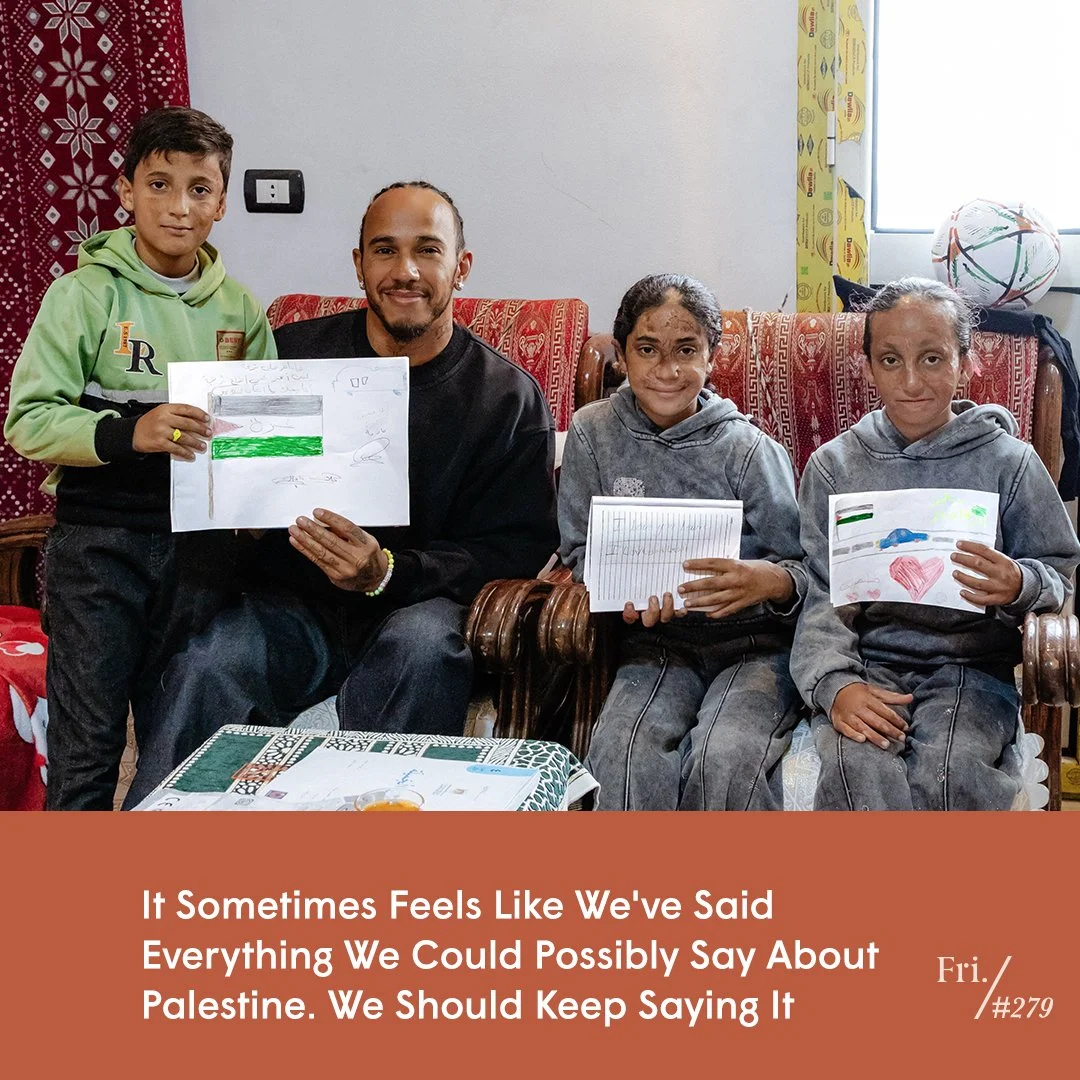
Image: instagram.com/lewishamilton
A note on language: As I’ve mentioned in every newsletter I’ve written about Gaza since October 7, it’s super important that we take care with our language when discussing Israel and Palestine, because the way we talk about this situation has real consequences for real people. So to be clear, when I critique the Israeli government and military, I am not critiquing all Israelis, much less all Jewish people. Characterizing critique of Israel and the Israel Defense Forces (IDF) as antisemitic is inaccurate and unproductive. Furthermore, it is disingenuous and actually dangerous to conflate Zionism with Judaism, as this list of prominent Jewish writers has argued. Lastly, when I use the words colonization, genocide, apartheid, occupation and ethnic cleansing to describe Israel’s actions, that’s based on the analysis of organizations like Amnesty International, Human Rights Watch, Israeli human rights group B’Tselem, the International Federation for Human Rights, the United Nations, the Center for Constitutional Rights, Jewish Voice for Peace, the International Association of Genocide Scholars, as well as other academics who study genocide, legal experts and South Africa’s application to the International Court of Justice to bring genocide charges against Israel. It is also based on the language Israeli officials and public figures have used themselves, 500+ instances of which have already been collected by Law for Palestine.
Sometimes, I feel like I’ve said everything I could possibly say about Israel’s genocide in Palestine: Palestinian people are deserving of basic human rights just like anyone else, and this really should not be controversial; it is disorienting and destabilizing to realize we can all see the same information but interpret it in such wildly different ways; celebrities are not good sources of moral or political guidance, but they are useful marketing tools—and accurate indicators of public opinion; Western media is incredibly Islamophobic and severely biased against Palestinians in particular, this has definitely gotten worse and this is not only wrong, it’s also very short-sighted because it contributes to declining trust in journalism; those of us who work in media would do well to remember the importance of accuracy and care in our reporting; there is a real need for radical hope in liberation movements; forever reminder that our liberation is linked.
Which is to say, it’s been almost three years since October 7, and the longer Israel continues to bomb hospitals, block aid from entering Palestine and suppress any criticism of its actions, the harder it is to find a ‘new’ angle to write about. This is obviously not a complaint, because ‘how do I write about genocide in fresh new ways’ is not a real problem. I’m more saying this as a pre-emptive explanation: the next 1,500 or so words may sound a bit familiar if you’ve been reading for a while. But after a week where I saw more social media posts praising Lewis Hamilton’s visit to the Egypt-Palestine border than about babies freezing to death, people wading through dirty floodwater after heavy rainfall (flooding that was worsened because Israel has destroyed Gaza’s stormwater and sewage infrastructure) and the IDF bombing Nasser Hospital despite an ostensibly binding ceasefire, I feel compelled to revisit some of the things we’ve already discussed.
I think we can expect more from our public figures now
The first time I wrote about Palestine in a newsletter was in 2021, when conflicts between Palestinian residents and Israeli authorities in the East Jerusalem neighbourhood of Sheikh Jarrah gained international attention. The residents were protesting the forced displacement of 58 people who were set to be evicted from their homes so they could be occupied (stolen) by Jewish settlers. At the time, I was arguing that a then quite surprising wave of celebrity support was linked to 2020’s racial reckoning, which normalized conversations about injustice, resistance and liberation for a wide range of people. Looking back at that time, I think increased awareness of colonization, land back and collective responsibility probably played into it, too. But what’s most relevant to this conversation is how pleased I was to see so many celebrities speaking out… and how little I expected of them. I don’t think any of the stars I mentioned in that newsletter, a list that included Rihanna, Steven Yeun, Yara Shahidi, Viola Davis and Trevor Noah, used the word ‘genocide,’ or went further than name-checking the oppression Palestinians were facing—though, to be fair, I don’t think I used the word genocide, either. But I still thought it was important and praise-worthy to see them post about this oppressed group of people, especially considering how much pressure there was to stay quiet. (Of course, if anyone can resist that pressure, it’s the wealthy people who have lots of social capital, right?)
Five years later, we are in a very different moment. To be blunt: I’m glad Shawn Mendes finally feels brave enough to say Free Palestine, but I think the fandom response—that is, showering him with praise about how brave it was to do so—is a bit much. I understand that Zionists place immense pressure on celebrities and public figures when they even carefully criticize Israel, much less use the ‘g-word,’ and yes, the more people who are speaking up, the better, even if it has taken a long time to do so. But can we at least agree that it has been three entire calendar years of seeing atrocity after atrocity play out on all our screens, which makes this actually just the bare minimum?
This is not to say that celebrities using their platforms to advocate for oppressed people in general and Palestinians in particular holds zero value. As we discuss all the time, there are good reasons not to depend on celebrities for moral or political direction, but they are very effective at spreading political information and normalizing the types of conversations I think we all should be having about power, privilege, identity and oppression. If Mendes’ post acts as a gateway to new knowledge for some of his fans, or shows another celebrity that it’s safe, or at least worth it, to speak up themselves, that is absolutely a win. It’s also, as I admitted a few weeks ago, comforting when public figures demonstrate a shared sense of humanity, not to mention a shared reality. (I really can’t overstate how discombobulating I find it when we’re all looking at the same photos and video footage of maimed children, dead bodies, destroyed cities and horrific living conditions, only some of us see a richer, politically powerful country committing genocide against much less powerful group of people, while others believe we’re looking at a proportionate response in a conflict between equally resourced countries.)
But can we at the very least develop a sense of scale? Celebrities making Instagram posts asking people to pay attention to Gaza and to donate to humanitarian organizations is just normal behaviour. Stars have been making advocacy part of their personal brands forever. We don’t have to talk about it like he’s doing something extraordinary.
Omission is an editorial choice
That being said, I don’t mind acknowledging when celebrities do things that are actually extraordinary, and involves real risk to their careers and/or personal safety. Macklemore going up against some of the wealthiest and most powerful people in America? Noteworthy. I’ll also give Lewis Hamilton credit for visiting Egypt’s Rafah border crossing to meet with the aid organizations that are trying to get food, medicine and other necessities into Gaza. “At Rafah border, I saw food trucks lined up ready to go, but they're regularly not allowed in or face major delays,” he wrote in his first of two posts. “The first driver in line that I spoke to had already been waiting over 12 hours. At the nearby logistics centre, I saw the hard work of the aid workers, but I also saw what gets rejected for crazy reasons. Sleeping bags, first-aid kits, medical equipment, wheelchairs, even footballs for kids. Israel needs to fulfil its obligations under the ceasefire and let the aid trucks in. No excuse.”
Dragnet's first dispatch from the besieged Gaza Strip: Dragnet contributor @Tamer_Alnoaizy spent hours walking through tents in Gaza's flooded displacement camps, where Palestinians whose homes and neighborhoods were destroyed by Israeli bombs are now sleeping in freezing water. https://t.co/Mh60okCq9q
— Dragnet (@draagnet) November 10, 2026
Of course, I’d still prefer if we didn’t make every celebrity’s approach to Gaza a referendum on their relative goodness, and instead focused on what they are asking of us—and, in this case, how that ask is being discussed in Western media. Hamilton’s post wasn’t a general message in support of Palestinian liberation; it was an attempt to call attention to the ongoing blockade, which goes well beyond food trucks. Despite a legal obligation to allow humanitarian aid into this occupied territory, Israel won’t allow engine oil and generator parts into Gaza, which means hospitals can’t run incubators, or air conditioning, or X-ray machines, or even sterilize their medical equipment. Desalination plants can’t work at full capacity. Bakeries and flour mills also depend on generators, which means food security can be impacted, and ambulances, buses and aid trucks need engine oil to run. The flooding we were all reading about this week was due to the first winter storm of the season; more bad weather will come, yet tents, tarpaulins, winter clothing and other equipment are only trickling into Gaza, and certainly not quickly enough or in adequate quantities to actually meet the needs of displaced Palestinians.
And yet, a lot of the reporting I read about Hamilton’s visit seemed satisfied to simply quote him instead of giving more of this important context. I even saw a couple of headlines that glossed over Palestinians entirely, instead framing their coverage around Israel’s response to Hamilton’s ‘accusations.’ (Which I’d probably characterize as statements of fact based on first-hand observation, but what do I know?) Worse yet, I saw far more articles about Hamilton than I did about the flooding and resulting deaths, or about the air strike on Nasser Hospital, which is one of only 20 hospitals in Gaza that is partially functional. (According to the World Health Organization, “the Gaza Strip’s health system has been systematically degraded by sustained attacks, with all 36 hospitals and the majority of primary health care centres damaged. Since October 2023, over 930 attacks on health have been recorded. Currently, only half of all hospitals are partially functional, with many operating beyond capacity. Just 48% of primary health care centres remain operational.”) I think it's important for us, as consumers of media and also just as humans, to note not just what gets covered, but how. I saw a tweet quoting former New York Times executive editor Dean Baquet as saying, “omission is an editorial choice” and while I couldn’t find a direct source for that, I do think the sentiment is both true and important. Who gets centred, who gets quoted, whose opinion is upheld as valuable expertise and whose observations are simply added for ‘colour’? These framing decisions communicate a lot to readers about what, and who, is important, credible and meaningful.
📍NEW 📍Sick Kids Hospital surgeon, Dr. Blayne Sayed, returned from Nasser Hospital last week. Any media that doesn’t forcefully pushback on these abhorrent lies Israel is spreading, is complicit in these crimes and guilty of a dereliction of duty. https://t.co/XUXjGH0cW2
— Samira Mohyeddin سمیرا (@SMohyeddin) November 12, 2026
For example: Last week, SickKids doctor Blayne Sayed came back to Toronto after volunteering at Nasser Hospital. Broadcaster Samira Mohyeddin just interviewed him about what he saw in Palestine, and as far as I can tell, she’s the only journalist who has done so. Why doesn’t any other outlet in Canada, or even just Toronto, think that’s a newsworthy story?
We are morally obligated to hold onto hope for a better future
I… have not felt very hopeful this week. I keep thinking about the videos that keep coming across my social feeds of people wading through grey, disgusting-looking water, or holding up their water-logged belongings. They’re never wearing enough layers. So often, their babies and children are right there in that dirty water with them as they beg for the tiniest sliver of human dignity. And then I look around my life, at the Christmas ornaments I just bought and the flowers on my mantel and the Uber Eats delivery I opted for because I didn’t feel like cooking, and it all starts to feel incredibly dystopian.
This is especially the case when combined with other, adjacent news, like the University of Toronto’s decision to reject an internal working group’s report on Islamophobia and anti-Arab and anti-Palestinian sentiment on campus. In the executive summary of the 175-page report, the working group says, “in our consultations with staff, students, faculty, librarians and administrators across the three campuses, we encountered a general pattern of over-policing and under-protecting speech, research, and advocacy by or on Muslims, Arabs, and especially Palestinians [emphasis mine], inconsistent with the University’s Statement of Institutional Purpose… Members shared with us their perception of procedural inconsistencies in informal meetings and formal complaints processes related to speech; content-specific enforcement of postering and protests guidelines, procedures, and policies; and dubious metrics of risk and safety assessments.” It’s bad enough that this working group—which, I must stress, is made up of University of Toronto’s own employees, students and community—found so much evidence of discrimination, but the university’s reason for rejecting the report and its 22 recommendations is worse. According to one of the report’s authors, the school said “while we expect that the Working Group’s report will validate the experiences of many members of our community, aspects will also be offensive to other members of our community, including some Jewish and Israeli colleagues and students.”
Absolute bombshell report on the rampant anti-Muslim, anti-Arab, and anti-Palestinian discrimination at @UofT. There is an entire section on the Faculty of Medicine @uoftmedicine. The report captures a small fraction of the stories of UofT staff, students, and faculty who have experienced racism, targeting, procedural unfairness, and professional and educational repercussions. In what I believe is an unprecedented move, UofT has rejected the report and its recommendations. It is interesting whose feelings appear to matter and whose lives seem to have lesser value. Read the full report here: https://t.co/gLhVI51WcR
— Kavita Algu (@KavitaAlguMD) November 12, 2026
To which I can really only say, is this real life? 175 pages of meticulously documented racism against one group of people across departments—including professors telling students that there is a link between Islam and political violence; insinuations, or explicit statements, about the inherent violence of Muslim people; double standards when discussing Israel and Palestine, especially as compared to Russia and Ukraine—but the school won’t accept it because doing so may upset some members of another group of people? What?
So, on one hand, yeah, of course the institutional racism, academic corruption, disappointingly biased news outlets and galaxy-brained stans have felt overwhelming. However! There have also been reasons to feel hopeful in recent weeks; the Blue Wave in the American midterm elections is a great sign, particularly the way young people aggressively shifted left compared to 2020’s election cycle. Affordability was a key driver of this swing, but corruption and the dismantling of American democratic systems also drove voters, per two Rutgers University experts. I think it’s likely Palestine played a role in how people thought about corruption and democracy, especially among younger and racialized voters. And, incoming senator Abdul al-Sayed’s landslide victory in Michigan, which I’d argue is at least partially related to his straightforward, common sense messaging around Palestine—and his refusal to engage with theatrical, bad-faith questions about some Jewish people’s discomfort with that messaging—is another positive change. So is the fact that Palestine has become a load-bearing issue for people around the world. It illuminates so many issues, and highlights just how connected this world really is.
This is Gaza which turns pain into hope https://t.co/gZ14xX5en3
— Motasem A Dalloul (@AbujomaaGaza) November 13, 2026
Earlier, I wrote that we are in a very different moment than we were in 2021. I meant that we’ve seen so many horrors that what once felt sufficient no longer does. But I guess this is the hopeful part: we’ve also seen real change. Incremental and small, yes. But real, and ongoing—and that matters, too.
Thank you for reading this week’s newsletter! Still looking for intersectional pop culture analysis? Here are a few ways to get more Friday:
💫 Upgrade to a paid subscription to support independent, progressive lifestyle media, and to access member-only perks, including And Did You Hear About, a weekly list of Stacy’s best recommendations for what to read, watch, listen to and otherwise enjoy from around the web. (Note: paid subscribers can manage, update and cancel their subscriptions through Stripe.)
💫 Follow Friday on social media. We’re on Instagram, YouTube and (occasionally) TikTok.
💫 If you’d like to make a one-time donation toward the cost of creating Friday Things, you can donate through Ko-Fi.