Post-BAFTAs, I Think We All Need to Read About Access Frictions
By Stacy Lee Kong
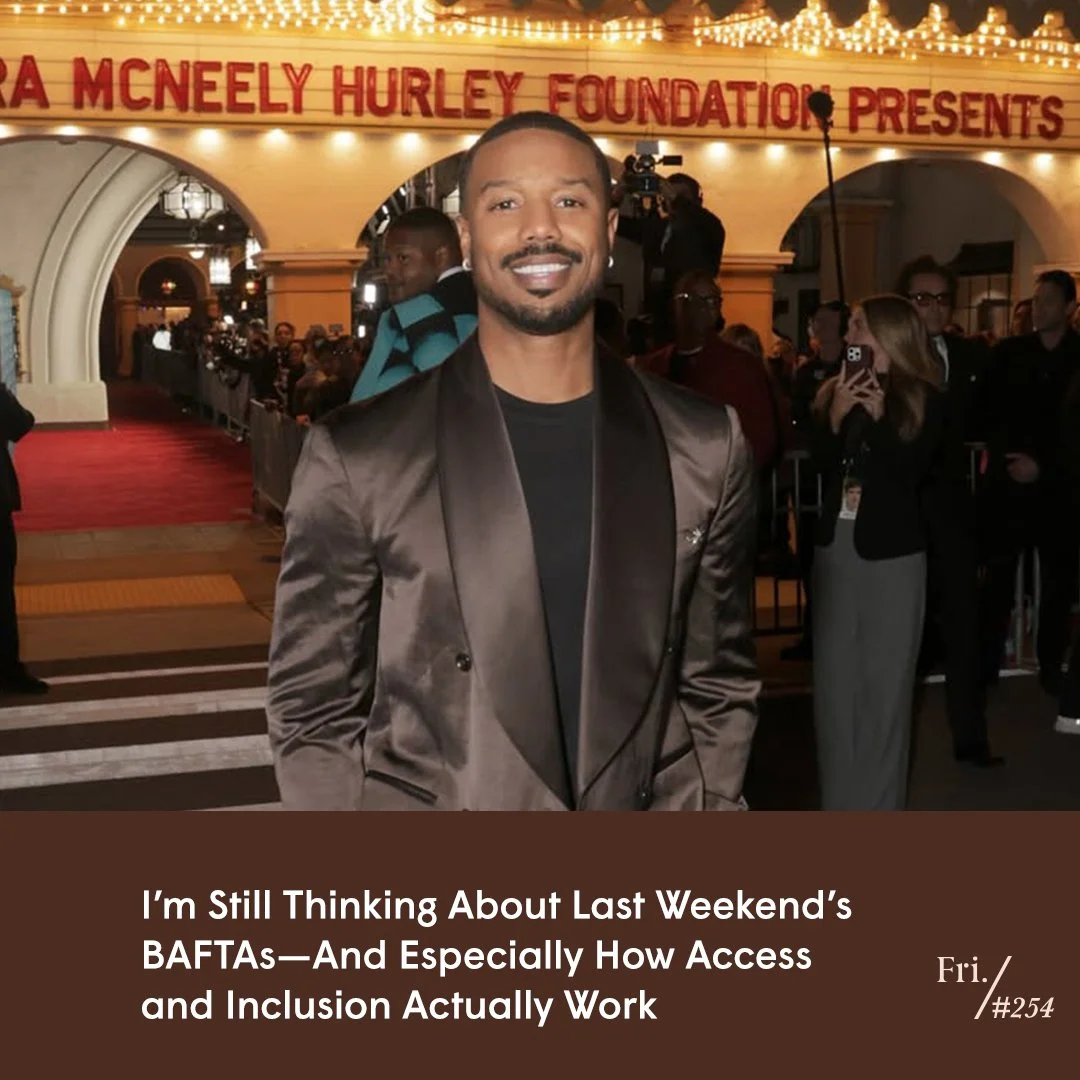
Image: instagram.com/sinnersmovie
Last summer, the BBC “sparked a national scandal” after it streamed punk rap duo Bob Vylan’s performance at Glastonbury Festival, where the band led the audience in chants of “Free Palestine” and “death to the IDF.” Those chants led to a police investigation, though no charges were laid. Still, the U.K. broadcaster was sooooo shaken by the political statements and ensuing controversy that it made a specific plan to monitor the BAFTA broadcast “closely” as a result. Apparently, as Deadline reported days before the Feb. 22 event, “the Bob Vylan debacle last summer has been a feature of contingency planning for the BAFTA Film Awards, with BBC executives and external producers at Penny Lane Entertainment keen to avoid screening any similarly controversial moments, should they occur.”
It went super well, of course… which is why I’ve talked more about the BAFTAs this week than I have in my entire life.
Okay, but no. What actually happened was, BBC and BAFTA execs sparked an even bigger scandal, this one international, after they aired audio of BAFTA honoree John Davidson, who has Tourette syndrome, yelling out the n-word while Sinners stars Michael B. Jordan and Delroy Lindo were on stage presenting an award. Though Davidson was seated about 40 rows back in the auditorium, he was, somehow, close enough to a live mic that the slur was audible throughout the room; spend a few minutes on social and you’ll actually see the moment that Jordan and Lindo heard it. The incident was pretty terrible for everyone involved: Davidson, who was there to celebrate I Swear, a biopic based on his life that details the social isolation and stigma he experiences due to his disability; Jordan and Lindo, who were subjected to a racial slur while at work; every other Black person in the room, who have largely been left out of the conversation but who also had to hear a racial slur while at a work event; and every Black person who watched the broadcast before the slur was, eventually, removed.
It's honestly a little on the nose that BAFTA superficially celebrated Black and disabled stories while doing nothing to materially support those communities, ultimately leaving those communities behind and fueling further division. The ultimate metaphor for neoliberalism.
— Daniella (@DaniellaMazzio) February 23, 2026
It was a perfect storm for discourse, which has of course been raging all week, increasing in tone and tenor every time another BBC misstep was uncovered. Oh, the broadcaster aired the BAFTAs on a two-hour delay, so they could have cut this slur to minimize its impact and just… opted not to? Oh, they left it in, even though they did remove the words “free Palestine” and references to genocides in Congo and Sudan from filmmaker Akinola Davies Jr.’s acceptance speech? Oh, they also removed the rest of Davidson’s tics, which included other slurs (including another racial slur that hasn’t been identified) and obscene language? Oh, the audience may not have been adequately warned about his tics? Oh, host Alan Cumming’s explanation for the slur was milquetoast at best, asking for understanding for Davidson and using the phrase, “we apologize if you were offended”? Oh, BBC producers first claimed they didn’t hear the slur, until Variety reported that Warner Bros., the studio behind Sinners, contacted the film academy immediately, asking it to remove the slur before the broadcast? Oh.
All of which is to say, I’ve spent a lot of time this week reading about this incident through the lens of opposition: Tourette’s vs. anti-Blackness, disability justice vs. racial justice, accommodation vs. the expectation of safety. Honestly, it has been informative, in some ways expansive—and yes, often frustrating. With each new revelation, I keep returning to the same questions: Do we truly believe our liberation is linked? And if so, what do we owe one another when we cause harm, inadvertently or not? Because as we move toward a more intersectional, less siloed approach to anti-oppression work, the more chances there are to get it wrong. Not to say that the BAFTAs are a space where that type of work is actually going on, of course. But they are a microcosm for what happens when different groups with different needs find themselves co-existing.
Davidson’s intent doesn’t undo the impact of shouting the n-word
From the jump, let’s be clear that none of this is Davidson’s fault. As part of his condition, he has coprolalia, which is involuntary, uncontrollable swearing and use of obscene language. The n-word is one of his tics. This language is unconscious and unintentional, contrary to some of the most ableist comments I’ve seen, including from Jamie Foxx. That means shouting this slur doesn’t reflect some kind of hidden opinion or agenda, and it isn’t itself a sign of latent racism. In fact, after the ceremony, he released a statement and did an interview with Variety where he stressed his lack of intent. He didn’t mean to, or want to, cause harm to anyone. This perspective was emphasized by some disability advocates, who were trying to mitigate misinformation about what Tourette’s is, explain how it actually works and shield Davidson from more harm. But in the process, they consistently minimized the impact of hearing the n-word with reasoning ranging from ‘they’re millionaires; they’ll be fine’ to ‘it’s just a word’ to ‘Tourette’s is a disability, so it can’t ‘do’ racism.’
Antiblackness is the Grammar of the World: The BAFTAS and the Aftermath by @SherrondaJBrown @DaShaunLH and @colonizedlocal pic.twitter.com/og0zGqpyBt
— Scalawag (@scalawagmag) February 26, 2026
But… the focus on intent is a logic that doesn’t actually hold. As Scalawag magazine explained in a very thoughtful X thread by Sherronda J. Brown, Da’Shaun L. Harrison and Tea Troutman, “Tourette syndrome does not create its own vocabulary. Coprolalia pulls language from what the world has already made legibly taboo. In a world structured by anti-Blackness, the linguistic archive is always already shaped by the idea that attacking Blackness is the ultimate infliction of harm. This isn’t about individual intent or blaming disability. Rather, this is to say that even involuntary speech is shaped by a collective unconscious structured by anti-Blackness. The tic reveals a larger truth: anti-Blackness is the grammar of the world, and it shapes what even the body can say without choosing.” (The whole piece is very, very good; I highly recommend reading.)
We also have firsthand accounts of the impact of hearing a slur in this context; at the Warner Bros. BAFTA after-party, Lindo only told Vanity Fair that “he and Jordan ‘did what [they] had to do’ while presenting—but that he also wished ‘someone from BAFTA spoke to [them] afterward.’” But Sinners production designer Hannah Beachler went into more detail on X, saying, “I keep trying to write about what happened at the BAFTAs, and I can't find the words. The situation is almost impossible, but it happened 3 times that night, and one of the three times was directed at myself on the way to dinner after the show. And a third time at a Black woman. I understand and deeply know why this is an impossible situation. I know we must handle this with grace and continue to push through. But what made the situation worse was the throw away apology of ‘if you were offended’ at the end of the show. Of course we were offended...but our frequency, our spiritual vibration is tuned to a higher level than what happened. I am not steal [sic], this did not bounce off of me, but I exist above it. It can't take away from who I am as an artist.”
I keep trying to write about what happened at the BAFTAs, and I can't find the words. The situation is almost impossible, but it happened 3 times that night, and one of the three times was directed at myself on the way to dinner after the show.
— HannahBeachler (@HannahEBeachler) February 23, 2026
The vocabulary words of the week are ‘access frictions’
Of course, there is blame to be placed, and it belongs squarely on the institutions that allowed—or perhaps it’s more accurate to say orchestrated—this situation. I’m not saying that to be a conspiracy theorist, although it is a little suspicious that Prince William is the president of BAFTA and this incident occurred just days after his uncle, Andrew Mounbatten-Windsor (fka Prince Andrew), was arrested on suspicion of misconduct in public office. But actually, I just mean that both of these institutions put processes in place that basically ensured something bad would happen during the ceremony, and that it would go super viral. According to Davidson, BAFTA promised all swearing would be edited out of the broadcast, which it obviously wasn’t, and also placed a microphone “just in front of” him. There are conflicting accounts, but it doesn’t seem people in the room or those watching at home were properly briefed on what Tourette’s tics can entail. (I think we can all agree that even if you give people a head’s up about potential “offensive language,” this does not immediately bring to mind the worst racial slur in our society.) And, BBC and BAFTA released conflicting statements and delayed apologies, and didn’t actually remove the slur from the broadcast until the morning after the ceremony. Taking all of that into account, this incident starts to feel less and less accidental.
It’s not just me. As a person who’s neither Black nor disabled, the voices I found most helpful this week were those who are both, and especially Black people who have Tourette’s. I personally learned a ton from @twitchyspoonie on X, who pointed out that BBC and BAFTA largely ignored the accommodations Davidson asked for, part of a pattern of behaviour that is unfortunately all too common among our society’s biggest institutions.
Why is no one talking about how the BBC obviously deliberately chose to exploit a disabled man’s disability and the trauma of two black men for clicks and outrage farming?
— emily 💍 comms closed (@moonlarking) February 23, 2026
I guess that’s to be expected based on, uh, the history of the world. But it’s all the more frustrating because the idea that different communities might have different needs is pretty basic. In fact, it’s the underpinning of a concept called access frictions, which I just learned about this week. According to Calling Up Justice, a collective focused on disability, racial and gender justice, “access frictions refer to the challenges and barriers that individuals face when trying to access resources, services, or activities. These barriers can arise due to various factors, such as physical, sensory, or cognitive disabilities. Access frictions can occur when serving one access need creates an access barrier for someone else [emphasis mine]. In the context of disability, access frictions are the obstacles that disabled people face when trying to access everyday services that non-disabled people often take for granted… While access frictions are primarily associated with disabled people, the concept is useful in non-disabled exchanges as well.” It’s that bolded line that I think is most relevant here; what we’re actually talking about is two marginalized groups who both deserve access to a space, but whose needs might be in conflict with one another. This doesn’t mean that one takes precedence over the other—it means the onus is on the organizers of the event to implement the right accommodations so that everyone’s needs are met. It’s also something I found within like, five minutes of Googling, because it’s an existing framework within disability communities. Why didn’t anyone at BAFTA or BBC think about this concept during their oh so careful planning for the award ceremony?
Only, we know the answer. For that to occur, organizers and society at large had to see those groups not only as equally deserving of access, but in fact as overlapping. Black people with Tourette’s exist, and face even more profound stigma and potential harm because of the compounding nature of racism and ableism. And that’s what I think has been missing from this conversation. U.K. charity Tourettes Action responded to Foxx’s ableist Instagram comments with a lengthy statement that said, in part, “What should have been a night of celebration for [Davidson] became overwhelming, and he made the difficult decision to leave the ceremony halfway through. This moment reflects exactly what I Swear shows so openly: the isolation, misunderstanding, and emotional weight that so often accompany this condition.” This is a tragic outcome, and one that should never have happened. But it’s telling that this org, and so many other disability advocates, didn’t perceive the night as celebratory for Jordan, Lindo, Beachler or any of the other Black people who were at the BAFTAs that night. Just as telling was BAFTA’s official statement, which came two days after the event and was mostly focused on the harm Davidson experienced, with just one mention of the Black people who were also harmed.
So: what do we owe one another?
However. Even though I wholeheartedly believe any blame lies with institutions, I do think there’s an important conversation to be had about Davidson’s responsibility. His initial statement reflected on how mortified he was that anyone might consider his “involuntary tics to be intentional or to carry any meaning” and urged people to watch I Swear to better understand what living with Tourette’s is like. Notably, he did not apologize, which became a point of contention in the discourse. On one side, there were people passionately explaining that no one should have to apologize for their disability, or for being disabled in public. On the other, people were asking Davidson to acknowledge his impact and apologize for the harm caused, even if he didn’t mean to hurt anyone. So far, he hasn’t made any additional public statements directly addressing members of Sinners cast and crew, though, according to the introduction to his interview with Variety, he has “reached out to the studio handling Sinners in order to directly apologize to Jordan, Lindo and production designer Hannah Beachler.”
I'm still on no sleep, but I just wanted to acknowledge this and say it's not enough and shows John Davidson, while he understands this word causes distress, never took the time to fully understand and account for the impact of him ticcing the n word. https://t.co/CuLC2c54iT
— TheDisabilityEnthusiast (@twitchyspoonie) February 24, 2026
But no one’s really happy. Some disability advocates are frustrated over the expectation of public remorse. Many racial justice advocates are upset that his apology is private when the harm was so, so public. And here's the thing: I understand the politics of not publicly apologizing for your disability. I agree that it would be an undue burden to apologize after every tic. But I think the resistance to acknowledging how harmful this tic was—from the institutions that have released their official statements, yes, but also from Davidson himself—makes this entire news cycle so much worse. Scottish rapper and social commentator Darren McGarvey published an explanation of why Davidson’s post-BAFTA statements haven’t landed on his Substack, and it beautifully illustrates the disconnect: “John’s subsequent comments in Variety, while offering more context and attempting to clarify what happened, arguably still fall short in one crucial respect. They continue to foreground explanation over acknowledgment. What remains largely absent is a clear, unambiguous recognition of the distress caused in that room at the moment of impact.”
I think it’s important to resist the oppositional framing that this discourse has naturally fallen into, obviously, but I do want to explicitly acknowledge that whiteness and white supremacy have a hand in this, too. Yes, it’s very human to use an apology to defend yourself (see: every celebrity apology for bad behaviour ever, basically), but it would be stupid to pretend that there aren’t other things at play here. Like: the widespread belief that Black people do not feel pain the way white people do, the overarching devaluation of Black people’s cultural contributions and the belief that slurs aren’t ‘real’ violence. (Which, they are.) Also, I think there were a lot of people who were just thrilled to have an excuse to be racist under the guise of disability justice. None of this is Davidson’s fault either; as Scalawag explained so beautifully, we are all steeped in anti-Blackness because we live in this society. But he does have responsibilities to his fellow human beings.
Which is why I wish he’d just said, “I’m sorry for the harm I caused, even though I didn’t intend to” like, five days ago. After all, that’s something we all learned to do as children.
Thank you for reading this week’s newsletter! Still looking for intersectional pop culture analysis? Here are a few ways to get more Friday:
💫 Upgrade to a paid subscription to support independent, progressive lifestyle media, and to access member-only perks, including And Did You Hear About, a weekly list of Stacy’s best recommendations for what to read, watch, listen to and otherwise enjoy from around the web. (Note: paid subscribers can manage, update and cancel their subscriptions through Stripe.)
💫 Follow Friday on social media. We’re on Instagram, YouTube and (occasionally) TikTok.
💫 If you’d like to make a one-time donation toward the cost of creating Friday Things, you can donate through Ko-Fi.