
MJ Corey is Keeping Up With *All* The Kardashian-Adjacent Media Theories
By Stacy Lee Kong
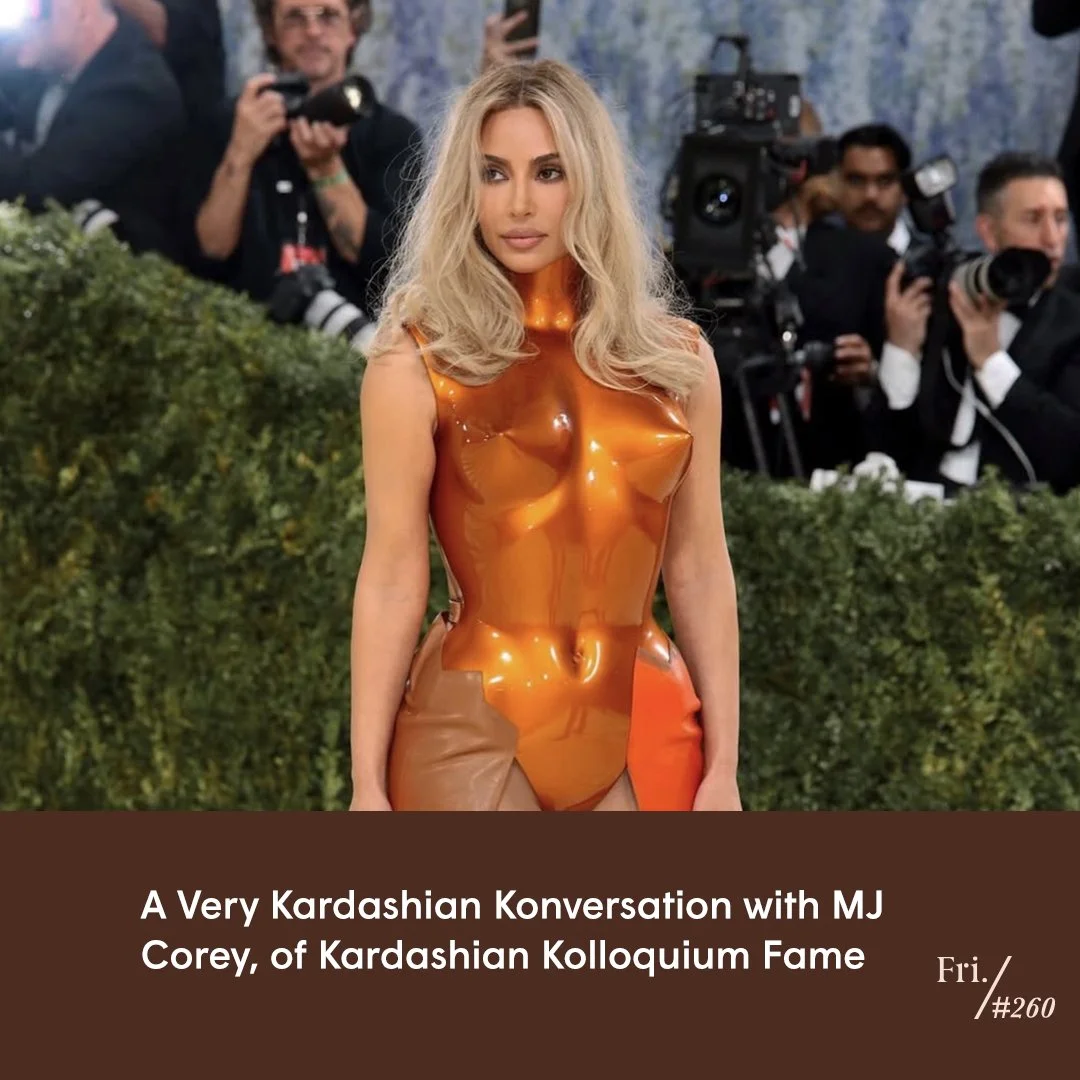
If you’ve spent any time at all thinking about why the Kardashians are… like that, you’ve likely come across MJ Corey’s work. The pseudonymous writer (who’s also a psychotherapist based in Brooklyn) has been analyzing the famous family and their various partners, friends and hangers-on through the lens of media theory since 2018, when she launched the Kardashian Kolloquium Instagram account. What started as a meme account quickly became serious analysis of the Kar-Jenner clan, leading to gems like a comparison between Kardashian and Trump publicity strategies, an explainer on the semiotics of Pete Davidson’s Big Dick Energy and so many academic memes. Oh, and also: data analysis! This is exactly how I want to think about celebrities, and these celebrities in particular, so I was obviously excited to chat with MJ ahead of the publication of her new book, Dekonstructing the Kardashians: A New Media Manifesto, which is out now. Read on for her take on why media theory is such a good way to understand the family’s ever-growing fame, the most surprising thing she learned in her research and the strategy behind the Kim K x Lewis Hamilton hard-launch.
What gave you the initial idea for Kardashian Kolloquium?
It was 2018, and a roommate put on the Bora Bora episode of KUWTK—season 6, the one with the lost diamond earring. I had this uncanny sensation while watching it that I couldn't explain. Kim was being a diva at the resort, and her brother Rob called her out by saying, “Mom raised you better than that, Dad raised you better than that.” Like most Kardashian episodes, the episode had felt so perfectly produced and structured, but when he said that, Kim looked genuinely embarrassed. I mentioned the feeling this evoked in me to my sister, who was a media studies major, and she said, ‘Read Baudrillard.’ So I did. And then I kept reading, learning about his work and the surrounding canon, and I kept thinking: these ideas are for everyone, not just comp lit majors. The most accessible way into them is through the thing that's already everywhere. I was enjoying the self-study so much that I started documenting my journey on Instagram. The first posts were pretty rough—a screenshot of relevant Kardashian moments next to a Baudrillard quote. But the response was immediate and specific. People seemed hungry for exactly this: permission to take the undeniable phenomenon seriously as something to unpack.
I love your approach of treating the Kardashian family like other major American media conglomerates, from Disney to WWE. But why does it work so well? Or maybe another way of putting this is: why do so many media theories apply to these people?!
The Kardashians arrived at the exact moment that all the conditions those theorists had been warning about finally converged into a single, scrollable, binge-able object. Baudrillard was writing about the simulacrum in the ‘80s. Benjamin was writing about aura in the ‘30s. McLuhan was writing about the medium being the message in the ‘60s. They were all describing a trajectory, and the Kardashians are where the trajectory landed.
But the deeper reason is that Kim is structurally unique in a way that makes her almost too good to be true as a case study. Most celebrities occupy one lane—music, film, fashion, politics. Kim occupies the junctions between all lanes at once. In my book, I write about how the scholar Christopher Till mapped her “betweenness centrality” and found she shows up in a social network visualization as a vital node to surprising references, and together we discussed how she could have the potential to exist as a larger node than almost anyone else in culture, with lines running in every direction. That means every theory that touches any of those domains—celebrity, capitalism, race, gender, technology, law—has a connection to her. She's not famous for one thing. She's famous as a media mechanism. There's also something about the family's longevity and self-awareness that makes them unusually rich. They've been doing this for nearly two decades and they've never stopped commenting on their own process and journey. The show is about the show. The brand is about the brand. That self-referential quality—the simulacrum aware of itself as simulacrum—is theoretically dense in a way that, say, Paris Hilton at her peak wasn't.
Do you think you could apply a similar lens to other mega celebrities, or is there something about this family that makes them uniquely 'analyzable' in this way?
For the reasons above, I think the Kardashians are the best examples for the kind of lens I use. That said, celebrity culture is a useful prism for unpacking all kinds of cultural phenomena, and people do. There are courses on Taylor Swift, Beyoncé and Bad Bunny! I'm hoping to have my moment to teach a Kardashian class one day.
Your new book, Dekonstructing the Kardashians, explores the frameworks that supported the family's rise to fame, and demonstrates how their cultural influence can help us understand how media works now. What are the most important things to understand about the Kardashians’ impact on culture and media?
First, they industrialized intimacy. KUWTK convinced an entire generation that access to a family's private life was a normal thing for an audience to expect—and that the family's job was to keep providing it. That's the template that the creator economy has been built on. They normalized what a theorist I admire named Mark Andrejevic called the “work of being watched” as a career path.
Second, they proved that in an attention economy, the main thing that kills you is indifference. Outrage works as fine as admiration—sometimes better. Every “Kar-trash-ian” tweet, cancellation attempt, think piece about why we should stop talking about them has extended the discourse. The critics were always the engine. That has consequences beyond the Kardashians. It's the same logic that explains why certain political figures are impossible to diminish through mockery, and why the media environment rewards extremity over nuance.
Third, they are the most precise measurement instrument we have for tracking the evolution of new media and its addictive, immersive impact on all of us. Studying them is one of the clearest ways to understand the conditions we're all living inside. I also uncovered in my research the common pattern that most American icons have throughout history—one way or another, they hit on major cultural anxieties around sex, death, race and class. This can tell us something about the forces that draw us in as viewers.
What were the most surprising or interesting things you came across while researching the book?
The book really is a compilation of incredible discoveries about media and icon history, much of which I did not previously know. There is a lot of discourse online about the Kardashians and cultural appropriation, but I had not before seen any mention of a major Kardashian irony related to the Renee Rogers case, which I came across while deep diving the history of hair discrimination. In 1981, a Black woman named Renee Rogers sued American Airlines for requiring her to wear her hair in a bun rather than braids. She lost—the judge ruled that braids weren't culturally specific to Black women because, in his words, they “had been popularized by a white actress in the film 10.” That actress was Bo Derek. The same Bo Derek Kim compared herself to in 2018 when she wore “Bo Derek braids” on Snapchat.
How did you navigate writing a book about people whose brand, fame and impact aren't static? For example, I saw the video you posted recently about the recent Ray J drama, and you noted that you wrote a chapter that referenced Ray J well before this most recent discourse. I'm so curious how you knew when to be done, because there's always going to be another discourse happening with this family.
This was a super difficult aspect of writing the book—I knew I had to keep the book grounded in its theory and history roots because otherwise there would just be too much Kardashian material to stuff in. My hope was that I could use enough examples to properly deconstruct the family's apparatus that readers would be able to see how the ideas apply to any ongoing or future antics.
What role do you think the Kardashians' relationships play in their brand-building right now? I'd love your take on the Timothée of it all, but also on the Lewis Hamilton of it all!
The relationships always open doors into new genres and industries and levels of legitimization. Lewis Hamilton makes sense for Kim because he's an entrance into the athletics world, but an intriguing "highbrow," international sport that involves a lot of luxury. As someone from humble beginnings, an outsider in that game due to his racial and class background, who has garnered a lot of respect for his resilience and activism, Hamilton's story works well with a lot of elements of Kim's American Dream brand.
Do you have any predictions about how they're going to continue to evolve as public figures in the next few years?
My guess is Kim will pass the Bar eventually and on-ramp to that world as soon as she can. The older guard Kar-Jenners will let their brands become persona proxies, and the kids will inherit the task of streaming or whatever comes next in media.
Dekonstructing the Kardashians: A New Media Manifesto is available now. You can also follow MJ and Kardashian Kolloquium on Instagram and YouTube.
Thank you for reading this week’s newsletter! Still looking for intersectional pop culture analysis? Here are a few ways to get more Friday:
💫 Upgrade to a paid subscription to support independent, progressive lifestyle media, and to access member-only perks, including And Did You Hear About, a weekly list of Stacy’s best recommendations for what to read, watch, listen to and otherwise enjoy from around the web. (Note: paid subscribers can manage, update and cancel their subscriptions through Stripe.)
💫 Follow Friday on social media. We’re on Instagram, YouTube and (occasionally) TikTok.
💫 If you’d like to make a one-time donation toward the cost of creating Friday Things, you can donate through Ko-Fi.