
A Close-Reading of the CNN Article that Spawned the Disturbing 62 Million Men Meme
By Stacy Lee Kong
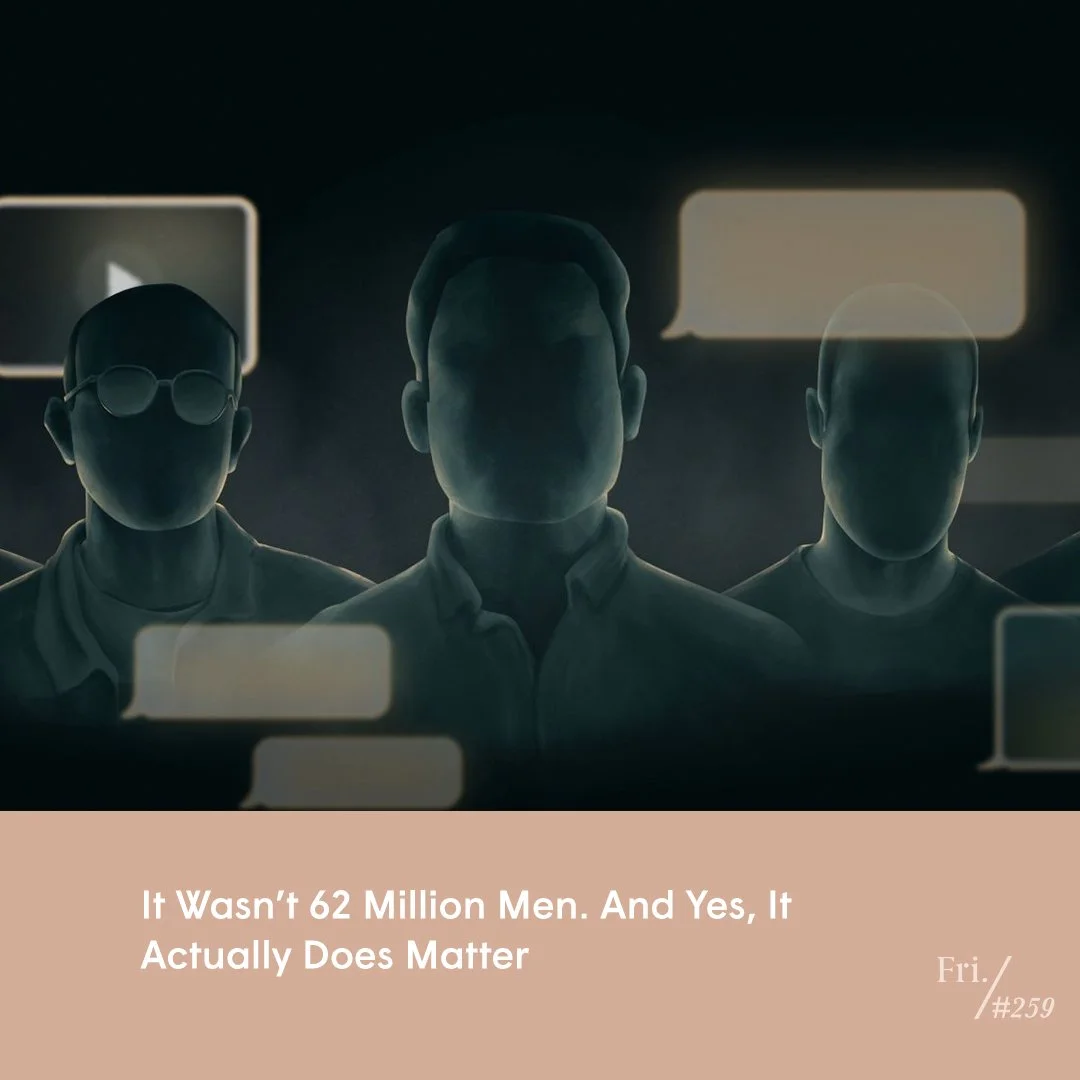
Image: CNN
Content warning: this newsletter contains references to and descriptions of sexual violence, intimate partner violence and other forms of gendered abuse.
The biggest discourse across my feeds this week is centred on an article published on CNN.com on March 26. It starts with a parallax scrolling effect, where the introduction to the story appears line by line. With each click, a horrific new detail emerges: “This is Piotr. He lives in Poland with his wife who’s in her 40s. We’re not showing you his face, or his real name. But we can show you the messages he sent us. What he says he is doing to his wife is a crime. Posing as a user, we found him in a private group—one of many—on the messaging app Telegram. At any hour, men from around the world gathered on the ‘Zzz’ group to swap advice on drugging and then filming the sexual assault of their partners while unconscious. The abuse, shared via video and pictures in this group of nearly a thousand users, was treated as a commodity. But for survivors, including three who spoke with CNN for this story, the consequences are devastating” (emphasis mine).
At first, the piece seemed to fly under the internet’s radar. But at some point last week, posts about the story started appearing on my various social media timelines. On April 15, author Shannon Watts tweeted, “CNN exposes a global ‘online rape academy’ that teaches men how to drug and rape women without detection. Over 62 million men attended in February alone.” (7.8k likes.) The following day, X user @meishato made a particularly popular version of a tweet I’ve seen dozens of times over the past few days, linking the male loneliness crisis to men’s propensity for sexual violence. (75k likes.) And earlier this week, @parhloumahrukh took the comparison even further, saying, “So Rape Academy dot com can stay up and running, but when women create a database of their abusers, that’s immediately taken down. What the fuck?” (164k likes.)
“Not all men.”
— 🍒 (@meishato) April 17, 2026
“62 million men attended the online rape academy in February alone.” pic.twitter.com/ibshe5VR5S
And listen, I agree with the sentiment behind these posts. I have previously argued that we’re more worried about lonely men than lonely people of any other gender because of patriarchy, and also that it’s difficult to muster up any sympathy over men’s loneliness when so many of them seem to believe women’s sexual availability would cure all their woes. I also very much agree with writer Jessica Winter, who wrote that viral New Yorker essay about how our response to the so-called male loneliness crisis is rooted in a societal idea that while suffering is unbearable for men, women are used to being degraded, oppressed and debased, so their loneliness is nbd.
What’s more, we’ve also been inundated with news reports of horrific gender-based violence, so the idea that millions of men could be colluding to drug and rape the women in their lives felt particularly infuriating—and frighteningly possible. This week alone, alt-pop singer d4vd was charged with the murder and prolonged sexual abuse of 14-year-old Celeste Rivas Hernandez, whose dismembered body was found in his Tesla back in September. The public also learned, via the L.A. prosecutor’s office, that he had “a significant amount” of child sex abuse material on his phone, which perhaps helps explain why d4vd’s fans were supposedly referring to a then-12-year-old Hernandez as his “girlfriend” as far back as 2022. A Louisiana man injured two people and killed eight children, seven of them his own, in America’s deadliest mass shooting in two years. And former lieutenant governor of Virginia Justin Fairfax killed his estranged wife, dentist Cerina Fairfax, before turning the gun on himself. And that’s not even considering other recent examples of mass rape, such as the French trial against Dominique Pelicot and 50 other defendants, who were all found guilty of secretly raping Pelicot’s drugged wife, Gisèle, over a period of nine years. Or the Epstein of it all, for that matter!
But. 62 million men didn’t join an online rape academy. So, I think it’s important to understand where that number came from, why this specific element of the story went so viral—and why it actually does matter if it’s one man, or 1,000 men, or millions of them.
Where did the 62 million men figure come from?
@xiandivyne I’m going to stop talking about this but it’s an article worth reading #fyp #feminism #xiandivyne ♬ original sound - Christian Divyne
Early in the article, the reporters— Saskya Vandoorne, Kara Fox, Niamh Kennedy, Eleanor Stubbs and Marco Chacon—reveal how they found Piotr, a detail that doubled as important context on the size and scope of this community. Specifically, it was through a porn website called Motherless.com, which they explain is “home to more than 20,000 videos of so-called ‘sleep’ content uploaded by users, with hundreds of thousands of views. The website, which had around 62 million visits in February alone and whose core audience is in the United States, describes itself as a ‘moral free file host where anything legal is hosted forever.’” (Emphasis mine, again.) The reporters go on to explain that they started their investigation with the ‘sleep’ community on Motherless, which German investigative journalists Isabell Beer and Isabel Ströh had previously reported on. (You likely remember that story; it’s the one that also found there were several Telegram communities where men discussed the best ways to sedate women in order to rape them, including one with 73,000 members.) From there, a Motherless user had posted a link to the Zzz Telegram chat, which the journalists subsequently joined and used to connect with Piotr.
Just one single man violating someone in this way is horrific, obviously, so the fact that thousands of them are, at best, fantasizing about doing something so profoundly harmful, and at worst actually doing it, is almost unthinkable. But, I do want us to acknowledge that the story never says there were 62 million people watching ‘sleep’ videos, or swapping tips on how to sedate the women in their lives for the purpose of assaulting them, or selling the odourless and tasteless drugs they’re using to commit this abuse, or creating and/or livestreaming these assaults. Instead, the article states that Motherless is a porn site that receives somewhere in the neighbourhood of 62 million unique visits across all of its videos per month. Its ‘sleep’ section is one subset of the site, which features about 20,000 videos, from ‘eyecheck’ videos where men are shown lifting the eyelids of their sleeping partners to ‘prove’ they’re actually unconscious, to graphic assault. Some of these videos have accumulated up to 50,000 views. And some of the same men who patronize Motherless are members of the Zzz Telegram group, which has just under 1,000 members. All of which is to say, what is being described in this article is deeply disturbing—but also still relatively niche. For context, even if we were looking at the site’s total traffic for February, that’s still only about 2% of Pornhub’s monthly traffic, which is about 2.6 billion unique visits.
I do want to pause here for a moment, though, because I want to be really, really clear: I’m not saying any of this in an attempt to minimize or downplay CNN’s investigation. What it describes—thousands of men who don’t just violate their partners but specifically do so without their knowledge, over and over again—is so evil, I’m actually a bit shaken.
This is partially poor media literacy—but there’s also something else going on here
But, the fact that ‘62 million men’ went so viral is disturbing in a different way. The most charitable reading of this situation is poor media literacy producing misinformation. People either didn’t read the article, or didn’t read it properly, and genuinely thought they were sharing accurate information.
@tashikann Christian Divyne is not the enemy here. Millions of people made a critical mistake that endangers victims and now you’re lashing out. The first way to protect an SA victim is to tell the truth and get your facts straight because no matter what, the only person who it will affect is the victim. #62millionmen #saawareness #tashika #fyp #BlackTikTok ♬ original sound - Tashika
I’d argue the use of the phrase ‘online rape academy’ is an indicator this is happening at least some of the time; the article’s headline is “Exposing a global ‘rape academy,’” and if you’re just skimming you might miss those single quotations, which indicate it’s a quote, not an objective description. In fact, the term is more metaphorical than literal. It comes up about two-thirds of the way through the story via Sandrine Josso, a French politician. In November 2023, former senator Joël Guerriau invited Josso to his flat, where he spiked her drink with ecstasy with the intention of raping her. (He was found guilty earlier this year.) Since then, she has become a sexual violence advocate with a specific focus on drug-facilitated sexual abuse (DFSA). She calls these groups “schools of violence,” going on to say that she “would even call them an online rape academy, where every subject is taught. There are all the ‘subjects’ and ‘disciplines’ needed to become a good rapist or sexual predator.” She’s describing the way men learn from one another how to violate women, but in the version of the story that went viral, that morphed into a formal education system, which implies an especially sinister level of organization. If this is mostly a misunderstanding, a closer read and a bit of critical thinking would have been extremely helpful. I mean, most countries in the world are made up of less than 62 million people (the total population of Canada, for example is 41 million people). Does it really seem plausible that a large country’s worth of people could run an organized crime operation at this scale and totally avoid detection of any kind?
Here’s the thing, though. I don’t think this was misunderstanding. Some people didn’t seem to care if the number was accurate or not. And when I say people, I do largely mean women. Content creator (and cis man) Christian Divyne has been trying to fact-check the 62 million figure on TikTok for about a week now, and his videos have prompted a barrage of angry replies, mostly from women, mostly claiming his insistence on ‘nit-picking’ this specific number is tantamount to doubting women’s experiences of sexual violence. To explain why this is a problem, I need us to cast our minds back to 2016. That was the year that Rolling Stone published an article detailing a violent gang rape at the University of Virginia. Headlined “A Rape on Campus,” it was published on Nov. 19, 2014 and centred on a UVA freshman, Jackie, who said in the fall of 2012, she had attended a party at Phi Kappa Psi fraternity with a junior named “Drew.” At one point in the evening, the story detailed, he took Jackie to a bedroom, where she was gang raped by seven of the fraternity’s pledges. It was, Jackie told journalist Sabrina Erdely, part of an initiation ritual.
That's how you end up trading privacy for a sense of safety that isn't grounded in reality.
— Chris Alvino (@ChrisAlvino) April 19, 2026
So when people shrug and say "the exact number doesn't matter," it actually does.
Bc getting the scale wrong doesn't just misinform people, it shapes what they're willing to tolerate.
The article garnered an immediate response. Protests erupted on UVA’s campus, police began a criminal investigation and pundits pointed to the case as an example of how entrenched sexual violence is on post-secondary campuses. (Which it very much is.) But questions about Erdely’s reporting quickly emerged. She didn’t interview Jackie’s alleged assailants, or the three friends she supposedly leaned on for support in the aftermath of the assault. She neglected to confirm basic facts: there wasn’t a party on the date Jackie said she was assaulted, and pledging always happens in spring, so there wouldn’t have been any pledges at the frat in the fall. And, she was fooled by emails that were supposedly from “Drew,” which it seems Jackie crafted herself.
Spreading misinformation doesn’t help survivors
It was a journalistic nightmare—Rolling Stone retracted the article and apologized, as did Erdely (eventually). But it was also a feminist one. The story undermined the very real existence of campus sexual assault, and the violence inherent in the college Greek system, providing misogynists with a gift-wrapped example of a fake rape accusation that they could point to every time a woman spoke up about being assaulted. And here’s the wildest part: this wasn’t the first time Erdely had written a story about sexual violence that prioritized salacious details over careful reporting. In 2011, she wrote a Rolling Stone feature about an alleged incident of child abuse within Philadelphia’s Catholic church. Her source—a man who said he’d faced brutal sexual abuse as a fifth-grade altar boy—had previously testified to the archdiocese, police and a grand jury, telling a different story in each instance, something she did not disclose, or even seem to know. That’s not to say he wasn’t abused. My point is more that inconsistencies open sources up to intense scrutiny, and it’s even worse if the audience realizes those inconsistencies themselves.
In both of these cases, Erdely abdicated her responsibility of care toward her source. Whether it was in pursuit of the most attention-grabbing story, or a genuine desire to support victims of sexual violence and hold perpetrators accountable, she was willing to take short-cuts, overlook inconsistencies and even engage in journalistic malpractice. And, I see something similar at play with the content creators who have glommed onto this 62 million men figure. Maybe they just want to (or they’re telling themselves they just want to) draw attention to sexual violence, but in practice, they’re fear-mongering and spreading misinformation. It reminds me of those human trafficking awareness TikToks that claim evil kidnappers are lurking in every Target parking lot, but which actually “overemphasize stranger danger and the unlikely scenario of being kidnapped in public [and] risk misinforming people about what to look out for and creating a false understanding of how people actually fall victim to human trafficking,” according to a 2023 Toronto Star article on the trend.
In all of these situations, the goal is attention, clout and clicks—not actually supporting or caring for vulnerable people most impacted by violent misogyny. And I think it’s actually crucial to recognize that, remember that the stories (and numbers) don’t have to be big and dramatic to be important—and to understand that fear-mongering doesn’t actually help any victims or hold any perpetrators accountable.
Thank you for reading this week’s newsletter! Still looking for intersectional pop culture analysis? Here are a few ways to get more Friday:
💫 Upgrade to a paid subscription to support independent, progressive lifestyle media, and to access member-only perks, including And Did You Hear About, a weekly list of Stacy’s best recommendations for what to read, watch, listen to and otherwise enjoy from around the web. (Note: paid subscribers can manage, update and cancel their subscriptions through Stripe.)
💫 Follow Friday on social media. We’re on Instagram, YouTube and (occasionally) TikTok.
💫 If you’d like to make a one-time donation toward the cost of creating Friday Things, you can donate through Ko-Fi.