
Your Favourite Rapper Has Nothing to Say About Palestine, But Macklemore Does?!
By Stacy Lee Kong
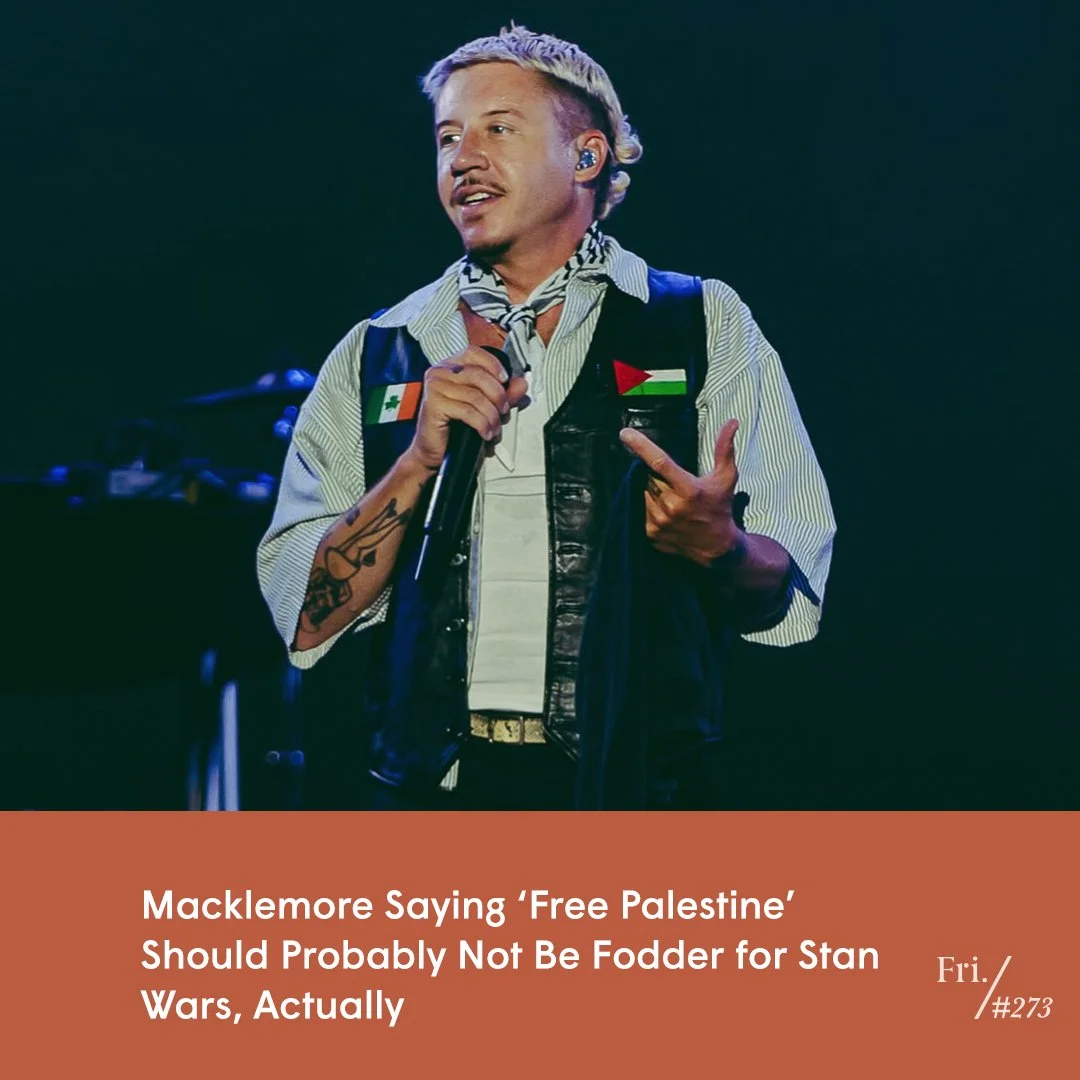
Image: instagram.com/macklemore
A note on language: As I’ve mentioned in every newsletter I’ve written about Gaza since Oct. 7, it’s super important that we take care with our language when discussing Israel and Palestine, because the way we talk about this situation has real consequences for real people. So to be clear, when I critique the Israeli government and military, I am not critiquing all Israelis, much less all Jewish people. Characterizing critique of Israel and the Israel Defense Forces (IDF) as antisemitic is inaccurate and unproductive. Furthermore, it is disingenuous and actually dangerous to conflate Zionism with Judaism, as this list of prominent Jewish writers has argued. Lastly, when I use the words colonization, genocide, apartheid, occupation and ethnic cleansing to describe Israel’s actions, that’s based on the analysis of organizations like Amnesty International, Human Rights Watch, Israeli human rights group B’Tselem, the International Federation for Human Rights, the United Nations, the Center for Constitutional Rights, Jewish Voice for Peace, the International Association of Genocide Scholars, as well as other academics who study genocide, legal experts and South Africa’s application to the International Court of Justice to bring genocide charges against Israel. It is also based on the language Israeli officials and public figures have used themselves, 500+ instances of which have already been collected by Law for Palestine.
Before 2024, I would definitely have put the “Thrift Shop” guy on the (hypothetical, to be clear) list of people least likely to inspire a newsletter. Like, quite high on the list. Then, he unexpectedly became the most vocal pro-Palestine rapper in the business with the release of “Hind’s Hall,” a song inspired by the students who protested Israel’s genocide in Gaza that year. The name comes from students at Columbia, who christened one of the buildings on campus—Hamilton Hall—Hind’s Hall in honour of Hind Rajab, the five-year-old Palestinian girl killed by IDF soldiers after spending hours huddled in a car, surrounded by dead family members and begging the Red Crescent to save her. Now, Mackelmore is making news again for his advocacy, which is how we got here, about to do a deep dive on his impact.
If you’ve been anywhere near the internet this week, you’ve likely seen the news: on Monday, the rapper posted an announcement on Instagram revealing that he’d been dropped as an opening act for Ed Sheeran’s Loop Tour because he called for a free Palestine at one of the MetLife Stadium shows in early September. He started with the reminder that he, Pink (who really kicked all of this off) and Ed Sheeran are not victims. “We have careers, money, opportunities and audiences around the world. Whatever consequences any of us face for what we say, we get to go home to our families. The victims are the Palestinian people… I want to make sure that as I tell this story, we don’t lose sight of that,” Macklemore (government name: Ben Haggerty) wrote. Then, he revealed that Robert Kraft, the billionaire owner of the New England Patriots, New England Revolution, several other sports teams and the Kraft Group, which owns Gillette Stadium, called Sheeran ahead of the tour’s scheduled stop at Gillette to say Macklemore would not be allowed to perform there. “Ed also told me that Kraft had rallied some of the other stadium owners and collectively they gave him an ultimatum: if Macklemore stays on the tour, you will not be allowed to play in our venues,” he continued.
To the surprise of absolutely no one, Sheeran sided with Kraft and his cronies, a decision that has backfired spectacularly. A short list: All of Sheeran’s supporting acts—Aaron Rowe, Lukas Graham, Beoga and Finneas—have since quit in solidarity. Fans are demanding refunds, saying they bought tickets thinking they’d be seeing Macklemore. An Irish radio station has even dropped his songs from their playlist. And his own statement, which characterized Israeli’s genocidal actions as “a conflict between Israel and Palestine,” literally contained the words “I am not complicit” and implied speaking about Palestine was inappropriate because there were children in the audience, has absolutely made it worse. (Spare a thought for his PR, truly.)
And you know what? I’ve been pleased to see things unfold like this. An article published in The Lancet earlier this year estimates more than 75,000 Palestinians were violently killed by Israeli forces between Oct. 7, 2023, and Jan. 5, 2025, 56% of them women, children and older people (that is, civilians). This doesn’t count non-violent deaths, injuries or the toll of trying to survive in a region that has been bombed into rubble, its entire infrastructure—energy, water, sanitation, agriculture, housing, healthcare—destroyed. According to the Costs of War project at Brown University’s Watson School of International and Public Affairs, a full accounting of the casualties would be closer to 236,505 people, or about 10% of Gaza’s pre-October 7 population. We have heard from parents carrying the remains of their children in plastic bags (an image I return to again and again because it is just so horrifying) and Western doctors who recount treating children who have been intentionally shot by snipers, “shredded” by shrapnel or crushed by buildings, often with no anaesthetic. A year ago this month, UNRWA said that Gaza had become home to the highest number of child amputees per capita in the world. I don’t mean to downplay the harm that has been done to Palestinian adults, including adult men. It’s just absolutely infuriating to see Sheeran trot out some BS ‘think of the children’ rhetoric when the harm Israel has caused to Palestinian children is so well-documented.
But. Over the past few days, this situation has morphed into a litmus test for other celebrities, their likes and comments suddenly becoming proof of their relative wokeness, and I do not like that at all.
It’s not surprising that this conversation has become a game of ‘Whose Fave is More Woke,’ but it is disappointing
Stan accounts are ranking pro-Palestine celebrities, tracking the stars that liked Macklemore’s statement and even keeping an eye on their fave’s social media accounts to see if they start following Macklemore, or unfollowing Sheeran. (Which we should take with a massive grain of salt, obviously, because the average person doesn’t actually know whether Ke$ha unfollowed Sheeran this week, at some other point in the recent past—or if she was ever following him at all.) It’s… incredibly disrespectful. This obsession with what celebrities are doing decentres Palestinians, who are still being killed and injured, despite a ceasefire ostensibly being in effect for the past 11 months. According to Al Jazeera, 1,381 people have been killed since the onset of the ceasefire in October 2025. This week alone, an Israeli drone carried out a ‘double-tap’ attack on a group of people in Sheikh Radwan, a neighbourhood in the north-west of Gaza City. This strategy involves dropping a bomb on a location, waiting for people to arrive on the scene to help the victims, then bombing that location again; in this case, the strike injured Palestinian Civil Defence paramedic Sharif Shadi Labad and killed 15-year-old Mohammad Abdul Zinati. And, another 21 people died in Gaza after taking shelter in a bombed-out building that collapsed as they slept. Who cares if Zara Larsson likes a post?
Except, of course, people do. Political posturing is a stand-in for action, and fandom is intertwined with our sense of ourselves. We need celebrities to appear ‘good’ because it means we are good—regardless of whether we, or they, are actually doing anything. There’s also something about the capitalist interpretation of support that I’m still thinking about, but for now will just say: it’s pretty wild to see people wondering how they can support Macklemore and driving streams of “Hind’s Hall” up the charts, instead of directing that energy toward supporting actual Palestinians, who are facing down their fourth winter without adequate shelter, food or medical care, or telling their elected officials they actually don’t want to pay for the $2.8 billion worth of bombs their government is sending to Israel.
you people have lost your fucking minds. no one knows how to be normal. https://t.co/HQOelMAFJc
— ophelia (@ophoelia) September 15, 2026
Also, these likes, comments and follows don’t even mean what these stans think they mean! These are not political action as much as they are social media engagements, and may not even reflect these celebrities’ actual beliefs (i.e., how they vote, who they donate to and what they really think). That’s not to say that online activism is irrelevant; a 2015 study about the actual impact of so-called ‘slacktivism’ found that, “although committed minorities may constitute the heart of protest movements, our results suggest that their success in maximizing the number of online citizens exposed to protest messages depends, at least in part, on activating the critical periphery. Peripheral users are less active on a per capita basis, but their power lies in their numbers: their aggregate contribution to the spread of protest messages is comparable in magnitude to that of core participants.” But I think it’s reasonable to distinguish between liking someone else’s post and making statements, or taking action, yourself. Especially when we’re talking about public figures who use social media as a brand-building and marketing tool, and who—unlike Sheeran, clearly—seem to understand that public opinion has shifted not just on Palestine, but also on their expectations of their faves. Parasocial though it may be, I think a lot of people now consider values alignment when making consumption and purchasing decisions, which means apoliticism is arguably a risk, not a benefit.
If nothing else, celebrities provide a lens to better understand how the world around us works
I never manage to actually settle on the answer to this question, but I am often thinking about whether celebrities have a purpose in political conversations. On one hand, they are useful tools, especially when it comes to amplifying or normalizing ‘controversial’ opinions. (To be clear, I don’t think ‘Palestinians deserve freedom and autonomy’ is controversial. But Robert Kraft and Ed Sheeran do.) On the other hand, I don’t really want to take any sort of moral guidance from ultra-wealthy celebrities, especially if they are performing a politic that resembles mine for the overarching purpose of shilling their music, movies or brand deals. But in this case, at least, I can see one really clear value: Macklemore and Sheeran’s respective statements make the collusion, complacency and class solidarity at play throughout our society legible to those of us who lack access to extreme wealth and its attendant power. Kraft and his billionaire, stadium-owning buds are willing to infringe on Macklemore’s right to free speech and artistic expression because they disagree with him, and they can exert this pressure because they have bought their way into positions of power and influence, and because Sheeran is willing to help them, because he prioritizes his own financial interests and comfort over any sort of responsibility to his fellow human beings. We kind of knew that before—at the very least, Colin Kaepernick did—but now we can all see it even more clearly.
This week’s news cycle is making other things legible, too. Like, how willing many celebrities are to align themselves with that power and influence to the detriment of their own communities, much less their fans. That’s Ed Sheeran. But it’s also Jay Z, who has palled around with Kraft for years. This week, Kaepernick told the MeidasTouch podcast that Kraft’s fellow owners treated him much like they’re treating Macklemore now: “When we filed the grievance, it was like, well, the owners wouldn’t do that,” he said. “Everybody just wants to win within the NFL. And the realization is, no. They want to protect their interests. They want to protect their power. They want to protect their money. And they also want people to know that if you take an action that they don’t agree with, they will come for you.” None of that stopped Jay from starting a criminal justice reform organization with Kraft that, intentionally or not, undermined Kaepernick’s protests, or from building a personal and professional relationship with Kraft and the wider NFL organization.
Yes—Kendrick Lamar never challenged the white NFL ownership.
— Don’t Boo…Revolt! (@BreeNewsome) September 16, 2026
He instead performed in the “Roc Nation Halftime Show”
which was always about making people forget the Kaepernick kneeling protests & distracting people from larger issues of racism in NFL & society https://t.co/BsMrdW13tP
And it’s plenty of other folks, too. When Rolling Stone senior editor Jeff Ihaza tweeted, “Robert Kraft and the heads of the NFL think Macklemore is more subversive—i.e. a threat to the status quo—than Kendrick Lamar… Kinda crazy, no?” he inadvertently sparked a conversation about Lamar’s politics, that very quickly grew to include other celebrities… including Beyoncé, who, as we’ve discussed extensively, loves using revolutionary aesthetics in her creative projects but is also staunchly apolitical. I know that’s not a new conversation, but it’s one that, to me, seems like it’s gaining traction. Back in 2023, I wrote that, “while I acknowledge that the general public often chooses their own comfort over difficult or inconvenient action, I do think there’s a tipping point, and we may be there. (At least, I hope we are.) The things we have learned over the past two months aren’t things we can ‘un-know,’ and I won’t be surprised if that contributes to a shift in what stans will overlook for, or about, their favourite celebrities, whether that’s Bey or Swift or someone else entirely.” And I do think that’s what we’re seeing slowly unfold.
That’s why the value to this news cycle for me isn’t necessarily seeing Macklemore say, “Free Palestine,” because he’s been saying it for years now—and frankly, I don’t need a celebrity to tell me that Palestinians deserve freedom. Instead, about giving us all a clearer understanding of who’s exerting control in our cultural spaces, what they want from us and what they are willing to do to get it. And, frankly, how little they understand public sentiment, or the shifting limits of their own power.
But all of this being said, a confession: though I don’t need a celebrity to tell me what’s right and wrong, I will admit that I like seeing public figures like Macklemore and Ms. Rachel speak out for Palestine in the face of pressure, threats and extremely powerful people who would rather they just shut up. I’ve written before about how disorienting it is to realize that two people can see death and destruction for more than 1,000 days and perceive it completely differently; there is something steadying in the knowledge that these wealthy, powerful entertainers who could insulate themselves from the real problems of the world see what I see, and think it’s wrong, too, and are willing to actually do something about it.
It's entirely possible this is very cheesy (and apologies if so), but: maybe that’s another benefit of putting celebrities into these political conversations. If they can function as a lens that allows us to more clearly see the bad, they can also serve to highlight goodness from time to time.
Thank you for reading this week’s newsletter! Still looking for intersectional pop culture analysis? Here are a few ways to get more Friday:
💫 Upgrade to a paid subscription to support independent, progressive lifestyle media, and to access member-only perks, including And Did You Hear About, a weekly list of Stacy’s best recommendations for what to read, watch, listen to and otherwise enjoy from around the web. (Note: paid subscribers can manage, update and cancel their subscriptions through Stripe.)
💫 Follow Friday on social media. We’re on Instagram, YouTube and (occasionally) TikTok.
💫 If you’d like to make a one-time donation toward the cost of creating Friday Things, you can donate through Ko-Fi.