
In Netflix's 'Best of the Best,' Star Maitreyi Ramakrishnan Says, "I'm Tamil. My Family is From Sri Lanka." The Internet Didn't Like That
By Stacy Lee Kong
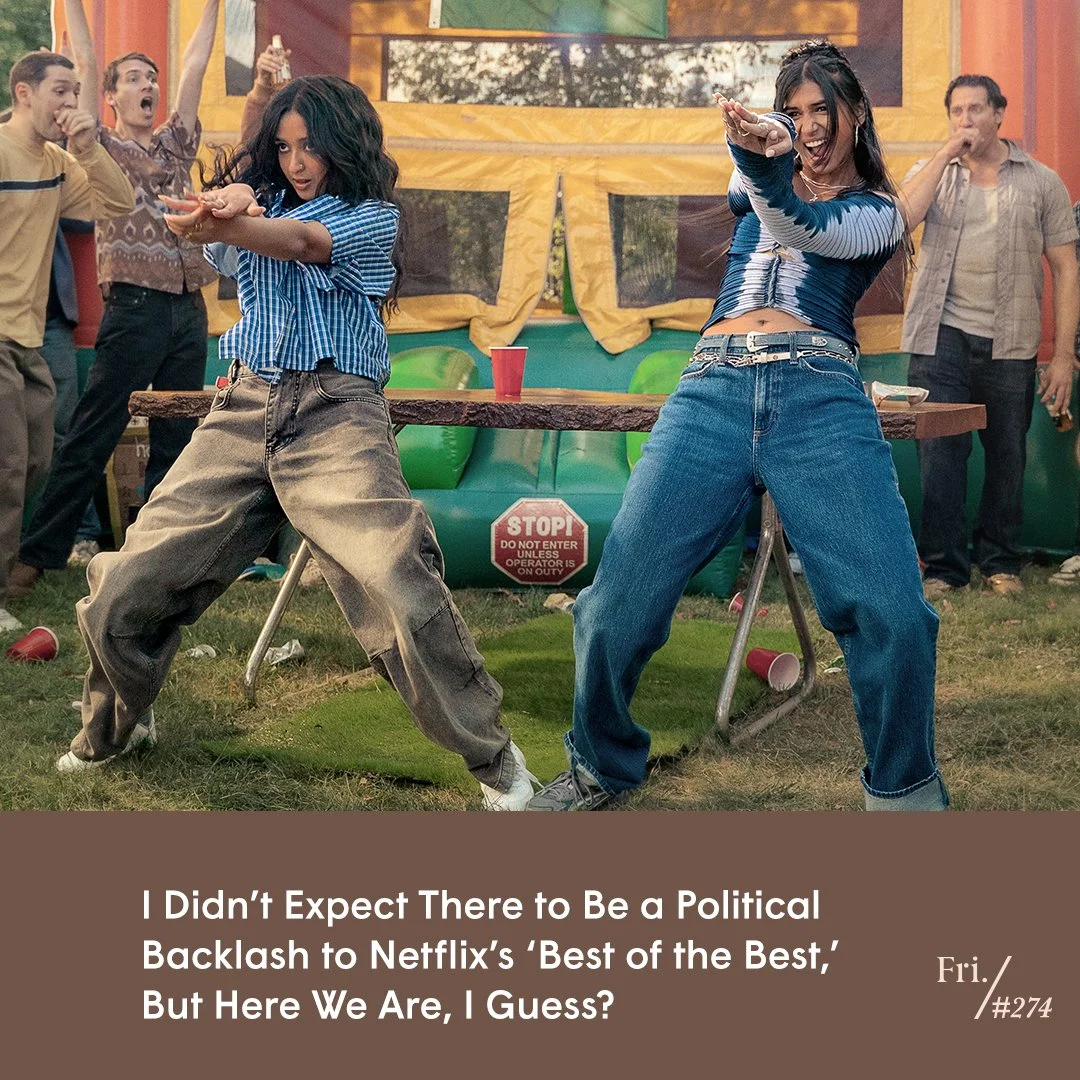
Image: instagram.com/macklemore
I knew I was going to have to watch Best of the Best, Netflix’s new dance dramedy, the second the trailer started showing up on my social feeds. I mean: it’s set in the hyper-competitive world of intercollegiate South Asian dance competitions, explores themes of sisterhood, belonging and self-acceptance and a solid 75% of the jokes are plays on some funny-because-it’s-true diasporic foible. Also, while there are love interests in the mix, the most important relationship in the movie is between childhood besties. It was basically made for me—and definitely for the teenage version of me who watched and re-watched Centre Stage, Step Up and the criminally underrated Honey, convinced that I, too, could find myself, make new friends and, yes, cause some ultra-fit dance bro to fall in love with me through my brilliant grasp of pop-fusion choreography. (This… was a very generous interpretation of my dance ability, btw.)
But I didn’t know I was going to write about Best of the Best until this week, when clips of frat party dance-offs and star Maitreyi Ramakrishnan’s perfectly deadpan one-liners started giving way to posts about her Tamil Eelam identity, hinging on a 30-second snippet of dialogue in the movie. Literally. About 27 minutes into Best of the Best, Ramakrishnan’s Maya and the aforementioned bestie, Anjali (Priyanka Kedia), are meeting the various members of UCLA Agni, the South Asian dance team they’ve just successfully auditioned to join. She introduces herself to the resident white boy on the team by saying, “I'm Tamil, my family is from Sri Lanka.” It isn’t a scene with tons of emphasis or emotional weight, but that wording was very deliberate, Ramakrishnan later explained. “For those who a similar family as mine, who are also probably Tamil Eelam diaspora all over the word, they know exactly the distinction of saying ‘Tamil Sri Lankan’ versus ‘I’m Tamil; my family is from Sri Lanka,’” she said in an interview during the movie’s press tour.
That distinction ignited a wave of criticism, largely (maybe exclusively?) from Sinhalese Sri Lankans, who took offence at her rejection of a nationalistic sense of self. In fact, this group was so upset at Ramakrishnan’s description of her own identity that they did they only thing they could do: leave bad reviews of her movie. Okay, I’m being snarky, but there is actually something serious happening here. This relatively simple statement—one millions of people around the world could, and do, use to describe themselves—has inspired a coordinated campaign to tank Best of the Best using review bombing, a tactic that has often been leveraged against racialized women in an attempt to silence, shame and/or punish them. It’s worth thinking about why that’s happening and, perhaps more importantly, why now.
When Maitreyi Ramakrishnan says she’s a “Tamil Eelam girlie,” this is what she means
But first! Some history. (And I’ll just pause here with a caveat that I’m not an expert, just a person who reads a lot, so consider this a starting point.) Okay, so: the Sri Lanka is a South Asian island nation largely made up of a Sinhalese ethnic majority, which today constitutes about 74% of the population, and a Tamil ethnic minority, which makes up about 12%, per the country’s most recent census. During Britain’s occupation of Sri Lanka, the colonizing government favoured Tamils, according to a 2020 article in the Harvard International Review, a dynamic that sowed the seeds for conflict between the two groups. So, when Sri Lanka gained its independence in 1948, the newly independent, and majority Sinhalese, government enacted policy that was ostensibly intended to undo the long-running disenfranchisement of Sinhalese people, but simultaneously resulted in discrimination against Tamils. And it wasn’t only unfair policies. Within a decade of independence, Sinhalese mobs began carrying out organized pogroms against Tamils, with major riots taking place in 1956, 1958, 1977, 1981 and 1983. (If this all sounds familiar, it’s because this is the playbook for oppression of minority groups in general; a similar system preceded the Rwandan genocide.)
According to a 2023 Al Jazeera op-ed by two members of People for Equality and Relief in Lanka (PEARL), a human rights non-profit that promotes justice and self-determination for Eelam Tamils, during that last pogrom, which became known as Black July, “Sinhalese mobs killed several hundred Tamils, according to government numbers, though activists have long insisted that the evidence suggests the true death toll was in the thousands. The mobs also destroyed Tamil businesses and displaced tens of thousands of Tamils. The violence was targeted and intentional, while police and government officials either failed to stop the violence or actively encouraged it.”
This triggered a 26-year civil war between the Sri Lankan government and the Liberation Tigers of Tamil Eelam (LTTE), the militant group better known as the Tamil Tigers, that wanted to create an independent Tamil state in northeastern Sri Lanka. The human cost of this war was profound: the United Nations estimates the death toll was between 80,000 and 100,000 people, plus thousands more who were ‘disappeared’ and hundreds of thousands who were displaced. And while it has not officially classified the Sri Lankan government’s actions as genocide, other experts have made compelling arguments to do so, including University of Illinois law professor Francis Boyle and a panel of international judges belonging to the Permanent Peoples’ Tribunal, a human rights organization based in Bologna, Italy. The Sri Lankan government rejects this accusation, obviously.
@thickthighsnbutterflies Our Tamil Eelam Queen explaining the way so many of us from the Diaspora feel about our identity. I learned very young that the country my parents grew up in was different than I thought when a 12 year old me joined marches urging the Canadian government to do anything to help our people. Ever since I acknowledge that my roots are from Sri Lanka but I am Tamil first. Special shout out to @TAHA for starting this dialogue with @maitreyi and Prashanth Best of the Best is out today on @Netflix #BestoftheBest #neflixfilm #eelamtamil #tamilcanadian #maitreyiramakrishnan ♬ original sound - Sureka
This is just the barest synopsis of 70-plus years of history, but I think it helps illustrate why Sinhalese Sri Lankans are so upset with Ramakrishnan—who, I must note, is a popular, young and outspoken celebrity with a platform in the millions. That is, she is not only rejecting the nationalistic and oversimplified narrative of Sri Lanka as a unified nation that has overcome past turmoil, she’s normalizing and mainstreaming a conversation that they have, for years, tried to suppress. (For more on that, see the Sept. 24 episode of CBC’s Commotion. Culture critic and guest host Radheyan Simonpillai tackled the Best of the Best backlash with guests Nedra Rodrigo, the founder of the Tamil Studies Symposium at York University, and Joyita Sengupta, a journalist at CBC, and I found the conversation offered some really helpful context.)
Review bombing a fun dance movie is surely a sign we’re in some sort of dystopian, late-stage capitalism hellscape, right?
At first glance, leaving bad reviews on a Netflix dance movie as a form of genocide denialism comes off as kind of… silly. But as with most pop culture news cycles, what’s happening under the surface is worth paying attention to. The practice of review bombing actually started as a form of customer complaint; in the 2010s, video game fans began coordinating to post negative reviews of games like The Elder Scrolls V: Skyrim, Nier: Automata and Crusader Kings II over mostly legitimate complaints. (In these specific cases: the introduction of paid mods, or putting player-created game modifications behind a paywall; demands from Chinese fans for a translation of the game; price hikes.) But it didn’t take long for the tactic to take on ideological importance; in 2013, Total War: Rome II was the subject of a review bombing campaign over the addition of historically inaccurate characters, namely female generals. In 2018, a Facebook group called Down With Disney’s Treatment of Franchises and its Fanboys tried to sabotage the ratings for Black Panther and harassed Star Wars actor Kelly Marie Tran off social media. And in 2020 (and again in 2025, sigh), The Last of Us was review bombed over “social justice warrior” themes and a focus on queer relationships (though not its Zionism). In that context, it’s not surprising that Ramakrishnan’s critics would try a similar tactic.
Notably, this type of review bombing doesn’t usually accomplish the bombers’ stated goals—just look at author Cait Corran, who in 2023 created fake personas to review bomb her rivals’ books and inflate her own profile. Her publisher ended up cancelling the publication of her next book, and her agent fired her as a client. That’s an extreme example of review bombing backfiring, but even in less dramatic cases, nothing really happens as a result of these attacks. Disney didn’t fire Tran, and Netflix isn’t going to ignore Best of the Best’s strong streaming numbers because 1,000 people used ChatGPT to leave poorly-written reviews on IMDb.
But that’s because the actual goal isn’t forcing a company to respond, is it? It’s, as I mentioned earlier, to silence, shame and punish, especially those who belong to historically marginalized groups and have the audacity to step into the spotlight. In fact, “review bombing is often targeted at media aimed at and made by women, people of colour, and the LGBTIQ+ community,” academic Claire Whitley wrote in a 2020 article for The Conversation. And that’s why ineffectiveness isn’t actually a defence, as Whitley goes on to explain: “It’s tempting to dismiss review bombing as a desperate act that occurs in an echo chamber and ultimately has no effect. However, its significance is clear—particularly in an increasingly online world. Ultimately, it serves as another obstacle for marginalised artists and reinforces longstanding hierarchies of power in the industry.”
Here's some bits from Maitreyi Ramakrishnan and Hasan Minhaj, navigating that Tamil identity through dance and storytelling in Best of the Best. https://t.co/4rmxt9lbzd pic.twitter.com/91uklRVym3
— Radheyan Simonpillai (@JustSayRad) September 19, 2026
That’s why I think it’s important to look at the attacks on Ramakrishnan this week. Importantly, while allegations of genocide have been raised against the Sri Lankan government, she is not using that language. She is not directly criticizing anyone. She’s literally only saying how she identifies, and even that is being perceived as a threat.
A couple of years ago, I met up with her at a hotel in downtown Toronto to interview her for a magazine profile. We chatted for way longer than we were supposed to, mostly because she was so thoughtful, and had so much to say, about politics and world events. She made the connection between the oppression her community has faced with that of other groups, including Palestinians and Indigenous people in Canada, spoke passionately about the need for strong labour protections and was refreshingly down to earth about the nature of celebrity—perspectives that were already starting to feel like potential liabilities, especially for young female celebrities. How I felt after that conversation was remarkably similar to writer Kylie Cheung’s feelings after attending Olivia Rodrigo’s Daisy Chain Fields festival over the summer: “I found myself most awestruck by the cultural implications of the biggest Gen Z pop star in the industry not just paying lip service or being coy about her political views, but stepping into her power as a feminist icon,” Cheung wrote back in August. “Embracing feminism. Reclaiming it as not just urgent and essential, but cool, fun, and celebratory at a time when too many young women and girls are being implicitly and explicitly told that feminism is cringe.”
There were maybe seven halcyon years were feminism was cool, but recently, it has become less and less common for young, female public figures to share real political viewpoints, for a variety of reasons ranging from self-protection to the demonization of ‘woke 1.’ I’m forever torn on the usefulness of celebrity advocacy, but on a deeply personal level, I just really love seeing a young, racialized woman use her platform in this way, and I don’t want to see her silenced.
Thank you for reading this week’s newsletter! Still looking for intersectional pop culture analysis? Here are a few ways to get more Friday:
💫 Upgrade to a paid subscription to support independent, progressive lifestyle media, and to access member-only perks, including And Did You Hear About, a weekly list of Stacy’s best recommendations for what to read, watch, listen to and otherwise enjoy from around the web. (Note: paid subscribers can manage, update and cancel their subscriptions through Stripe.)
💫 Follow Friday on social media. We’re on Instagram, YouTube and (occasionally) TikTok.
💫 If you’d like to make a one-time donation toward the cost of creating Friday Things, you can donate through Ko-Fi.