
Get In, Everyone—We’re Going to Eat the Rich
By Stacy Lee Kong
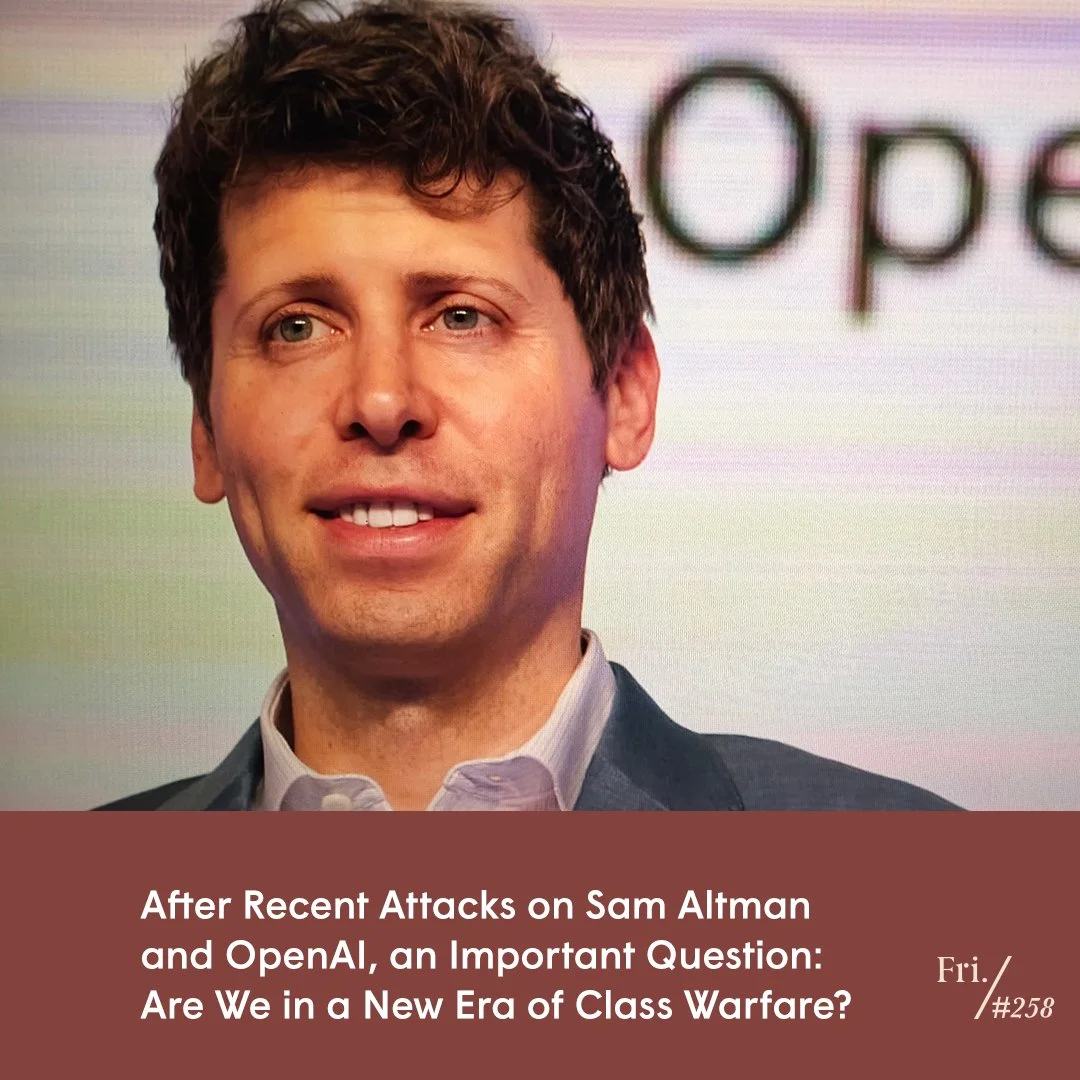
Image: Shutterstock
Last week, three young people attacked OpenAI CEO Sam Altman in two separate incidents: on Friday, a 20-year-old man allegedly threw a Molotov cocktail at Altman’s San Francisco home, where it set an exterior gate on fire, before making his way to OpenAI’s office, where he threatened to set the building on fire. Then, on Sunday, two suspects—aged 25 and 23—were arrested after allegedly firing a gun at Altman’s home. These incidents have sparked plenty of media coverage, not least because Altman quickly took to his personal blog to imply journalists Ronan Farrow and Andrew Marantz were somehow culpable because they had recently published a critical New Yorker piece about the CEO’s trustworthiness, or lack thereof. But what I found even more interesting was the wave of analysis that dropped in the days following these incidents, all focused on young people’s growing anger over AI: “The ‘Techlash’ Against A.I. Is Here. Have We Hit a Tipping Point?” (Rolling Stone); “Online response to the attack on Sam Altman’s house shows a generational divide” (Fortune); “The A.I. Backlash Turns Violent” (Compact magazine); “A.I. Has a Message Problem of Its Own Making” (New Yorker).
On one hand, the pundits aren’t wrong. There is an ever-growing disconnect between the tech bro elite and their cronies (who openly and clearly admit their goal is to accumulate more and more and more and more wealth, ideally by eliminating every societal safety net for the average person) and said average person (who understandably finds the prospect of joblessness, homelessness and a barren wasteland of a planet unappealing). The New Yorker’s Kyle Chayka put it pretty perfectly when he wrote, “if you tell people often enough that your product is going to upend their way of life, take their jobs, and very possibly pose an existential threat to humanity, they just might start to believe you. A recent Gallup survey of Gen Z found that forty-two per cent of respondents felt ‘anxiety’ about A.I. and thirty-one per cent felt ‘anger.’” (I’ll add to that: 48% of respondents said the risks of A.I. in the workforce outweigh its benefits and 80% said using this technology makes learning more difficult. What’s more, the youth are reporting a 14% decrease in excitement and a 9% drop in hopefulness since just last year.)
— Elihan091390 (@EH_BEYAK9013009) April 10, 2026
But, I think the attacks on Altman are actually a sign of something bigger and messier than a backlash to one industry. A caveat: I’m still trying to wrap my head around these ideas, but I think what we’re actually seeing is an entirely predictable class conflict, and an accompanying reshaping of our political spectrum.
AI is a harbinger of change, but not the cause
First, the class war. You know I think everything comes back to capitalism, so no surprise here: on one level, this is very much about a handful of people who are colluding to maintain their unfettered accumulation of wealth. As the New York Times reported late last year, the A.I. boom has propelled already wealthy tech titans, like Altman and Nvidia’s Jensen Huang, into new stratospheres of wealth and created a new crop of billionaires, including the founders of start-ups including Scale AI, Cursor, Perplexity, Mercor, Figure AI, Safe Superintelligence, Harvey and Thinking Machines Lab. The potential payout is so good that struggling shoe brand Allbirds, once beloved by the Silicon Valley set and former U.S. president Barack Obama, just announced it is pivoting to A.I. infrastructure thanks to a $50 billion infusion of funding by an unnamed investor. (Though, investment pros agree this is very, very silly.)
According to a recent Mother Jones feature on the rise of the American oligarchy, “between 2000 and 2020, as tech monopolies consolidated power, the share of the nation’s wealth held by the top 0.00001 percent roughly doubled. By the end of 2025, it had nearly doubled again. It is no longer novel or even particularly accurate to note that the richest Americans control a greater share of resources than they did during the Gilded Age; they are, according to French economist Gabriel Zucman, about three times wealthier. That wealth is increasingly concentrated in a single industry, consumed by a singular purpose. The American oligarchy is an A.I. oligarchy.”
I think we all knew that Nirit is dishonest. Her response to the acts targeting Altman really underlines this fact. She keeps ignoring the words of AI CEOs themselves: https://t.co/aV6lT83h1T pic.twitter.com/8tILPVqjBQ
— Dr. Émile P. Torres (they/them) (@xriskology) April 16, 2026
At the same time, A.I. CEOs are openly admitting that A.I. has the potential to annihilate the world as we know it. Like, literally annihilate. And even if that’s overblown, it’s well-established that biased algorithms, massive data centres and unrestrained automation are already fuelling the climate crisis, denying vulnerable people access to social services, exacerbating healthcare inequities for racialized people (and especially Black people), causing cognitive decline, eroding confidence, creating more work for human employees and actively creating a future where there is no human workforce, with all of the economic and social disasters that implies. Last year, Anthropic’s CEO, Dario Amodei, told Axios that “AI could wipe out half of all entry-level white-collar jobs — and spike unemployment to 10-20% in the next one to five years [leading to] the possible mass elimination of jobs across technology, finance, law, consulting and other white-collar professions, especially entry-level gigs.” Of course, as Fortune writer Chris Morris pointed out at the time, Amodei was saying all of that on the heels of his company releasing its latest chatbot, so he clearly wasn’t too worried about this coming economic apocalypse.
Exploitation isn’t just happening in tech, though
But here’s the thing: A.I. isn’t the only sector where regular people are being exploited on the regular. In fact, it feels like the wealthy industrialist/robber baron ethos embraced by Elon Musk, Mark Zuckerberg, Altman et al. is actually entrenched everywhere. Grocery magnates are price-gouging shoppers, overcharging for bread and, more recently, meat. Consumer packaged goods conglomerates are going all-in on shrinkflation, selling us sneakily smaller bottles of dish detergent and bags of chips, without reducing the price. Real estate companies are driving up rent in an attempt to maximize their profits, creating a housing crisis where about 20% of Canadians are living in unaffordable housing (i.e., it costs more than 30% of their income) and 45% worry about being able to afford their housing going forward. Employers of all stripes are exploiting their workers in a variety of increasingly creative (derogatory) ways, whether that means adopting unfair ‘on-call’ scheduling practices, restricting their employees to part-time hours or monitoring their remote employees to punish them for perceived infractions of ‘time theft.’ (Of course, they’re not very concerned about wage theft. Shocker.) Lastly, and maybe not directly economic, but it is extremely jarring to realize that there is documentation of power brokers across every single sector abusing, raping and torturing children and young women, and no one will ever do anything about it. Taken together, it feels very clear that there is a class of people who see profiting off the rest of us as some kind of divine, or at least inalienable, right. And… I just don’t think we can discount that when we’re trying to parse the attacks on Altman, or the overall disdain for ultra-wealthy A.I. evangelists. No wonder people, and especially young people, are angry. And no wonder they’re reacting with violence and/or glee at someone else’s violence.
12 years ago billionaire Nick Hanauer gave a Ted talk warning his fellow plutocrats that if they did nothing about inequality the pitchforks would come for them. He didn’t do this because he’s a good guy, it’s because he has the same sense of self-preservation that the ultra… pic.twitter.com/BFeT9T2nKZ
— barbarism critic (@barbarismcrit) April 15, 2026
In fact, these attacks are entirely predictable tbh! And I mean that so literally: In an interview with Fortune, Aleksandar Tomic, an economist and the associate dean for strategy, innovation, and technology at Boston College, pointed to the Industrial Revolution as a precursor to today’s A.I. anxiety. During the late 1800s and early 1900s, technological advances reduced British farmers’ reliance on human labour, while new factories and mills needed employees, pushing millions of people to migrate from rural areas to urban ones. Once settled in cities, though, these economic migrants found themselves working long hours for low wages in dangerous conditions, oppressed for the benefit of wealthy industrialists. And they reacted to that oppression with protests, industrial sabotage and even violent uprisings, particularly in response to governments’ military intervention. (The resulting labour movement led to the abolishment of child labour, the establishment of weekends and the eight-hour workday and introduced the concept of a living wage—but did not end factories, commerce or capitalism. Just, you know, for the record.)
In that context, the attacks against Altman feel aligned with the actions of Luigi Mangione, the 27-year-old man accused of killing UnitedHealthcare CEO Brian Thompson, or 29-year-old Chamel Abdulkarim, who is accused of igniting a six-alarm blaze at a California warehouse last week, totally destroying the building and its contents, which amounted to about $500 million of Kimberley-Clark paper goods. In a video posted to social media, he can be heard saying, “Should have paid us more.” And, according to First Assistant U.S. Attorney Bill Essayli, in conversations with co-workers and friends, he compared himself to Mangione and boasted that he “just cost these [expletive] billions [of dollars]” before going on to say, “all you had to do was pay us enough to live. Pay us more of the value WE bring. Not corporate. Didn't see the shareholders picking up a shift.”
If we zoom out, this tension also helps illustrate a recent shift in the political spectrum
@etymologynerd All frameworks are reductive!!
♬ original sound - etymologynerd
Somewhat tangentially, this all makes me think of a conversation I’ve seen bubbling up for a few months now around shifting political frameworks. Most recently, I came across a really fascinating TikTok by linguist Adam Aleksic, who was talking about historical and current political ‘cleavages,’ the social and cultural factors that divide a society into groups with differing, or even competing interests. In 19th century Europe, that looked like owner class vs. worker class, church vs. state or urban vs. rural, for example, while in 1960s America, race, class and gender became the defining cleavages. But now, Aleksic argues, a new framework is emerging, and it’s centred on technology. He argues that previous political compasses don’t really capture our current, technology-mediated reality. In this framework, the cleavage is modernity (pro-A.I. and rapid technological growth) vs. nature (pro-reconnecting with the material world and other humans, and looking to limit the amount of influence machines have on our lives). I’m not 100% sure what this means yet, but my gut says it’s related to the way we’re seeing young people react to A.I. in particular and the ownership class at large, and will be helpful in understanding where the world goes in the next few years.
However: whatever political framework we’re evolving into, it’s probably important to remember that we’re not floating through these changes without agency. I don’t think we should throw Molotov cocktails or shoot at people’s houses, obviously. But I also know change doesn’t happen by asking politely. Exploited workers around the world are remembering that right now—and the global elite would do well to do the same.
Thank you for reading this week’s newsletter! Still looking for intersectional pop culture analysis? Here are a few ways to get more Friday:
💫 Upgrade to a paid subscription to support independent, progressive lifestyle media, and to access member-only perks, including And Did You Hear About, a weekly list of Stacy’s best recommendations for what to read, watch, listen to and otherwise enjoy from around the web. (Note: paid subscribers can manage, update and cancel their subscriptions through Stripe.)
💫 Follow Friday on social media. We’re on Instagram, YouTube and (occasionally) TikTok.
💫 If you’d like to make a one-time donation toward the cost of creating Friday Things, you can donate through Ko-Fi.