
Let’s Talk About How We’re Talking About Ariana Grande’s Body
By Stacy Lee Kong
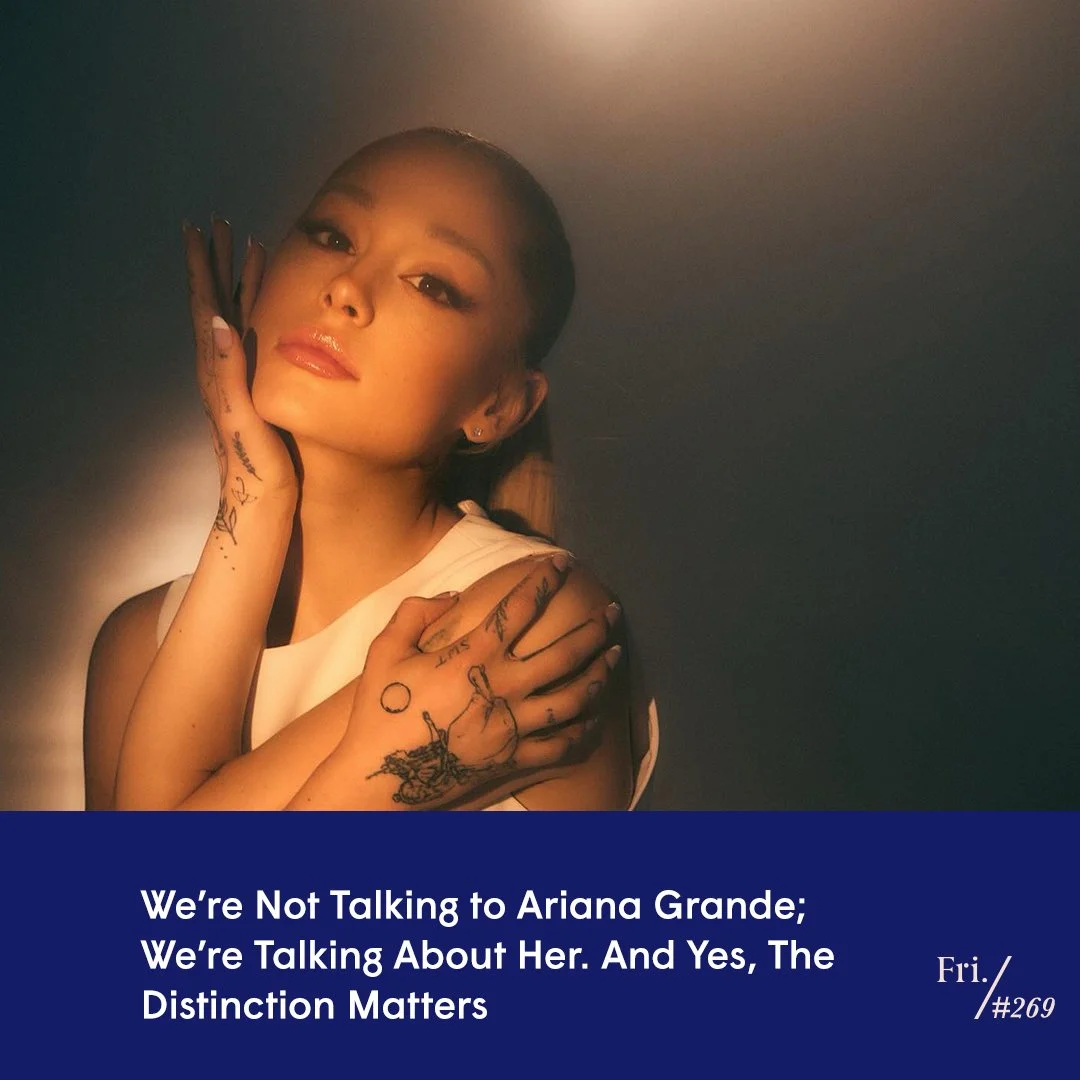
Image: instagram.com/arianagrande
Content warning: This newsletter contains references to disordered eating.
You know when TikTokers post a video reply to a specific comment to make a wider point, and they’re like “Please no hate to this commenter, they’re just a good example of [insert wider phenomenon here]”? Well, I’m about to do the same thing to Craig Jenkins, Vulture’s music critic and a writer whose work I quite like, for his review of Ariana Grande’s eighth album, Petal. Not because of his opinion on the music. At this point, I care 0% about these songs, though for the sake of accuracy, I will note that he was measured, saying the album is “low on the toe-tapping immediacy of ‘Yes, And?’ and the vocal theatrics of ‘Don’t Wanna Break Up Again’ but serves grit and angst that feel vital and honest.”
Instead, my problem is with his framing, and how this review—like much of the cultural criticism about Grande this week—hinges on a problematic conceit. From his headline (“Ariana Grande Can’t Win”) to his thesis (“Grande’s art is in acrimonious conversation with its spectators”), Jenkins is positioning this week’s discourse around the album, the disturbing music video for the title track and especially the singer’s appearance as a battle around public scrutiny and privacy. And respectfully, I call BS. Or at least, I’m going to point out that’s playing into her team’s PR spin, something I think journalists have a professional responsibility to resist.
I can’t imagine anyone reading this newsletter has actually missed any of this discourse, but just in case: the video for “Petal,” which dropped on Friday, inspired yet another wave of commentary about Grande’s weight loss and overall health, thanks to both her appearance and the video’s pointed references to harmful, unrealistic beauty standards, particularly for women in entertainment. Two days later, Grande’s team sent People magazine a statement doubling down on the idea that the public is policing her body, saying, “Ariana will be taking a step back from visibility after she completes the Eternal Sunshine Tour. She looks forward to finishing the tour and ending it on a high note, both healthily and happily, and then taking a much-deserved break from public-facing work and appearances, which has led to endless, ongoing public scrutiny. This tour has been a beautiful experience for her. She loves her fans and has loved every minute of this tour so much.”
the thing too is isn't just about "little girls." her body is a product. she is using it to sell us music and movies and makeup and presenting it as something desirable that we should want and pay for. that's capitalism, sure. but it's also a choice she and her team are making.
— hazel scott (@battymamzelle) August 4, 2026
And… most of what I’ve read about the singer this week has followed that lead. In the New York Times, Julia Jacobs calls out online arguments “over diet culture, privacy and the age-old fixation on the bodies of female celebrities” and focuses on the parasocial nature of these commenters, even comparing Grande to Chappell Roan and Doja Cat, two celebrities who have publicly pushed back against the demands of their fanbases. In the Toronto Star, columnist Vinay Menon argues that “her body is back where it does not belong: in the news, [which] is itself unhealthy.” And in Harper’s Bazaar, Louis Staples similarly focuses on public scrutiny, writing, “we don’t know precisely what Grande is dealing with behind the scenes, or what she plans to do with her time out of the spotlight. But it’s hard not to be reminded of celebrities such as Demi Lovato and Lindsay Lohan, who have taken a step back from being endlessly dissected and seem happier and healthier on the other side.”
First of all, Lovato and Lohan didn’t simply ‘take a step back.’ They went to rehab, several times each, because they needed treatment for addiction. So… I’m not sure that’s the best comparison. But also: Public scrutiny is not actually the problem here???
The idea that ‘we don’t talk about women’s bodies’ needs a little nuance
I haven’t somehow become a different person who doesn’t care about toxic beauty standards. (The opposite, actually—I think I’m actually even more attuned than usual to the kinds of bodies that are now being portrayed as socially acceptable and desirable, and like every other woman I know, and feel a complicated mix of anger and fear when I allow myself to really take in how thin celebrities have gotten.) But I admit, I’ve struggled with the idea that we don’t talk about women’s bodies for a long time. Philosophically, of course it makes perfect sense. The most efficient way to disrupt the societal impulse to assign value to people’s, and especially women’s, bodies based on size, shape and appearance is to just… not talk about people’s bodies. But as I think we all know, this is challenging to actually put into practice, even in the least complicated examples.
HAAATE the way “don’t talk about stranger’s bodies” has been co opted to mean “don’t question the external factors influencing the bodies displayed on magazines/billboards/social media”
— libra mage | c0mms open 📍 (@ackermanlor) August 4, 2026
Take Adele, whose then newly-thin body went viral in 2020. In that case, it was pretty obvious that praising her for losing weight was fatphobic, and easy enough to say that we should not do that. But even in situations like that, it doesn’t feel reasonable to expect people to actually ignore when a celebrity’s appearance changes. I mean, I’ve personally worked at multiple publications that racked up thousands upon thousands of page views via slideshows of stars’ haircuts and manicures—clearly, attention is the fundamental mechanism of celebrity.
Meanwhile, talking about Grande is genuinely fraught. The societal messaging around what an acceptable body looks like is maddeningly narrow and ever shifting. We perceive her as vulnerable for many reasons, some fair (the tragedies she’s experienced in her life, the likelihood that she is not well) and others problematic (her whiteness, which she’s always benefited from despite past stints of racial cosplay, and the youthful persona she leans into). And there are some people who are zooming in on her photos to see if she has lanugo or just how prominent her clavicle is, and that doesn’t feel like it’s coming from a good place.
But: the vast majority of the conversations I’m seeing aren’t judgmental trolling. They’re honest and concerned, because we are all seeing a person who has become so thin that it is actually distressing—while at the same time seeing her team call her healthy and happy, her family post in support and various industry powerbrokers allow her to keep working. And this isn’t the first time a talented young singer became thinner and thinner and thinner, all the while performing, attending events and occupying a prime space in the public eye. Only, in that case, she died.
This is not permission to be careless in our language though
I should pause here to note that experts universally agree that it’s best not to comment specifically on anyone’s body. As psychiatrist Sarah Gupta told USA Today, “when the focus stays on individual bodies, even with good intentions, it can quickly become toxic and harmful… [So,] instead of asking whether a specific person looks ‘too thin,’ we can talk about the broader patterns we’re seeing, [such as] the rapid rise in the visibility of medications like GLP-1s and the messages they send when used outside of current clinical guidelines.”
THIS. EXACTLY THIS. "Talking about it won't help her!" It's not HER I'm trying to help. That is the people around her's responsibility. As a pop star and celebrity she should be mindful of the content she puts out. https://t.co/arcnMWQVQ0
— cat😷🍉🇸🇩🇨🇩🇧🇩 (@mercurial_moons) August 4, 2026
There are also real concerns around social contagion, which is when “behaviors, emotional states, or disorders… spread between individuals through social mechanisms such as peer pressure and emotional imitation, rather than through biological means.” Social contagion can be positive (apparently happy teachers make for happy students), but for the most part, we hear about this phenomenon in negative contexts, such as suicide, violence and, yes, eating disorders. According to an article published in the September 2023 issue of the Journal of Online Trust and Safety, “there is a strong social component in both the development and the perpetuation of eating disorder behaviors that occurs on a cultural as well as peer-to-peer level. Specifically, adolescent peer groups are known to have a salient impact on individual health behaviors, in particular, behaviors surrounding diet. Particularly in female adolescent friend groups, heavy emphasis on body image and weight loss has been observed, leading professionals to believe that peer groups may contribute to the high prevalence of disordered eating among this demographic.”
Add to that the risk of providing people with a handy guide to restricting their food intake, or at the very least glamorizing the act of starving themselves, and it’s clear we do need to take care in how we talk about the singer. That’s why I’m not publishing the most recent photos of Grande, or speculating about any diagnoses that she may or may not have, or including descriptions of her appearance, which can be triggering and inspirational for people who have eating disorders. But I don’t think it’s bad for us to acknowledge that something is clearly wrong here. In fact, I think we have to do that.
So, here's how we talk about it
The last time I wrote about Grande’s body, I tried to get at this tension; back then, I wrote, “culture critics and columnists don’t seem to be willing, or capable, of making a distinction between body talk and raising a red flag—and I think there is a distinction. I truly believe smart, thoughtful adults should be able to understand the difference between mocking someone’s body and recognizing the signs that we are returning to an era of normalized disordered eating. For me, there’s an uncomfortable cognitive dissonance in pretending we’re not seeing what we so clearly are.”
we will never know what approach is better for her as a person bc we don’t know her so I personally fall in the camp of not normalizing that look to the people that watch her and yeah that means gently saying and reminding everyone that this is not something to aspire to.
— Karla 🇲🇽 • Method Acting Apologist • (@Artisticneed) August 3, 2026
At the time, I wasn’t quite sure what a conversation about Grande ‘should’ look like, though. Now, I think I have a better idea. To go back to where we started, Jenkins and other culture critics are largely focusing on the public’s behaviour, and how that impacts Grande: are people judging her, or intrusively analyzing her body, or holding her to impossible standard, or breaking one of the foundational rules of modern feminism? And okay, I agree that it’s not useful to speculate about what, exactly, is going on with her health. But, I think we need to remember that we’re not talking to someone we know in real life; we’re talking about a public figure who has opted into fame, and who is deliberately, explicitly telling the public, and particularly her very young, overwhelmingly female fanbase, that her current body is healthy. Grande’s family, friends, business partners, lawyers, doctors, etc. are all in a position to have a sensitive conversation with her about whether that is true. The general public is not. So, I think we can acknowledge without judgment that her weight loss appears dangerous, rely on experts for advice about how to talk to the people we know in real life about eating disorders—and ask some real questions about what is happening here.
Like, why is her team so invested in portraying her as healthy and happy? Do they really have her best interests at heart, or are they invested in protecting her tour’s profitability? What are professional responsibilities at play here? Like, what’s a tour promoter’s responsibility, and a movie producer’s responsibility, and a play director’s responsibility, not just to Grande, but to the audiences they are targeting? Has any media outlet actually read NEDIC’s responsible media guide on covering eating disorders? Because… it doesn’t seem so. And if her team, and the singer herself, are to be believed and her health is good, what does that tell impressionable young women—and older women—about our own bodies?
Because honestly? If Grande, her team, her fans and various culture critics don’t want us to ‘scrutinize’ her body, that’s okay. I’d be happy to shift my attention.
Thank you for reading this week’s newsletter! Still looking for intersectional pop culture analysis? Here are a few ways to get more Friday:
💫 Upgrade to a paid subscription to support independent, progressive lifestyle media, and to access member-only perks, including And Did You Hear About, a weekly list of Stacy’s best recommendations for what to read, watch, listen to and otherwise enjoy from around the web. (Note: paid subscribers can manage, update and cancel their subscriptions through Stripe.)
💫 Follow Friday on social media. We’re on Instagram, YouTube and (occasionally) TikTok.
💫 If you’d like to make a one-time donation toward the cost of creating Friday Things, you can donate through Ko-Fi.