
5 Things I Wish I’d Written About This Year
By Stacy Lee Kong
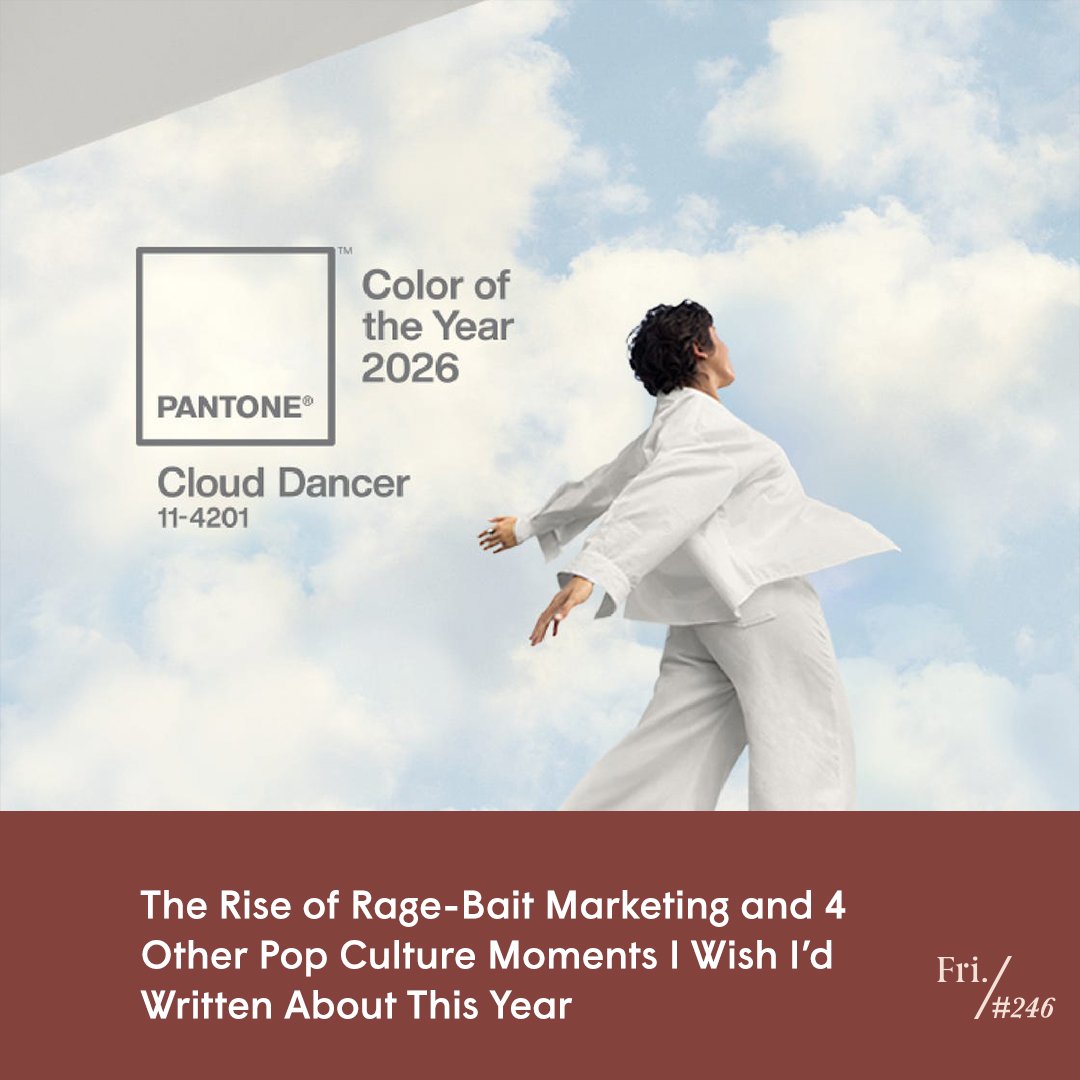
Image: Pantone
We are deep into year-in-review season—which is obviously the natural follow-up to gift guide season—and as usual, I’m thinking about the past year of Friday Things. Honestly, I didn’t write about as many things as I wanted to in 2025, mostly because my non-newsletter life was, uh, slightly bonkers. I left my role as EIC of a new magazine, started freelance writing and editing again, launched a new print-focused agency with some brilliant friends, and had so many feelings about everything (🫠). But I’m really proud of the things I did write. (My top 10, in chronological order: Bad Bunny and cultural bereavement, Adriana Smith’s tragic un-death, Beyoncé’s Buffalo Soldier shirt (which led to an interview with CNN!), the misogynoir inherent in those ‘BBL smell’ rumours about Cardi B, experiencing Spicemas in Grenada, a breakdown of that viral Wired surrogacy article, reflecting on the third anniversary of Oct. 7, the Skims merkin, an ode to Teen Vogue and how we should be talking about Ariana Grande’s increasingly obvious weight loss.) But a lot of other things happened this year that I didn’t get a chance to write about, and of course I had thoughts about them. So, here is my slightly belated take on five other big pop culture stories, including the rise of rage-bait marketing, the next phase of stan culture and, of course, Diddy.
The internet’s glee over catching the Coldplay concert cheaters is a sign that we live in a carceral society
I am fascinated by our societal need to see people face consequences for every infraction, real or imagined, a behaviour that fits right into philosopher Michel Foucault’s notion of the carceral continuum. Foucault wrote about this concept in 1975 as a way to describe the way institutions, like prisons, hospitals, poorhouses and asylums, became tools and sites of social control, particularly through methods of surveillance. Just 50 years later, I’d argue that everyone and everywhere in modern society has been absorbed into this continuum, including regular citizens. Online abuse, doxxing and swatting are definitely aspects of this phenomenon, especially for Black women and other racialized women. But I’m actually thinking about less obvious examples, like those videos exposing cheaters on vacation, or that super viral TikTok about the group of women who were gossiping about a friend at brunch—or the Coldplay kiss cam cheating scandal, and especially the number of people who began tagging Astronomer CEO Andy Byron’s wife in their posts about it. Even though those posts were ostensibly about disclosing problematic behaviour for the benefit of the victim, Byron’s wife, I think if we’re really honest about the posters’ motivations—and their followers’—it’s clear that the posts go so viral because they’re publicly shaming people who we perceive as transgressing social norms. To be fair, my least woke opinion is that some people probably do need to have more shame. But I don’t know that the entire internet tagging you in posts about your (allegedly) cheating husband actually accomplishes that.
Haven’t seen something as white-hot viral as that video of the CEO cheating on his wife at a Coldplay concert in a while. Very unfortunate for them, but kind of nice for us? Almost reminiscent of pre-whateverthefuckthisis internet. Unless they launch a podcast.
— Katie Nolan (@katienolan) July 17, 2025
Also, not related to the Coldplay kiss cam co-workers/couple, but definitely related to our carceral society: that bonkers X post about how America should replace EBT with Nutraloaf. (Also known as prison loaf, Nutraloaf is a nutrient-dense but bland food that is served in American prisons as punishment.) (This idea is so cartoonishly evil it’s actually a dystopian sci-fi trope.) Poverty is widely perceived as a personal failing, and nothing shows that as clearly as this smug and apparently serious suggestion to deny poor people even the tiniest degree of joy, because heaven forbid someone enjoy a nice meal once in a while.
One day I’m writing an entire newsletter about this, because I think there’s a lot to unpack: online mob mentality, surveillance culture, changing ideas of privacy, rage-bait… But for right now, I am mostly just worried that we are doomed to always respond to behaviour we think is bad with dreams of punishment, which makes it really difficult to imagine achieving abolition, or even just a kinder online experience. So, you know, yikes.
Pantone’s colour of the year was definitely rage-bait marketing
Earlier this month, Oxford University Press chose ‘rage bait’ as the Word of the Year for 2025, and it was a very appropriate selection. The term, which refers to “online content deliberately designed to elicit anger or outrage by being frustrating, provocative, or offensive, typically posted in order to increase traffic to or engagement with a particular web page or social media content,” can be applied to anything online, but I’m most interested in the sharp rise of rage-bait marketing, which has absolutely dominated the advertising space this year. Think, American Eagle’s eugenics-lite ad campaign featuring Sydney Sweeney, Dunkin Donuts’ similarly genetics-focused campaign featuring The Summer I Turned Pretty star Gavin Casalegno, e.l.f. cosmetics’ Matt Rife campaign, the aforementioned Skims full-bush thong and two recent AI Christmas campaigns, one from Coca Cola and the other from McDonald’s. But you know the thing that annoyed me the most? Pantone’s 2026 colour of the year announcement. It’s not as blatant as these other examples, I know, but something about the brand’s insistence on plausible deniability is infuriating to me.
@oldloserinbrooklyn Pantones color of the year is cloud dancer dystopia. #pantone #clouddancer #fashionjob #pantonecoloroftheyear ♬ original sound - Mandy Lee
In case you don’t know, every year, The Pantone Color Institute selects a “defining colour” for the next 12 months. The choice serves two purposes: to reflect where we are culturally, and to forecast what’s bubbling up in design. Increasingly, though, the Color of the Year™️ drives trends, with fashion and home décor designers using it in their work, publishers curating round-ups of similarly-hued products and some companies even partnering with Pantone to release items in that colour. Importantly, the choice is never just about design; it’s also about zeitgeist, as Laurie Pressman, vice president of the Pantone Color Institute, told NPR last year. “It's emblematic of a snapshot in time and it's giving people what they feel they need,” she said in December 2024. “It's us taking the temperature: What's taking place in the world around us and how does that get expressed into the language of color?”
So imagine the internet’s surprise when Pantone announced last week that its Color of the Year for 2026 was… white. Well, technically Cloud Dancer, “a lofty white that serves as a symbol of calming influence in a society rediscovering the value of quiet reflection,” per Pantone. “A billowy white imbued with serenity, PANTONE 11-4201 Cloud Dancer encourages true relaxation and focus, allowing the mind to wander and creativity to breathe, making room for innovation.”
@nya.etienne hot take this hot take that…. reclaim ur attention by clocking ragebait!!! 👀🤬 #marketingnews #medialiteracy #culturereport #intellectualinfluencer #fyp ♬ Yacht Club - MusicBox
Which, sure, I guess. But it doesn’t take a lot of sophisticated analysis to see the problem with covertly hinting at white supremacy, especially at a time when the U.S. presidential regime is disappearing anyone who ‘looks like’ an immigrant (which I say with all of the side-eye I can possibly muster), cozying up to white supremacists, rolling back EDI programs and policies, making racist statements about Somali people, and so on. It’s giving racist dog-whistle, you know? In a New York Times Styles Group Chat column, the paper’s chief fashion critic, Vanessa Friedman, speculated that this was an accidental misstep, saying, “Serenity is clearly the vibe. But given the recent political discourse, when I hear ‘white,’ less salubrious associations also leap to my mind — ones that I doubt Pantone took into consideration but that could be twisted to pretty uncomfortable ends.” I… disagree. I think, like McDonald’s and e.l.f. and American Eagle, Pantone did a cute little cost-benefit analysis, crafted a story about why it would make sense to choose a serene colour going into the next year (the plausible deniability part) and bet it would generate enough buzz to offset any potential backlash. And sure enough, this year did see the highest spike in searches for Pantone in a five-year period.
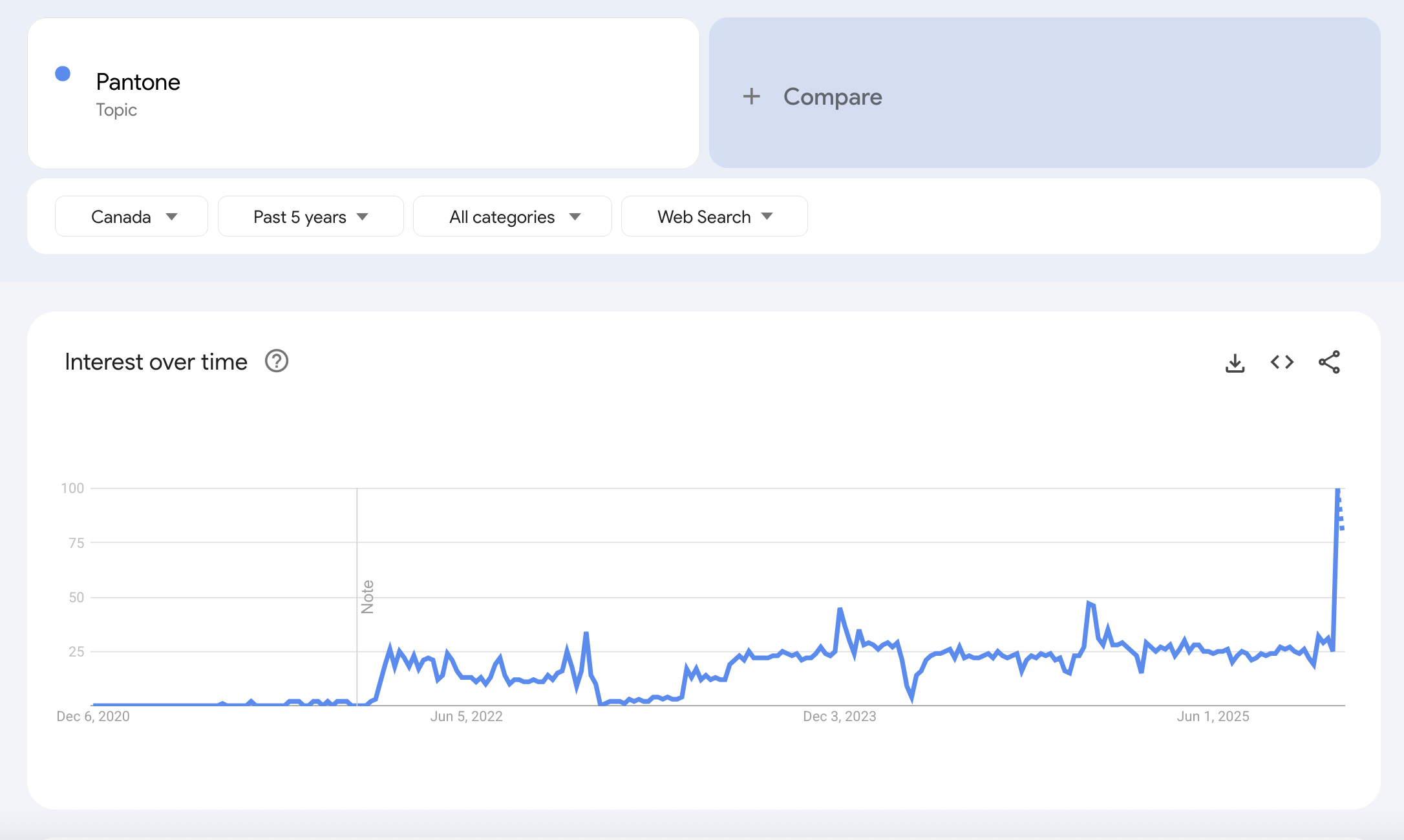
Image: Google Trends
Is rage-bait worth it, though? As one CEO told Berlin-based PR firm PR on the Go earlier this fall, “rage-baiting may spike engagement in the short term, but it poisons long-term brand equity. We’ve seen this play out in the moving industry where some brands used outrage-driven content about ‘scam movers’ to attract clicks. The data told a clear story: while traffic briefly jumped, customer retention dropped by nearly 40% within three months because the tone eroded credibility… Rage-baiting might win impressions, but it loses something far more valuable: audience confidence.” Keeping that in mind, it’s worth considering what all those new searches will uncover—while the company’s official site still ranks first in search, articles titled “Pantone Color (mistake?) of the Year,” “Pantone's 2026 colour of the year is white. Some critics say the optics aren't great” and “Pantone Responds to ‘Color of the Year’ Controversy” are right up there. Not exactly a favourable brand story for potential audiences to find, you know? Especially since light hues don’t even seem to be trending for the coming year.
I’m kind of curious if companies will learn a lesson here, but I’m even more interested in whether consumers do. Because I don’t think people enjoy being baited in this way, and smart companies listen when we tell them so. Just ask McDonald’s.
Celebrity has definitely become a placeholder for religion, right?
I’ve been thinking about this since I came across a tweet from L.A. Times writer and editor Suzy Exposito about the decline of music criticism, which she partially explained by saying, “a spiritual void has made cult leaders of pop stars.”
My take on music criticism’s decline:
— Suzy Exposito (@HexPositive) August 25, 2025
-Artists can reach fans from a safe-ish distance on social media
-Publicists limit access to critics out of a Trumpian resistance to real journalism
-Google destroyed said journalism
-A spiritual void has made cult leaders of pop stars https://t.co/MoEUEpDF37
I haven’t fully figured out my thesis yet, but I do think there’s something to this. Fans are definitely not new, and they’ve been topics of critical analysis for decades (Henry Jenkins’ 1992 book, Textual Poachers: Television Fans and Participatory Culture, deeply shaped my understanding of media when I first read it in university), but there does seem to be something specific to the experience of fandom at this time. I think a combination of easier and more access to celebrities and the decline of traditional religiosity makes it possible for public figures to slot into the spaces spiritual figures used to exclusively occupy. But I also think the practice of fandom provides community in the same way church does for older generations. If you remember all the articles about how Crossfit became church for fit people in the late 2010s, this feels very similar. I even wonder if standom can be compared to religious ecstasy—which, btw, might just be one manifestation of a very human phenomenon.
Speaking of criticism, ‘let people like things’ is the most annoying response to cultural analysis
Forgive the dramatics, but this year really showed me that we are in an art-criticism apocalypse. On the media front, legacy publications are increasingly moving away from critique. At the New York Times, four staffers—television critic Margaret Lyons, music critic Jon Pareles, theater critic Jesse Green and classical music critic Zach Woolfe—were reassigned to make room for new critics who would tackle those beats “not only through traditional reviews but also with essays, new story forms, videos and experimentation with other platforms,” as Variety reported. (So: TikTok, I guess?) Over the summer, Vanity Fair’s new editorial director confusingly announced the magazine would be focusing more on core subjects, including Hollywood, while also cutting back on reviews and trade coverage, and firing chief critic Richard Lawson and… Hollywood correspondents David Canfield and Anthony Breznican. (This is the same guy who made the brilliant decision to bring on Olivia Nuzzi, though, so perhaps these aren’t such confusing decisions after all.) Meanwhile, the Chicago Tribune, once the stomping grounds of Gene Siskel of Siskel and Ebert fame, eliminated the position of film critic entirely.
Excited about our century of "let people enjoy things" cinema
— Robert Rubsam (@rob_rubsam) December 5, 2025
Equally worrying is the way audiences perceive art criticism: as unnecessary at best, an attack at worst. I think this has a lot to do with fandom, which has become a common, if not the default, way of understanding the world. Through that lens, cultural products, like visual art, movies, TV shows and music, become not just stories for us to absorb, but also offshoots of ourselves. And when that happens, critique becomes judgement, or maybe even confrontation. This is kind of ridiculous, obviously, and also so, so boring. I’ve talked about this before, but to me the purpose of critique is to illuminate the cultural, social, economic and political threads at play in a piece of art, so the audience can better understand what informed and influenced that art, what it is saying about the world at this moment, why it matters and where it might be falling short. Whether a critic likes, or dislikes, a piece of art or its creator is almost entirely beside the point.
And what happens when audiences and outlets forget that? You get Rolling Stone’s review of Taylor Swift’s Life of a Showgirl, which gave the album a perfect 5-star rating, a score that… seemed unwarranted, to put it mildly, thus undermining the outlet’s credibility and playing into the stan expectation of hagiography instead of any meaningful analysis. Embarrassing, tbh.
I don’t know what to think about Netflix’s new Diddy doc
I am three-quarters of the way through Netflix’s 50 Cent-produced documentary series about Diddy, and I have a lot of thoughts so far, though not a cohesive argument. Sooooo, a short list:
· While I appreciate how provocative it is for 50 Cent to be the executive producer of this project considering his own sexual assault allegations, that doesn’t mean he made this series; it means he funded it. The person who actually crafted each episode was director Alex Stapleton, an award-winning documentarian whose lived experience as a Black woman was foundational to the series’ approach. Not to say 50 had zero creative involvement, because I don’t know if that’s true, but it does seem odd that the public’s focus has been so much on his role and so little on hers.
You got to be a real piece of shit if Suge Knight is one of the good guys in a movie about you.
— devon sawa (@DevonESawa) December 7, 2025
· That being said, I do question some of the framing, and especially the people we’re being guided to sympathize with. It feels like the goal of showing how abusive Diddy has been in so many different areas of his life has had the unintended consequence of minimizing other people’s abusive behaviour—including Biggie’s. I’m also not sure if I like that so many people are asking if Suge Knight is actually a good guy, you know?
· I am also noticing all the people who have stories about Diddy’s abusive and exploitative behaviour dating back decades, because what do you mean he’s literally always been like this? Why was the Making the Band cheesecake story played for laughs? Why was Aubrey O’Day’s allegations against him written off as bitterness? Why was he allowed to get to the point where he could kick and punch Cassie on a hotel security tape and then pay off whoever he had to in order to get away with it? Yeah, Diddy’s a monster—but he was surrounded by enablers who allowed him to behave that way, and I don’t think we can credit all of that to fear. Not when greed and personal benefit likely also came into play.
· It was super super super super gross to see Justin and Christian Combs, two of Diddy’s sons, on-screen while he was discussing his legal strategy. It was only a small snippet of episode 3, but demands a nuanced conversation about cycles of abuse and psychosexual trauma, I think.
Bonus: I think we need an updated deep dive on Pop Crave
Unfortunately pop crave is becoming my main source of new information https://t.co/Go6tkBrAKW
— gianmarco (@GianmarcoSoresi) December 10, 2025
How do they decide which global events will get the Pop Crave treatment? Why do so many people find this account so trustworthy? How is it possible that I am learning breaking news from this account a not-insignificant percent of the time? What are the logistics of their expansion into political coverage? How do they decide who stuns, versus who’s merely “in a new photo”? Are they ever being a little shady when they describe people as talented? I want to know it all.
And Did You Hear About…
Happy December! To mark the holidays and ring in 2026, I’m bringing my weekly recommendations out from behind the paywall and offering a 25% off sale on paid subscriptions. So, if you’d like to support the work I do with Friday Things—and keep getting these curated recommendations come January—upgrade your subscription here. (Offer valid until Jan. 8, 2026.)
My friend Wing Sze Tang’s new travel-focused newsletter, which is launching soon and already fueling my 2026 travel dreams.
This fascinating take on the world’s falling birthrates, and what they have to do with changing ideas around masculinity, community and feminism.
The Cut’s round-up of gossip you probably missed. (I am way too online and actually did miss a lot of these!)
Snow Bear, a beautiful animated short by Aaron Blaise, a former Disney animator and the director of Brother Bear. It was both inspired by, and a way to heal from, his wife’s death. The more I see AI, the more I want things that are made by people and this is a really lovely example of that. (Also, this is a great story about Blaise’s inspiration and process, though there are spoilers.)
This truly spectacular alternative to Spotify Wrapped.
Thank you for reading this week’s newsletter! Still looking for intersectional pop culture analysis? Here are a few ways to get more Friday:
💫 Upgrade to a paid subscription to support independent, progressive lifestyle media, and to access member-only perks, including And Did You Hear About, a weekly list of Stacy’s best recommendations for what to read, watch, listen to and otherwise enjoy from around the web. (Note: paid subscribers can manage, update and cancel their subscriptions through Stripe.)
💫 Follow Friday on social media. We’re on Instagram, YouTube and (occasionally) TikTok.
💫 If you’d like to make a one-time donation toward the cost of creating Friday Things, you can donate through Ko-Fi.