
The Discourse About Teyana Taylor's Portrayal of Perfidia Beverly Hills in 'One Battle After Another' is *Still* Raging on X
By Stacy Lee Kong
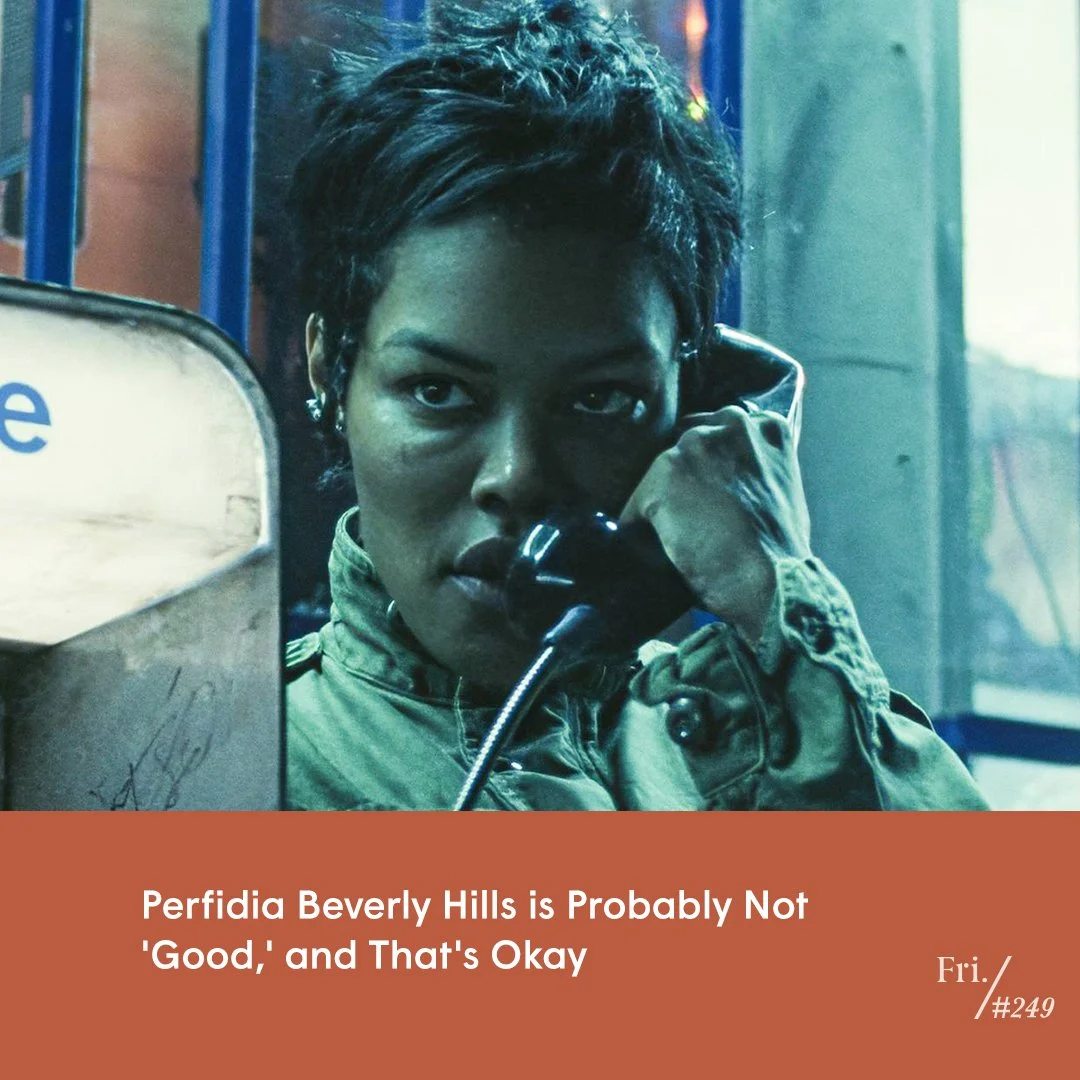
Image: Warner Bros.
My X feed has been the site of a really fascinating—and also slightly unhinged—discourse for days now, and I really want to talk about it. So: last Sunday, Teyana Taylor took home the Golden Globe for Best Supporting Actress for her role as Perfidia Beverly Hills in Paul Thomas Anderson’s One Battle After Another, a good indicator that she’ll do well this awards season. This is great news for fans of Taylor, but less so for a particular stripe of armchair movie critic that would prefer Perfidia be something other than what she is: a complicated, contentious character. If you haven’t seen the movie, it’s a black comedy/action/thriller that follows Bob Ferguson (Leonardo DiCaprio), a former revolutionary who lives off the grid with his daughter, Willa (Chase Infiniti). Thanks to her father’s stories, Willa thinks Perfidia, her mother, is a revolutionary hero, but the reality is more complicated than that.
(If you want to avoid spoilers, stop reading now.)
@onebattleafteranother The film everyone's been talking about is coming home. #OneBattleAfterAnother ♬ original sound - One Battle After Another
The truth is, Willa isn’t Bob’s biological daughter. Her father is actually Steven J. Lockjaw (Sean Penn), a white supremacist military man who—you’ll be shocked to hear—is sexually obsessed with Black women. Years before, Lockjaw caught Perfidia trying to liberate detained immigrants from an ICE-style detention centre, but agreed to let her go if she would meet him later for sex, which she did. She later gives birth to a baby girl, who Bob thinks is his. Perfidia, struggling with postpartum depression, heavily invested in her self-imposed mission to change the world and totally uninterested in settling down, soon leaves them to focus on her activism. When she kills a security guard during a bank robbery, Lockjaw negotiates a deal: if she’ll provide him with the names and locations of her fellow revolutionaries, he’ll make sure she avoids jail time. She does, a decision that allows Lockjaw to hunt down and execute many of her comrades. Years later, Bob and a now 16-year-old Willa are living under assumed names in California, while Perfidia is in witness protection in Mexico.
As you can probably guess based on the fact that Taylor’s award was for best supporting actress, Perfidia is not the protagonist of this movie. In fact, the bulk of the film is actually about what happens when Lockjaw pops up again, this time looking to eliminate the evidence of their liaison—that is, Willa—because he’s been invited to join a white supremacist secret society and its leadership frowns upon that kind of thing. But the discourse? That is all about Perfidia Beverly Hills. To be fair, while some of the posts I’ve been seeing are kind of whiny arguments, many others ask interesting and valid questions, like whether the movie has a cohesive political or moral centre; whether movies need a cohesive political and moral centre; if Anderson’s storytelling undermines the notion of armed revolution; what kind of representation is ‘good’; the inherent power differential of a white man creating Black characters and how much he may be relying on stereotypes and caricature; what counts as trauma and if it’s bad for a story to explore that; and how things are going on the media literacy front. Like, it has gotten to the point that at least one segment of the discourse just became a trending topic on X, four days later. But as always, the thing I’m struck by is not the discourse itself, but instead what it says about us. Or in this case, our relationship to storytelling. Because taken together, these conversations illuminate a shift in what we seem to want and expect from fiction.
Modern movies aren’t morality tales, but audiences sure do seem to want them to be
Societal shifts over the past 10 to 15 years have supercharged what we’ve always done when relating to storytelling, namely parsing these texts for meaning and looking for ourselves in the stories we enjoy. There’s been a normalization and spreading of standom, which means there are now more people engaging in stan behaviour, and that stan behaviour is being applied to a far wider range of people, from traditional celebrities to reality show couples to TikTok life coaches. At the same time, a sharp rise in the amount and quality of cultural critique primed audiences to think deeply about the social and cultural messages these works were sending, whether intentionally or not. And, most recently, lifestyle media’s left-leaning political orientation and the short-lived but important mainstreaming of actually leftist perspectives (think, abolishing the police, decolonizing institutions and embracing intersectional feminism) trained audiences to assign morality to the messages they found in their favourite movies, TV shows, books and other cultural products. While there are probably other factors at play, these feel like the big reasons why audiences today are less passive viewers, more deeply engaged consumers, with all the investment and entitlement that implies. I don’t think any of this is bad, to be clear. But I do think these developments have led to some unintended consequences that we are now grappling with… By which I mean arguing about on the internet.
I also just think there's this expectation that a movie needs to adhere to an exact moral and political standard with audiences these days, and any perceived deviation from that means it should be criticized in perpetuity. Art being challenging and divisive used to be cool. https://t.co/G7pieJs9TO
— Nuanced Film Takes (@BadFilmTakes1) January 14, 2026
I say that because it genuinely seems like audiences are now super uncomfortable with ambiguity of all types. In fact, if there’s one thing this discourse is illustrating, it’s that there’s a huge subset of people who want their stories to communicate a crystal clear message that is also morally unimpeachable. Which is interesting because that genre actually did exist: it pretty perfectly describes the morality play, a type of theatre that evolved in the late medieval period. A brief history lesson: early European theatre focused on performing bible stories, but by the 1300s, a new type of play was evolving that was more allegorical than literal. Dubbed morality plays by modern scholars, this type of theatre featured characters that represented ideas and plotlines that imparted life lessons on the audience. According to BeyondShakespeare.org, these plays offered audiences “the road map towards getting a good afterlife. This is presented by allegorical characters who represent concepts, rather than real people. So a personification of all Humanity will be accosted by a representation of Lust, and protected by Chastity, say.” In essence, these plays were about ideas, not plot or character, and their purpose was didactic—moral instruction was the entire point. The idea that stories can impart a message about how we should be living remains a key element in modern storytelling, of course, but these days we don’t often go to the movies to see pure allegories. Instead, we’re typically meeting characters that are meant to feel like real people, and following a plot that expresses ideas about how the world is, or even how it should be, but isn’t necessarily interested in laying out what the path to salvation would look like.
And yet. There seem to be a lot of people who are invested in seeing Perfidia as ‘good,’ and in critiquing Anderson for creating a character who doesn’t represent Black women ‘well.’ And she kind of doesn’t? Compelling, entertaining and watchable as she may be, this character regularly makes decisions that feel uncomfortable to the audience, and run contrary to her stated values. Her moral compass is shaky, and her motivations are simultaneously grand and selfish. She betrayed her comrades and abandoned her family, and we’re never really sure if these actions actually do benefit the greater good. Furthermore, she’s both hypersexualized and arguably participates in her own sexualization—at the hands of a white man, no less. If you’ve been trained to relate to stories by identifying with the character who feels most like you, as I’d argue audiences today have, it’s clear why that would sting.
Who is demanding that morality matters, though
To be fair, it’s hard to know how much of this is extremely online behaviour, and whether mass audiences are truly concerned with the ideological messaging of the movies they watch. I’m not even sure if the people who are posting so voraciously about OBAA actually believe what they’re saying, or if they’re just really invested in winning against internet strangers. But, broadly speaking, I do think this phenomenon is a thing, especially since we’ve seen audience ideas around morality play a role in other aspects of filmmaking, from the homogenization of storytelling and disappearance of certain Hollywood genres, like the erotic thriller, to the rise of faith-based content.
“does the fiction film have coherent radical politics?” is a question that sounds like “can you take me to the potty? i can’t go by myself!”
— jourdain searles (@judysquirrels) January 15, 2026
And I can only speak for myself here, but it’s kind of an annoying thing! Well, not just myself. Critic Jourdain Searles—whose posts about this conversation became that X trending topic—is also annoyed. Searles’ perspective, which I tend to agree with, is that movies are stories first, which means that analysis has to happen within the constraints of art and narrative. “[O]ne thing that really annoys me is when people want a film to be directly related to our real life and politics. it’s a pynchon riff. it’s a comedy. it’s supposed to be fun. it’s about characters, not real people. it’s a STORY. grow up!” she says. “I have no respect for this jacobin shit where folks are like ‘well the film should have coherent politics’ lol watch a documentary and leave fiction alone!”
Here’s where it gets complicated for me, though: I am not immune to the allure of representation in fiction. I want to see characters who look and think like me on-screen, and I want them to be good because I think I’m good. And okay, I’m biased, but I don’t think this is a moral failing! Instead, it’s a very natural consequence of Western consumerist culture, as author Carlee Gomes argued in her essay “The Puritanical Eye: Hyper-mediation, Sex on Film, and the Disavowal of Desire.” Focused on the decline of sex scenes in Hollywood movies, Gomes makes an explicit link between late capitalism and audiences’ desire for stories, characters and even creators who can be understood as morally good. “The desire to exclusively engage with media and art made by ‘unproblematic’ artists is a direct result of Americans viewing media consumption as an inherently political act because that is the supreme promise of Western prosperity and the religion of consumerism, and because it’s seemingly all that’s left,” she writes. “We’ve been stripped and socialized out of any real political energy and agency. Our ability to consume is the only thing remaining that’s ‘ours’ in late capitalism, and as a result it’s become a stand-in for (or perhaps the sole defining quality of) every aspect of being alive today — consuming is activism, it’s love, it’s thinking, it’s sex, it’s fill in the blank. When the act of consuming is all you have left and indeed the only thing society tells you is valuable and meaningful, the act must necessarily be a moral one, which is why people send themselves down manic spirals deciding what, who is ‘problematic’ or not, because for us the stakes are that high now.”
And something else! For those of us who experience marginalization, who have been stripped not just of political energy and agency, but also historically denied financial, social and cultural power, consuming can feel like an even more powerful form of agency. So, it’s really not surprising that there’s an additional layer of tension when we’re faced with stories that depict us as something other than good, or unproblematic. That’s what’s happening with Perfidia, for sure. For example, earlier this week, comedian KevOnStage posted a video talking about why he’s been feeling so invested in how Sinners and OBAA do during award season, and how much of that has to do with what he calls the “weight of Blackness.” There was one part that really stood out to me: “We also feel like the movie needs to be more for us, because when it wins, we win. I think that’s the same thing about Teyana Taylor’s character in One Battle After Another. She actually won the Golden Globe for best supporting actress and Black people—I see a lot of discourse basically tearing her down, like, you know, ‘We only win when it’s a criminal or a hoe. She played the jezebel type.’ I didn’t see that at all; I saw that character as a flawed revolutionary.”
Sinners + Teyana Taylor and the weight of Blackness. pic.twitter.com/1Kdg90pKwZ
— Kevín (@KevOnStage) January 13, 2026
Real representation is probably a better goal than ‘good’ representation
That tension is the reason I keep coming back to this conversation, I think; in theory, stories are stories, not real life, and characters are characters, not avatars for our actual selves. Practically, though, stories have reflected us back to ourselves when we otherwise felt invisible, and provided visions of a more equitable, safe or beautiful world. They have sometimes felt more real than real life. I mean, it’s hard to get mad at people for wanting to be seen as good when so much of the societal messaging about marginalized folks is still that we’re somehow lacking—something that we especially see about Black people in general.
But maybe this is a good reason to revisit New York and Vulture critic Angelica Jade Bastién’s review of the movie, especially her description of Perfidia’s appeal: “[She] is a contradiction nestled in thorns, selfish and prickly and bold. Taylor brings to life a kind of flawed rendering of Black womanhood that I have longed to see in cinema. Not aspirational, but something more meaningful. Genuinely complex, authentically inhabited. The image of Perfidia swollen deep in her pregnancy, firing off an automatic machine gun, says it all. There’s nothing simple and warm and sacrificially maternal about this woman. She’s jealous of her baby daughter, racked with hormones and memories of a complicated birth. Every image and voice-over carry the friction of expectation that she should be something more upstanding and easy to root for. Taylor’s performance doesn’t ask you to root for Perfidia so much as be galvanized by her,” she writes.
What if the actual problem with this discourse is less that we want to see ourselves in popular media, and more that we want that representation to be moral? If so, perhaps the solution is not demanding ‘good’ but ultimately simple stories and characters, but instead embracing flawed characters that act for frustrating, opaque and contradictory reasons… just like we do in real life.
Thank you for reading this week’s newsletter! Still looking for intersectional pop culture analysis? Here are a few ways to get more Friday:
💫 Upgrade to a paid subscription to support independent, progressive lifestyle media, and to access member-only perks, including And Did You Hear About, a weekly list of Stacy’s best recommendations for what to read, watch, listen to and otherwise enjoy from around the web. (Note: paid subscribers can manage, update and cancel their subscriptions through Stripe.)
💫 Follow Friday on social media. We’re on Instagram, YouTube and (occasionally) TikTok.
💫 If you’d like to make a one-time donation toward the cost of creating Friday Things, you can donate through Ko-Fi.