
Was the Person Who Shot At Rihanna's House an Obsessed Fan? Why it Matters
By Stacy Lee Kong
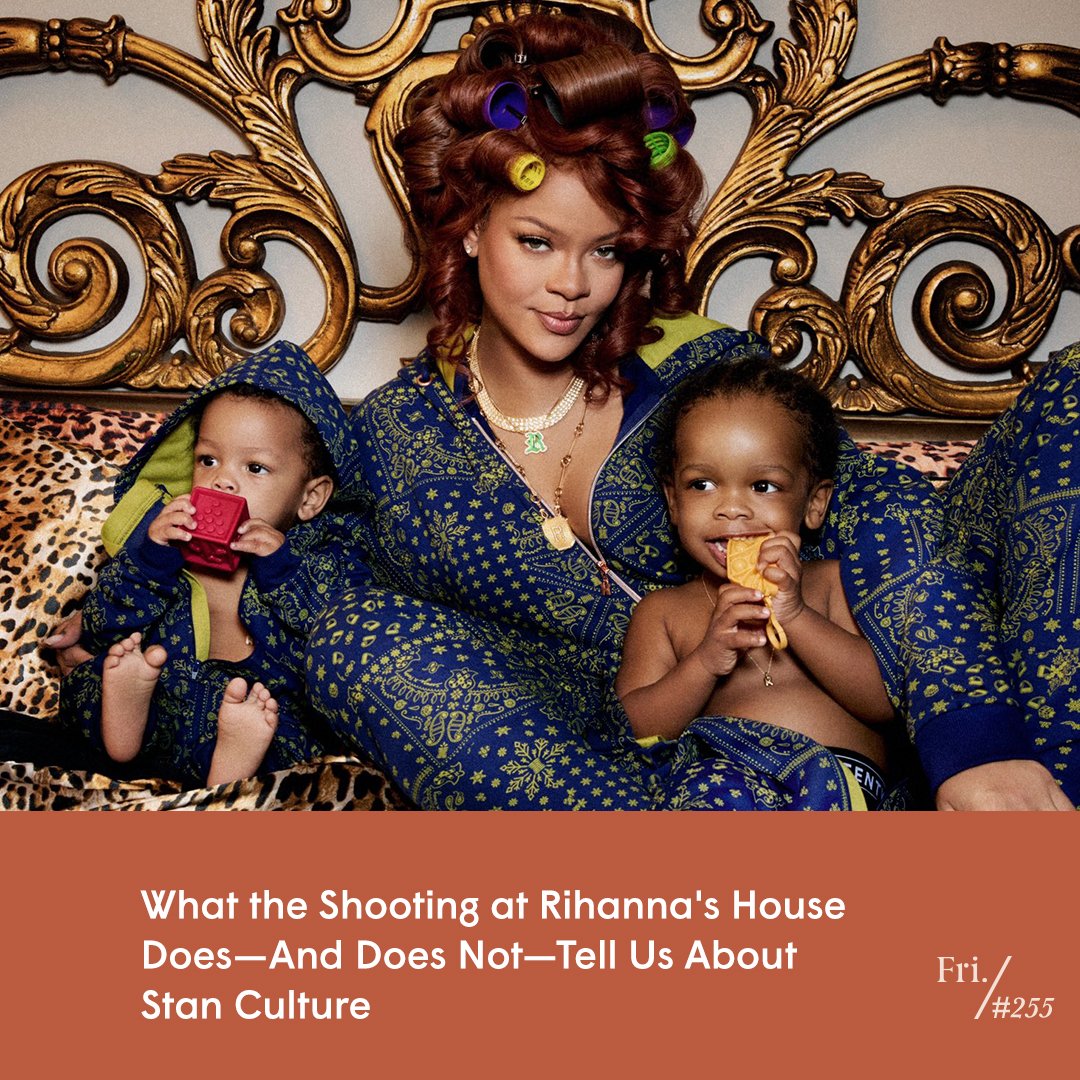
Image: instagram.com/badgalriri
On Sunday, March 8, a 35-year-old Florida woman named Ivanna Lisette Ortiz was arrested after shooting an “AR-15-style weapon” at a Beverly Hills mansion owned by Rihanna and A$AP Rocky. Both stars, their three children, Rihanna’s mother and four other people were at home at the time of the shooting. Luckily, no one was injured. However, Ortiz has been charged with one count of attempted murder, three counts of shooting at an inhabited vehicle or dwelling and 10 counts of assault on a person with a semi-automatic firearm, all of which are felonies. Neither Rihanna nor Rocky’s teams have addressed the shooting publicly, but the family was seen leaving L.A. on Monday afternoon—of course we don’t know if that was due to pre-planned travel, or because of this incident.
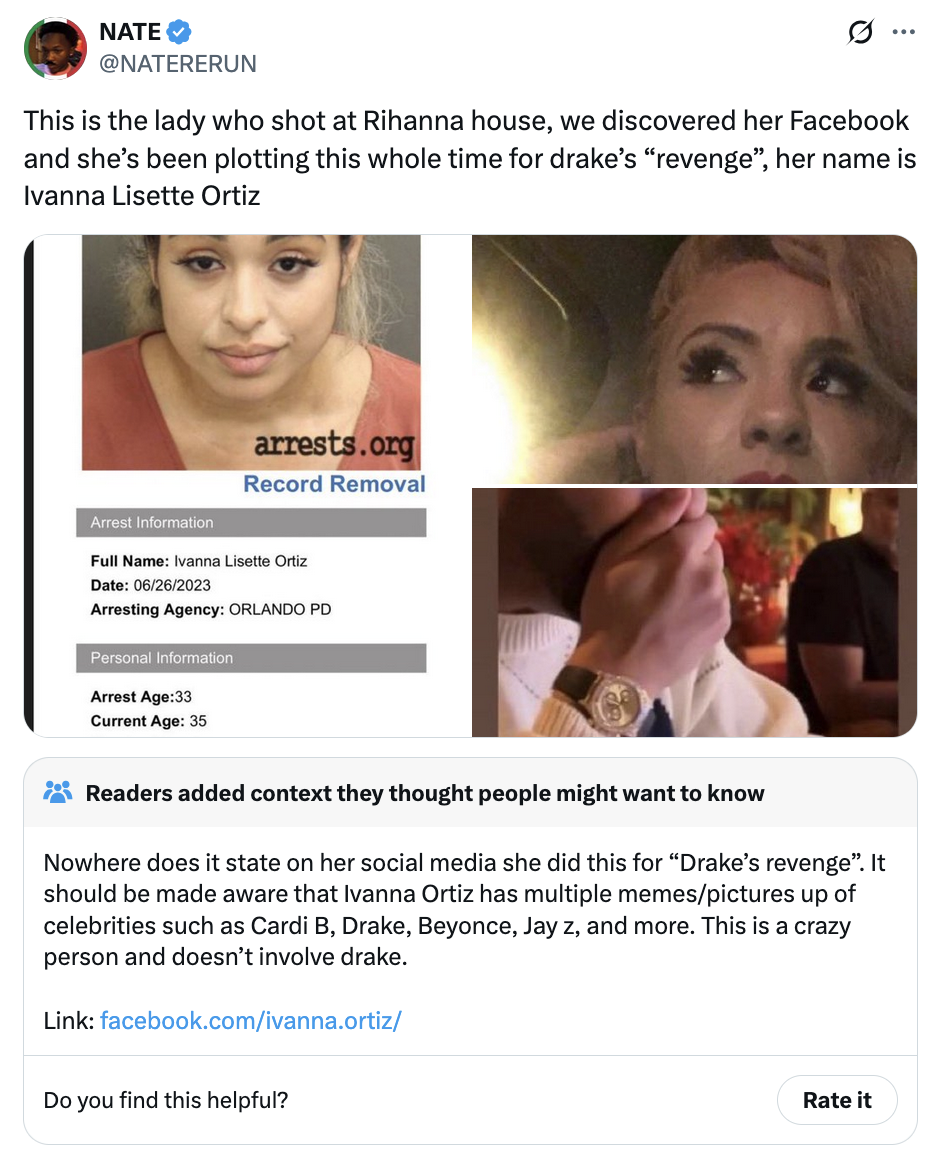
It obviously didn’t take long for people to look for insight into Ortiz’s motivations, and social profiles that seem to belong to her offered a wealth of clues. Namely, several posts directed at Rihanna, as if they were personally beefing. (There were also mentions of other celebrities, including Kim Kardashian and Cardi B.) While these posts might have had the veneer of stan wars at first glance, it just requires a few seconds of watching to realize that something deeper was going on here. In a Facebook post from Feb. 23, she says “@badgalriri Are you there? Cause I was waiting for your AIDS 5-head self to say something to me directly instead of sneaking around like you talking to me where I’m not at.” A few days earlier, she had posted a photo of Drake covering his mouth looking shocked, accompanied by text that says “When Drake found out Rihanna has AIDS.” Other posts have been circulating on Twitter, including a video where she talks about experiencing a “ray of force” that is “trying to push her down,” but that “God’s judgement will be overwhelming against you when he grabs you and throws you down.” It’s not clear who she’s talking about, exactly, but she quickly pivots to Rihanna, saying the star’s appearance is “God’s judgement against her” and that “I [Ortiz] keep telling her to stop harassing me… and she keeps doing it, she keeps harassing me.” She also claims that she bought stock in Ulta as a form of protection. In yet another post, she says that God will reward her when Rihanna dies.
Considering the times we live in—and how often vigilante internet sleuths have thought they solved a crime, but were actually blaming innocent people instead—I do think it’s important to acknowledge that a) while it looks like this is the same person who’s in the booking photos from Orange County jail, we don’t know that for sure and b) it’s also possible that some of these videos are fake, especially those circulating on X. That being said, I think we can assume that this shooting was the result of something going terribly wrong for Ortiz and that her social media posts may have reflected that. And, most relevant for this conversation, that this incident sits on the same continuum as previous examples of celebrity stalking, but needs to be contextualized within our culture of surveillance, the changing social contract between celebrities and non-celebrities and even the overall rise in stalking, and especially cyberstalking.
Celebrity stalkers aren’t a new phenomenon, but the internet has changed things drastically
Some pop culture history: while there are a few especially notorious examples of celebrity stalking—John Lennon’s killer stalked him first, and Jodie Foster’s stalker shot then-President Ronald Reagan in 1981 thinking it would get her attention—there was another Hollywood star whose fatal encounter with a stalker changed everything. In 1989, a fan’s obsession culminated in the shooting death of 21-year-old Rebecca Schaeffer. The 19-year-old fan had become furious after watching Scenes from the Class Struggle in Beverly Hills, a black comedy where Schaeffer appeared in bed with a co-star, and decided she should be punished for “becoming another Hollywood whore.” So, he paid a private detective to find her address in DMV records, bought a gun and travelled from from Tuscon, Arizona to L.A., where he went to her apartment and shot her. The crime sparked the creation of the Los Angeles Police Department’s anti-stalking division, the Threat Management Unit, led to the creation of America’s first anti-stalking legislation and directly contributed to the growth of the private threat assessment industry.
But it also changed how society understood stalking. As prosecutor Marcia Clark told the Los Angeles Times in 2024, “what struck me about the case is the naivete of everyone involved. When Bardo surfaced at [CBS’s studio, where Schaeffer was filming the comedy My Sister Sam], the guard thought, ‘It’s a lovesick fan’ and thought nothing more of it. So she never knew this guy was actually tracking her. My memory of it is no one assigned a great deal of significance to this guy, and that’s understandable at the time. Probably 100 guys like that showed up and never appeared again and never caused a problem.” But, she went on to say, “thank goodness these laws were put in place before the explosion of the internet. Even more than the laws, public awareness matters.”
The concept of a helicopter flying over a persons home to document children leaving their home to find safety after their home was shot at is soooo weird https://t.co/OcpUm5f2Kq
— LOVER GIRL JA !🩶 (@theerealestja) March 11, 2026
No longer does a stalker have to pay a private detective to find out where the target of their obsession lives, because that information is often easily found online. In fact, Rihanna’s address was published in an 2023 article about the sale of “one of her side-by-side Beverly Hills homes.” And it’s not just about what information is readily available; it’s also about how readily accessible celebrities are now. In 2015, Buzzfeed ran a fascinating story about how social media had ushered in what was then a new age of celebrity stalking, arguing that, because their professional opportunities are increasingly tied to high social media engagement, there’s a corresponding increase in stalking. According to the article, 20% of the LAPD’s Threat Management Unit cases were celebrity-related at the time, double what it was in 2008—and I’d be so curious to know what those numbers look like now. Because if you recall, celebrities became even more online during the early months of COVID, when movie roles and album roll-outs paused and many pivoted to endorsement deals to make up the resulting income shortfall… and honestly, I’m not sure that ever really settled back to pre-pandemic levels. If anything, I think the mega popularity of TikTok has actually cemented that approach into the celebrity promo playbook. Just look at the way up-and-coming stars use social media to speak directly to their burgeoning fanbases about everything from feminism to identity to, oh yes, their new projects.
To be fair, Rihanna doesn’t need to provide that level of access to her fans anymore, but she’s existing in an ecosystem that increasingly demands that of its participants, and primes audiences to expect it. And, all of this is happening amid a rise in stalking behaviour, and especially cyberstalking. (According to a 2025 study from University College London, “while cyberstalking remains less common than physical stalking, the proportion of respondents who reported being cyberstalked increased from 1.0% to 1.7% over the study period, outpacing both physical and cyber-enabled stalking.” Importantly, young people, women and queer folks disproportionately experience cyberstalking—and, as a different 2023 study found, this is happening in so many new ways as our lives become increasingly digital.)
But, I think it’s also important to differentiate between stan behaviour and stalking behaviour
But, there’s this thing that happens when we’re talking about celebrity stalking that I think it’s worth unpacking a bit, which is the way media coverage and online discourse tend to situate stalkers within the context of fandom, or at least standom. That’s already happened a little bit in Ortiz’s case, with some online commenters speculating that she is a Drake stan, and others invoking her name when criticizing people who post something negative about their fave. (Ahem.) And you guys? I don’t think we should do that.
To be fair, there is a lot to say about stan culture, which has become even more prevalent and intense over the past decade or so. Just take Heated Rivalry. The TV series, which debuted late last year, is based on Rachel Reid’s Game Changers books, which had a relatively small fandom before the show premiered. But, over the past few months, the size and intensity of that fanbase has exploded in step with the popularity of the show—and has led to over the top infighting, and pretty disturbing behaviour toward actors Hudson Williams, Connor Storrie and François Arnaud. As Wired explained last month, “Williams [became] the target of stan Twitter rage-baiters online, who appeared to be looking for a reason to end his career. His rumored relationship with a woman has led many to accuse him of queer-baiting. Anti-Asian slurs have been tossed at Williams by detractors with relative ease on X… Meanwhile, Storrie and Arnaud’s relationship is being heavily debated in the fandom. Despite Storrie being nearly 26, their 15-year age gap has caused an uproar, with some fans calling Arnaud a ‘groomer’ and a ‘pedophile’ while flooding his Instagram comments with insults and threats. They’ve gone so far as to harass a fellow actor he was dating.” (It’s so intense that a University of Ottawa prof is even studying the fandom, and how this rapid expansion has changed it.)
It’s clear that stan culture goes beyond mere affinity for a show or star. Back in December, I questioned whether celebrity fandom was taking on religious overtones, similar to how Crossfit and SoulCycle ‘became’ churches in the 2010s when they were starting to “fill spiritual and social needs for many nonreligious people,” as The Atlantic put it in 2017. The same thing does seem to be happening here, and that can lead to a level of fervour that causes real harm. Also: it does normalize a type of engagement and discourse that can provide a cover for something more serious, I think. When it’s commonplace to fantasize about having a relationship, positive or negative, with someone you don’t know and who doesn’t know you, it can be hard to tell what’s a one-liner posted for clout and what’s delusion.
Still, I think it’s important to distinguish between stan culture and stalking behaviours because words mean things, and it feels dangerous to flatten the differences between actions that can be overwhelming or harmful to other people and actions that can be legitimately life-threatening. The motivations are different, the perpetrators’ ability to control their impulses is different and the outcomes can be very, very different. Also, conflating these two types of behaviour diminishes how potentially harmful stalking can be—and whether people take victims seriously. Baywatch star Alexandra Paul has written about being stalked, too, and part of her experience has been the indignity of trying to explain that she really is in danger. Last year, she recounted a trip to the grocery store that ended with her stalker slipping into the passenger seat of her car, saying, “the Santa Monica police arrive within minutes, but the stalker is already melting into the crowd of shoppers. The policeman is young and, from the way he keeps telling me to calm down, it’s clear that he thinks I am a hysteric who had a falling out with a friend. That is because my stalker is a woman. A white European woman, conventionally attractive, neatly dressed and 20 years younger than I am. I have always felt having a female stalker has meant that my case is not taken as seriously as if it were a man—even though female celebrity stalkers commit violence at the same rates as men.” That’s in a state that led the charge on stalking legislation.
As always, these situations make me think about levels of privilege; Paul has fewer resources than Rihanna. You and I have fewer resources than Paul. But as we live increasingly public lives, our risk of being stalked increases. That’s why it feels like something to take seriously—for exactly what it is.
Thank you for reading this week’s newsletter! Still looking for intersectional pop culture analysis? Here are a few ways to get more Friday:
💫 Upgrade to a paid subscription to support independent, progressive lifestyle media, and to access member-only perks, including And Did You Hear About, a weekly list of Stacy’s best recommendations for what to read, watch, listen to and otherwise enjoy from around the web. (Note: paid subscribers can manage, update and cancel their subscriptions through Stripe.)
💫 Follow Friday on social media. We’re on Instagram, YouTube and (occasionally) TikTok.
💫 If you’d like to make a one-time donation toward the cost of creating Friday Things, you can donate through Ko-Fi.